
R-454B Refrigerant Homeowners Atlanta Should Know About: The Short Version
If you own an air conditioner or heat pump in Atlanta, the biggest thing to understand about R-454B refrigerant homeowners Atlanta are hearing about is this: your current system is not suddenly obsolete. The change affects what gets built and installed from now on, and it quietly changes how your future repairs, refrigerant top-ups and replacement decisions play out.
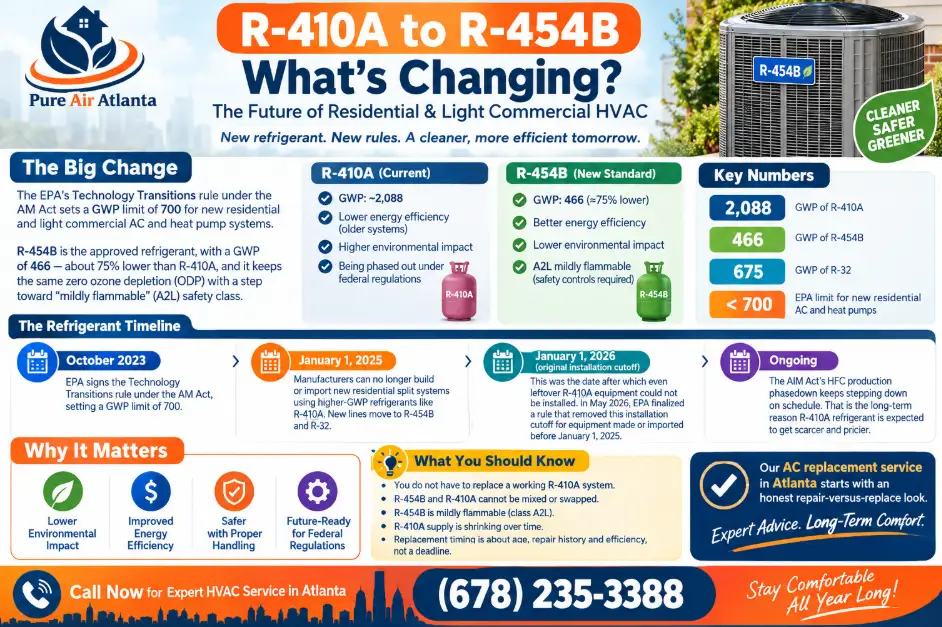
Since January 1, 2025, new residential split air conditioners and heat pumps in the United States are built around lower-impact refrigerants instead of R-410A. R-454B is the one most major brands chose. That sounds technical, but it comes down to a few practical questions. Do you have to replace your AC? Can your technician still service it? Will the new refrigerant cost more? And is the new equipment safe? This guide answers each one for Atlanta homes, using the current federal rules, not recycled 2023 headlines.
Quick answers for Atlanta homeowners
- You do not have to replace a working R-410A system. EPA says there is no requirement to stop using equipment already in service, and you can keep repairing it.
- R-454B and R-410A cannot be mixed or swapped. Each system is built for one refrigerant. The nameplate on your outdoor unit tells you which.
- R-454B is mildly flammable (class A2L). New equipment is designed for it, with leak detection and safety controls, and technicians need A2L-specific handling.
- R-410A supply is shrinking over time because the federal HFC phasedown continues, so refrigerant for older systems is likely to get more expensive.
- Replacement timing is about age, repair history and efficiency, not a deadline. Our AC replacement service in Atlanta starts with an honest repair-versus-replace look.
What Is Actually Changing: R-410A to R-454B Explained
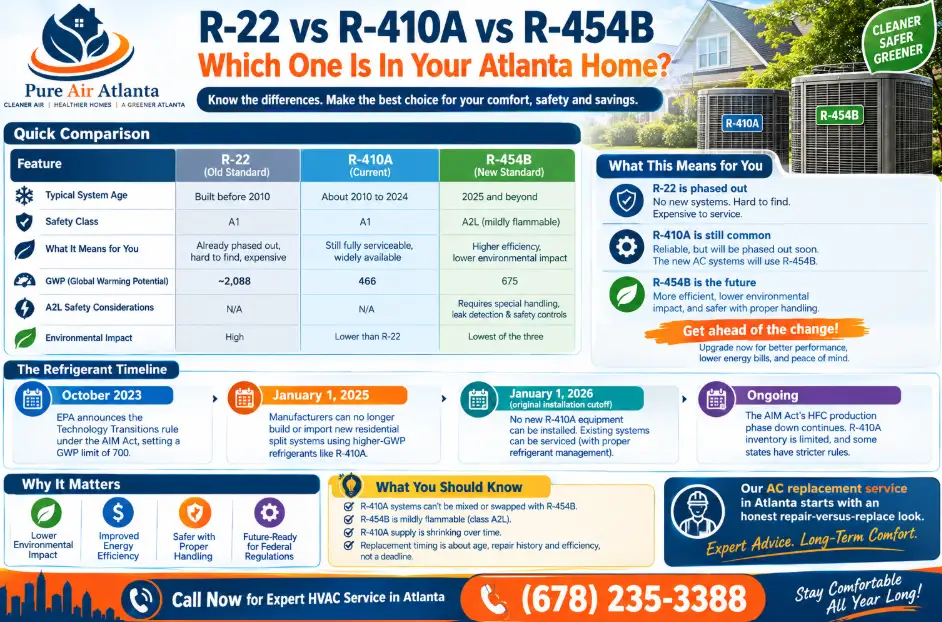
For about fifteen years, R-410A has been the standard refrigerant in residential central air conditioners and heat pumps. It works well, but it has a global warming potential (GWP) of roughly 2,088, which is why it is being phased down under the federal American Innovation and Manufacturing (AIM) Act. Under EPA’s Technology Transitions program, new residential and light commercial air conditioning and heat pump systems need a refrigerant with a GWP below 700.
R-454B has a GWP of 466, about 75 percent lower than R-410A, and it keeps the same zero ozone depletion. R-32 is the other common replacement, with a GWP of about 675. Both belong to the A2L safety class, which is a step toward “mildly flammable” compared with R-410A’s A1 class.
The refrigerant timeline, in plain English
Do You Have to Replace Your R-410A AC? No, Here Is What EPA Says
This is the question behind most calls we get about the new AC refrigerant 2025 changes, and the answer is reassuring. EPA’s own HFC phasedown FAQ states that there are no requirements to stop using specific equipment already in service, and that you can continue to repair your existing air conditioning or heat pump system, including replacing major components such as a compressor or condensing unit. EPA also notes that the availability of HFCs and components may lessen over time.
So an R-410A system that cools your Atlanta home reliably is fine to keep. What changes is the economics later in its life. As R-410A gets scarcer, every refrigerant-related repair on an older system carries more price risk, which is worth factoring into a decision on a unit that is already 12 to 15 years old.
How to tell which refrigerant your system uses
- Go to the outdoor condenser and find the silver or white data plate on the side panel.
- Look for the line that says “Refrigerant” or the abbreviation, followed by R-22, R-410A, R-454B or R-32.
- Note the manufacture date on the same plate. Systems made before 2025 are almost certainly R-410A (or R-22 if they are much older).
- If the plate is faded, take a photo and send it to us. A technician can confirm it in seconds.
R-22 vs R-410A vs R-454B: Which One Is in Your Atlanta Home?
Most Atlanta houses fall into one of three groups. The table below compares the three refrigerants so you can see where your equipment sits.
| Refrigerant | Typical system age | Safety class | What it means for you |
|---|---|---|---|
| R-22 (Freon) | Built before about 2010 | A1 | Already phased out of new equipment. Servicing is limited and expensive, so repairs on old R-22 systems deserve a hard look. |
| R-410A | About 2010 to 2024 | A1 | Still fully serviceable. Keep it if it runs well. Plan for rising refrigerant cost as supply tightens. |
| R-454B | 2025 onward | A2L (mildly flammable) | Standard in new equipment from most major brands. Lower GWP, built-in safety controls, and technician A2L training required. |
One rule applies to all three: never top off a system with a different refrigerant than the one printed on its nameplate. R-410A and R-454B are not interchangeable, and trying to convert or mix them damages equipment and creates a safety risk. If your system is running low, the first question should be “where is it leaking?”, not “which refrigerant do I add?”. Our guide to AC low on freon signs in Atlanta homes walks through the warning signs, and the freon recharge service in Atlanta page explains how a proper leak check and recharge works.
Is R-454B Safe? Understanding A2L Refrigerant at Home
“Mildly flammable” is the phrase that makes homeowners nervous, so here is the realistic picture. A2L refrigerants need a significant ignition source and a high concentration in the air to burn at all, and if they do ignite the flame is weak and slow-moving. That is very different from a gas like propane (an A3).
Manufacturers also build protection into the equipment itself. Many R-454B systems include a refrigerant leak sensor that, if it detects a leak, switches on the indoor fan to disperse the refrigerant instead of letting it collect. Installation and service procedures are stricter too: A2L-rated tools, correct brazing and evacuation practices, and proper ventilation of the work area.
What this means when you hire someone
- Choose a contractor who is licensed and trained on A2L equipment. In Georgia, HVAC contractors are licensed through the Georgia Secretary of State’s Conditioned Air Board. You can read how licensing works on the Georgia Secretary of State Conditioned Air Board FAQ.
- Ask whether the technician has A2L training and uses A2L-rated recovery equipment and leak detectors.
- Never allow venting of refrigerant to “just get the job done.” It is illegal, harmful, and a sign of a contractor to avoid.
- Be wary of unlicensed handymen offering “R-454B conversions” for old systems. That is not a legitimate service.
Will R-454B Cost More? Repair, Replacement and Refrigerant Prices
Here is the honest cost picture for an Atlanta homeowner, without invented numbers.
New R-454B equipment
New systems can cost more upfront because A2L equipment adds sensors, controls and updated components. Manufacturers also point to improved efficiency, which can offset some of that over the life of the unit. Get at least two written quotes that show the model, SEER2 rating and refrigerant.
Servicing an R-410A system
Repairs are still routine. The risk is future refrigerant pricing: as the HFC phasedown tightens supply, topping off an older leaking system is likely to cost more each year. Compare it with our AC freon recharge cost in Atlanta breakdown before you commit to repeated top-offs.
Servicing an R-454B system
New systems carry a manufacturer warranty and cleaner parts availability for years. Service calls need A2L-trained technicians, so choose a company that has made that investment.
Repair or Replace? A Practical Rule for R-410A Systems in Atlanta
Atlanta’s long, humid cooling season is hard on equipment, so system age and repair history matter more than the refrigerant label. Use this simple framework.
| Your situation | Usually the smarter move |
|---|---|
| R-410A system under about 10 years old, running well | Keep it and maintain it. Schedule routine AC maintenance service in Atlanta every year. |
| R-410A system, one-time minor repair | Repair it. See typical pricing in our AC repair cost in Atlanta guide. |
| R-410A system, 12+ years old, with a refrigerant leak | Get a replacement quote alongside the repair quote. Repeated refrigerant top-offs on an aging unit rarely pay off. |
| Failed compressor or coil on an older R-410A system | Usually replace. A major component repair on an old system often costs a large share of a new unit. |
| R-22 system of any age with a leak | Replace. R-22 is unavailable in new equipment and costly to service. |
| Planning a replacement anyway | Ask for R-454B (or R-32) options and compare SEER2, warranty and installer A2L training. |
If a technician tells you “R-410A is banned, so you must replace now,” get a second opinion. That claim is wrong. On the other hand, if your system is old and leaking, replacement can be the right call for reasons that have nothing to do with regulation. If you want a straight answer, our team can inspect the unit and explain repair and replacement side by side through our AC repair service in Atlanta.
R-454B Across Different Equipment: Split Systems, Heat Pumps, Mini Splits and Rooftop Units
The change reaches more than central air. Here is how it shows up across the equipment Atlanta properties actually use:
- Central AC and heat pumps: R-454B is the common choice. If you are weighing a heat pump for the first time, read our heat pump vs furnace in Atlanta comparison.
- Ductless mini splits: Many new models use R-454B or R-32. For pricing on a new install see ductless mini split installation cost in Atlanta, and for older homes without ducts read mini split vs window AC for an old Atlanta house. Existing units can be handled by our mini split repair service in Atlanta. Georgia mini split rebates are covered in mini split rebates in Georgia.
- Package units and rooftop units: Commercial and light commercial replacement planning is different because of crane, curb and structural work. See RTU replacement in Atlanta, package unit vs split system in Atlanta, and the package unit repair service in Atlanta.
Permits and Codes in Atlanta: What to Know Before a Replacement
When you replace a system, the work should follow local rules. The City of Atlanta’s Office of Buildings handles building permits and inspections, and its technical permit page lists the permits that can be requested online and gives the city’s contact number for electrical, plumbing and HVAC permit questions. Georgia’s statewide construction rules are published by the Georgia Department of Community Affairs.
Permit requirements depend on your property and scope of work, so confirm with the city before the project starts. A reputable contractor will explain whether a permit applies and handle the paperwork.
Seven Questions to Ask Before You Accept an AC Quote
- Which refrigerant does the quoted system use, and what is its safety class?
- Is the equipment manufactured in 2025 or later, or is it leftover R-410A inventory?
- What are the exact model numbers, SEER2 rating and warranty terms?
- Are the technicians trained and equipped to handle A2L refrigerants?
- Does the quote include a leak test, evacuation and refrigerant charge verification?
- Will existing line sets and the indoor coil be replaced or reused? (A mismatched coil can void a warranty.)
- Who pulls the permit, and what happens at inspection?
Not Sure What Your System Uses? We Can Check It on a Visit
Pure Air Atlanta can identify your refrigerant, check for leaks and tell you honestly whether to repair or replace. No pressure, no scare tactics.
Call (678) 235-3388Or contact our Atlanta HVAC team or browse transparent HVAC pricing.
R-454B Refrigerant Homeowners FAQ
Can I put R-454B in my old R-410A air conditioner?
No. R-454B and R-410A are not interchangeable. Each system is engineered for one refrigerant, and mixing or converting them can damage the equipment and create safety problems. Always match the refrigerant to the nameplate.
Do I have to replace my R-410A system because of the phase out?
No. EPA states there is no requirement to stop using equipment already in service, and you can continue repairing it. The R-410A phase out applies to the manufacture and supply of refrigerant and new equipment, not to your running unit.
Is R-454B refrigerant safe for my family?
Yes, when installed and serviced correctly. It is classed A2L (mildly flammable), so equipment includes leak detection and safety controls and technicians use A2L-specific procedures.
Will R-410A refrigerant disappear?
Not overnight. Existing R-410A can still be used for servicing, and reclaimed refrigerant remains available. But the federal HFC phasedown continues, so supply is expected to tighten and prices to rise over time.
What is the difference between R-454B and R-32?
Both are lower-GWP A2L refrigerants used in new equipment. R-454B has a GWP of 466 and R-32 about 675. In daily use, comfort depends more on correct sizing, installation and airflow than on which one is inside.
How do I know if my AC is low on refrigerant?
Warm air from the vents, ice on the coil or lines, hissing sounds and rising electric bills are common signs. Read our guide to low freon warning signs in Atlanta. Because refrigerant is not “used up,” low levels point to a leak that needs repair.
Does Georgia have its own refrigerant rules?
This guide reflects the federal EPA rules. Some states set stricter timelines of their own, so confirm current requirements for your address with your contractor and the agencies linked above.
Sources and Further Reading
- EPA Technology Transitions Program
- EPA Frequent Questions on the Phasedown of Hydrofluorocarbons
- EPA Technology Transitions fact sheet (updated May 2026)
- City of Atlanta Office of Buildings
- Georgia Secretary of State: Conditioned Air Board FAQ
Explore more local help on our Atlanta neighborhoods HVAC service page.
HVAC Service Area — ZIP Code Directory
92 ZIP codes served · Tap any ZIP to call +1 (678) 235-3388 · pureairatlanta.com