

RTU Replacement Atlanta: What the Swap Really Costs and Why Quotes Differ
RTU replacement Atlanta projects are rarely a simple box swap. The price moves with the crane lift, the roof curb underneath, the permit, the refrigerant in the new unit and what your roof warranty allows. Most Atlanta contractors publish none of those numbers, so owners compare quotes that are not built on the same scope.
This guide gives you published cost ranges, the Atlanta and Georgia rules that apply, and a bid checklist, so you can compare proposals with confidence. If your rooftop unit is failing right now, start with our package unit repair in Atlanta service page and call (678) 235-3388.
When Should Atlanta Building Owners Stop Repairing an RTU and Replace It?
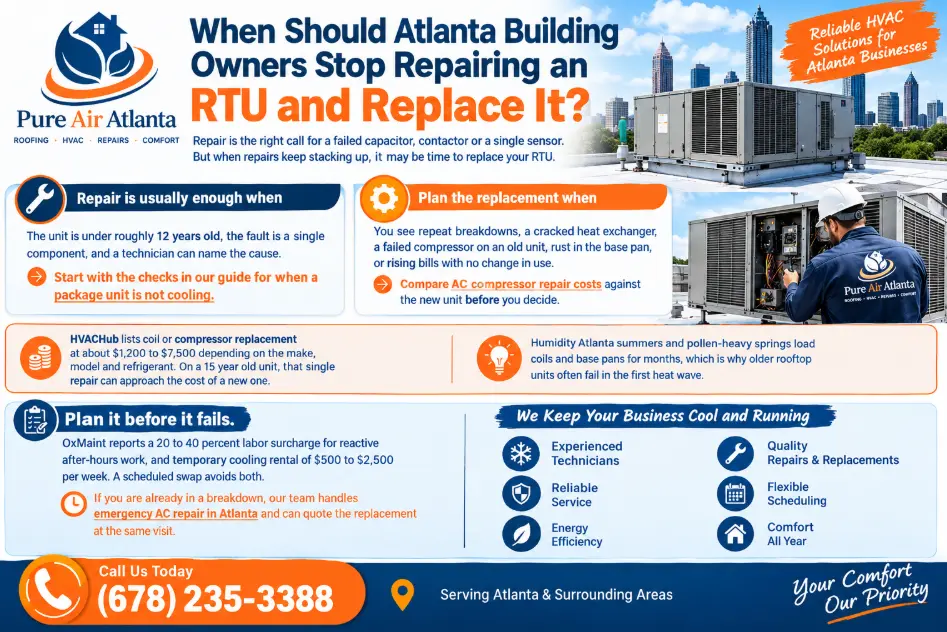
Repair is the right call for a failed capacitor, contactor or a single sensor. Replacement becomes the better investment when repairs keep stacking up on an aging unit. OxMaint cites a common rule: when a repair costs more than about 40 to 50 percent of the installed price of a new unit, replacement usually wins. The same source treats 15 to 20 years as a realistic life for a well-maintained rooftop unit.
Repair is usually enough when
The unit is under roughly 12 years old, the fault is a single component, and a technician can name the cause. Start with the checks in our guide for when a package unit is not cooling.
Plan the replacement when
You see repeat breakdowns, a cracked heat exchanger, a failed compressor on an old unit, rust in the base pan, or rising bills with no change in use. Compare AC compressor repair costs against the new unit before you decide.
HVACHub lists coil or compressor replacement at about $1,200 to $7,500 depending on the make, model and refrigerant. On a 15 year old unit, that single repair can approach the cost of a new one. Humid Atlanta summers and pollen-heavy springs load coils and base pans for months, which is why older rooftop units often fail in the first heat wave.
Plan it before it fails. OxMaint reports a 20 to 40 percent labor surcharge for reactive after-hours work, and temporary cooling rental of $500 to $2,500 per week. A scheduled swap avoids both. If you are already in a breakdown, our team handles emergency AC repair in Atlanta and can quote the replacement at the same visit.
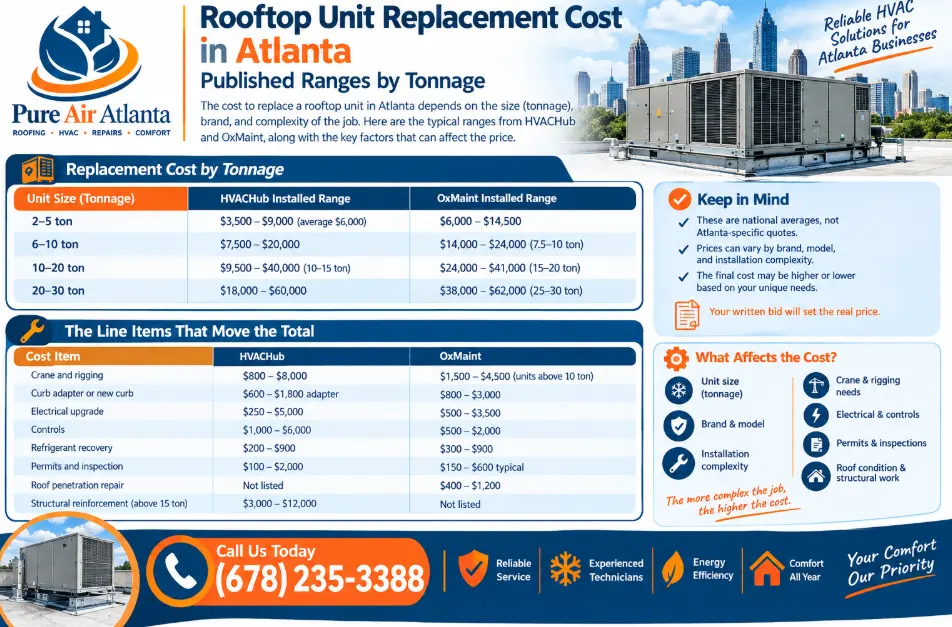
Rooftop Unit Replacement Cost in Atlanta: Published Ranges by Tonnage
No Atlanta contractor we reviewed publishes real figures for this job. The Estes RTU page, for example, lists cost factors but no dollar amounts. To fill that gap, we cross-checked two 2026 national cost guides, HVACHub 2026 rooftop price breakdown and the OxMaint 2026 RTU cost guide. They do not agree, and that disagreement is useful, because it shows how much the scope assumptions matter.
| Unit size | HVACHub installed range | OxMaint installed range |
|---|---|---|
| 2–5 ton | $3,500–$9,000 (average $6,000) | $6,000–$14,500 |
| 6–10 ton | $7,500–$20,000 | $14,000–$24,000 (7.5–10 ton) |
| 10–20 ton | $9,500–$40,000 (10–15 ton) | $24,000–$41,000 (15–20 ton) |
| 20–30 ton | $18,000–$60,000 | $38,000–$62,000 (25–30 ton) |
Published national estimates, not Pure Air Atlanta quotes. HVACHub assumes a standard-efficiency straight swap for its low end, so treat its low figures as best case. Your written bid sets the real price.
The line items that move the total
| Cost item | HVACHub | OxMaint |
|---|---|---|
| Crane and rigging | $800–$8,000 | $1,500–$4,500 (units above 10 ton) |
| Curb adapter or new curb | $600–$1,800 adapter | $800–$3,000 |
| Electrical upgrade | $250–$5,000 | $500–$3,500 |
| Controls | $1,000–$6,000 | $500–$2,000 |
| Refrigerant recovery | $200–$900 | $300–$900 |
| Permits and inspection | $100–$2,000 | $150–$600 typical |
| Roof penetration repair | Not listed | $400–$1,200 |
| Structural reinforcement (above 15 ton) | $3,000–$12,000 | Not listed |
Two things explain most of the gap between low and high bids. First, whether the new unit lands on a compatible curb or needs an adapter and roof work. Second, whether the quote includes the crane, controls and startup, or leaves them as change orders. For a small restaurant or retail space, the unit price is often the smaller part of the surprise. Ask each bidder to price the same scope, then use our pricing page and the checklist below to line them up.
RTU Swap Crane: What the Lift Adds to Your Quote
An RTU swap crane is rented for the lift, so you pay for the crane size, the time on site and the setup. HVACHub reports that units over about 2,200 lbs often need a 24 to 40 ton crane with certified rigging, adding roughly $2,500 to $8,000. Smaller units on low roofs can sometimes be lifted with lighter equipment, which is why the published range starts as low as $800.
- Unit weight and reach. Ask for the operating weight of the new unit and the crane reach needed to clear the parapet.
- Staging space. Tight Midtown and Buckhead lots can force a smaller truck or an off-hours lift. If the crane must stage on a public street or sidewalk, ask your contractor whether the City of Atlanta requires a right-of-way permit.
- Timing. HVACHub notes that spring and fall help you avoid rush crane premiums. Restaurants often schedule the swap before opening hours.
- Bundling. The same source reports 8 to 18 percent savings when you combine two to four replacements with one contractor, since one crane day covers several units.
Our crews work across the city, from HVAC services in Midtown Atlanta to HVAC services in Buckhead, so we plan crane access during the site walk rather than on swap day.
Roof Curb Adapter: Will the New Unit Fit the Old Curb?
A roof curb adapter is a steel transition that lets a new rooftop unit sit on the existing curb when the footprints or duct openings do not match. It is one of the most common reasons an RTU replacement Atlanta quote changes after the first visit, because the old curb is hidden until someone measures it.
Efficiency rules made this more common. The 2023 DOE standards raised minimum rooftop efficiency by about 15 percent, and ACHR News coverage of the 2023 DOE rooftop standards notes that the larger coils needed add size and weight. Manufacturers offset some of that with new cabinet designs, but a unit from 2010 and a compliant unit from today rarely share the exact same footprint.
Measure before you approve a price
- Outside dimensions of the existing curb and the supply and return duct openings.
- Curb height, condition and whether the nailer, insulation and flashing are intact.
- The footprint and operating weight of the quoted unit, with the manufacturer’s curb drawing.
- Whether the quote names an adapter, a new curb or a direct fit, and who flashes it.
Published figures put an adapter at $600 to $1,800 and a full curb replacement at $1,200 to $4,000. A cracked or rusted curb should be replaced while the unit is off, since reaching it later means another crane day.
Roof Warranty, Flashing and Structure: The Costs Nobody Mentions
Many small commercial owners still have a roof warranty running. The Buildings.com rooftop equipment installation guide advises reading the warranty before work starts, contacting the warranty holder first, and using a roofing contractor authorized by the roof manufacturer. Failing to follow the roof requirements can void coverage, and improper detailing around a penetration can cause condensation problems that warranties typically exclude.
Structure matters too. Units above about 15 tons can need added support, and HVACHub lists reinforcement at $3,000 to $12,000. If the new unit is heavier than the old one, ask for a written statement that the roof framing has been checked, or ask for a structural engineer’s review.
Ask every bidder these three roof questions
1. Who flashes the curb, and will that party keep my roof warranty valid?
2. Is roof penetration repair in the price or an allowance?
3. Has the new unit’s weight been checked against the roof structure?
Rooftop work also has safety rules. The OSHA 1926.501 fall protection standard sets when workers near unprotected roof edges need fall protection, so a professional crew will bring guardrails, warning lines or harnesses. Ask your contractor how the crew handles it.
Atlanta Permits, Georgia Codes and Contractor Licensing
A like-for-like rooftop replacement generally requires a mechanical permit, and the licensed contractor normally applies. Third-party permit guides estimate $68 to $225 for a like-for-like swap in Atlanta, but fees depend on scope, so confirm with the city. Start with the City of Atlanta online permitting portal and the City of Atlanta Buildings & Zoning page. Changing the system type, adding ductwork or upgrading electrical service can add permits and plan review time.
- Codes. The Georgia DCA list of current state minimum construction codes lists the 2024 International Mechanical Code with Georgia amendments for mechanical work and the 2015 IECC with Georgia supplements and amendments for energy. Your permit reviewer applies the edition in force on the permit date, so ask the contractor which one they are designing to.
- License. Georgia licenses conditioned air contractors. Review the Georgia Secretary of State conditioned air contractor guide and verify your contractor’s license before you sign.
- Inspection. Expect a final inspection before the permit is closed. Keep the permit card posted on site until then.
Duct modifications often come up during a swap. If the new unit changes your supply connections, ask about duct sealing in Atlanta while the roof curb is open, and consider commercial air duct cleaning in Atlanta if the ducts have not been cleaned in years.
Refrigerant Changes: R-410A, R-454B and What to Ask Your Contractor
Refrigerant rules changed while many owners were not looking. According to ServiceMag refrigerant transition update, no new residential or light commercial AC equipment can ship with R-410A since January 2025, and the main successor in ducted equipment is R-454B. R-410A remains legal for servicing existing units, though supply is tightening and prices are rising.
The installation side shifted again in 2026. ACHR News report on EPA R-410A installation relief describes EPA enforcement relief for R-410A systems made before January 1, 2025, and EPA’s May 2026 final rule removes the installation deadline for systems in that category whose components were made or imported before that date. Check the current status on the EPA Technology Transitions program page before you buy stored inventory.
- Ask which refrigerant the quoted unit uses and whether the technicians are trained for it. R-454B belongs to the mildly flammable A2L class.
- Ask whether recovery of the old charge is included. Published figures run $200 to $900.
- If you keep other R-410A equipment, read our AC freon recharge cost in Atlanta guide so you know what servicing may cost as supply tightens, and see our freon recharge service page.
Georgia Power Rebates and Other Ways to Lower the Bill
Georgia Power’s Georgia Power commercial heating and cooling rebate sheet lists per-ton rebates for packaged rooftop units based on efficiency (IEER):
| Cooling capacity | Minimum IEER | Rebate |
|---|---|---|
| 65,000 to under 135,000 Btu/h | 15.3 | $60 per ton |
| 135,000 to under 240,000 Btu/h | 14.7 | $50 per ton |
| 240,000 to under 760,000 Btu/h | 13.6 | $40 per ton |
From the Georgia Power sheet: total rebates are capped at $100,000 per building per year and 50 percent of equipment cost. Confirm pre-approval and eligibility with the program before you sign.
A rebate on a 10 ton unit is a few hundred dollars, so treat it as a tie-breaker between two efficient models, not the reason to replace. Bigger savings come from a right-sized unit, working economizers and quality controls. Ask for the IEER rating on every quote, and plan a seasonal tune-up through our AC maintenance service in Atlanta so the new unit holds its efficiency.
How an RTU Replacement Day Works
- Site walk and measurementsTechnicians check the curb, ducts, electrical, access and roof condition. This is where an adapter or a roof repair gets priced.
- Proposal and permitYou receive a scoped written bid. The contractor submits the mechanical permit to the city.
- Equipment orderLead time depends on the model. Order before peak season so the unit is on the ground when the weather turns.
- Swap dayPower is locked out, refrigerant is recovered, the old unit is lifted off and the curb and adapter are set and flashed. Published examples run 6 to 10 hours for a 4 ton swap and 24 to 40 hours for a 12 ton replacement.
- Startup and inspectionThe crew reconnects power, ducts and controls, checks airflow and charge, then the city completes the final inspection.
How to Compare RTU Replacement Bids Line by Line
The cheapest number on paper is often the one that leaves the crane, curb or permit out. Ask every contractor to confirm these items in writing:
| Scope item | What to confirm |
|---|---|
| Equipment | Make, model, tonnage, IEER rating, refrigerant, and heat type (gas or electric) |
| Crane and rigging | Included or allowance, crane size, access and any street staging permit |
| Curb | Direct fit, adapter or new curb, and who flashes it |
| Roof | Roofer authorized by the roof manufacturer, warranty impact, penetration repair |
| Permit | Who pulls it, fees included, inspection included |
| Electrical and controls | Disconnect, wiring, thermostat or building controls |
| Startup and warranty | Commissioning, labor warranty length, parts warranty length |
| Schedule | Lead time, swap-day hours, any after-hours premium |
If two bids differ by thousands of dollars, the table above will usually show you where. You can also review customer testimonials and meet our technicians before you decide who comes on your roof. For a related commercial comparison, see how replacement costs work for wall units in our PTAC replacement cost in Atlanta guide, or browse our full list of HVAC services in Atlanta.
RTU Replacement Atlanta: Frequently Asked Questions
How much does RTU replacement cost in Atlanta?
Published 2026 estimates for small commercial rooftop units run from roughly $3,500 to $9,000 for a 3 to 5 ton straight swap at the low end, up to $14,000 to $24,000 for 7.5 to 10 ton units at the higher end, before special extras. Sources disagree because scope differs, so compare written bids that itemize crane, curb, permit and startup.
How much does a crane add to an RTU swap?
HVACHub puts crane and rigging at $800 to $8,000 depending on lift weight and roof height, and OxMaint lists $1,500 to $4,500 for units above 10 tons. Units over about 2,200 lbs often need a 24 to 40 ton crane, which is the upper end of that range.
What is a roof curb adapter and do I need one?
A roof curb adapter is a steel transition that lets a new rooftop unit sit on an existing curb when the footprint or duct openings differ. You need one when the new unit does not match the old curb, which is common because newer high-efficiency units can have larger coils and different cabinet dimensions. Published adapter costs run about $600 to $3,000.
Do I need a permit to replace a rooftop unit in Atlanta?
A like-for-like HVAC replacement generally needs a mechanical permit, and your licensed contractor normally applies for it through the City of Atlanta. Changing the system type or electrical service can add more permits, so confirm the scope with the Office of Buildings before work starts.
Will replacing my RTU affect my roof warranty?
It can. New curbs, flashing and penetrations change the roof, and ignoring the roof manufacturer's requirements can void coverage. Read the warranty first, contact the warranty holder, and use a roofer authorized by the roof manufacturer for any curb or flashing work.
Can I still get an R-410A rooftop unit?
Most new light commercial AC equipment manufactured since 2025 uses lower-GWP refrigerants such as R-454B instead of R-410A. EPA's 2026 final rule removed the installation deadline for systems whose components were made or imported before January 1, 2025. Existing R-410A units can still be serviced, but ask your contractor which refrigerant the quoted unit uses.
How long does an RTU replacement take?
Published job examples range from about 6 to 10 hours for a 4 ton swap to 24 to 40 hours for a 12 ton replacement, and 40 to 80 hours for a 25 ton unit. Permit review, equipment lead time and crane scheduling add calendar time before the swap day.
When is the best time to replace a rooftop unit in Atlanta?
Spring and fall are usually best. HVACHub notes that these seasons help you avoid rush crane premiums, and OxMaint reports a 20 to 40 percent labor surcharge for reactive, after-hours emergency work. Planning the swap before peak summer also avoids temporary cooling rental, which can run $500 to $2,500 per week.
Get an Itemized RTU Replacement Quote
Send us your unit’s nameplate, roof access photos and building address. We will price the crane, curb, permit and startup as separate lines so you can compare.
Call (678) 235-3388 Request a Written Estimate- HVACHub 2026 rooftop price breakdown and the OxMaint 2026 RTU cost guide for national cost ranges.
- Georgia Power commercial heating and cooling rebate sheet for per-ton rooftop rebates.
- Buildings.com rooftop equipment installation guide for roof warranty and flashing guidance.
- ACHR News coverage of the 2023 DOE rooftop standards for the 2023 DOE rooftop standards.
- City of Atlanta online permitting portal, City of Atlanta Buildings & Zoning page, Georgia DCA list of current state minimum construction codes, Georgia Secretary of State conditioned air contractor guide, OSHA 1926.501 fall protection standard and the EPA Technology Transitions program page.
Cost figures are published third-party estimates from the dates listed and are not quotes from Pure Air Atlanta. Code editions, rebate terms and EPA rules change, so confirm each with the issuing agency before you sign a contract. For questions about our service area or process, see our HVAC FAQ page or contact Pure Air Atlanta.
Related guides from Pure Air Atlanta
HVAC Service Area — ZIP Code Directory
92 ZIP codes served · Tap any ZIP to call +1 (678) 235-3388 · pureairatlanta.com