
Package Unit vs Split System Atlanta: The Short Answer for Atlanta Homes
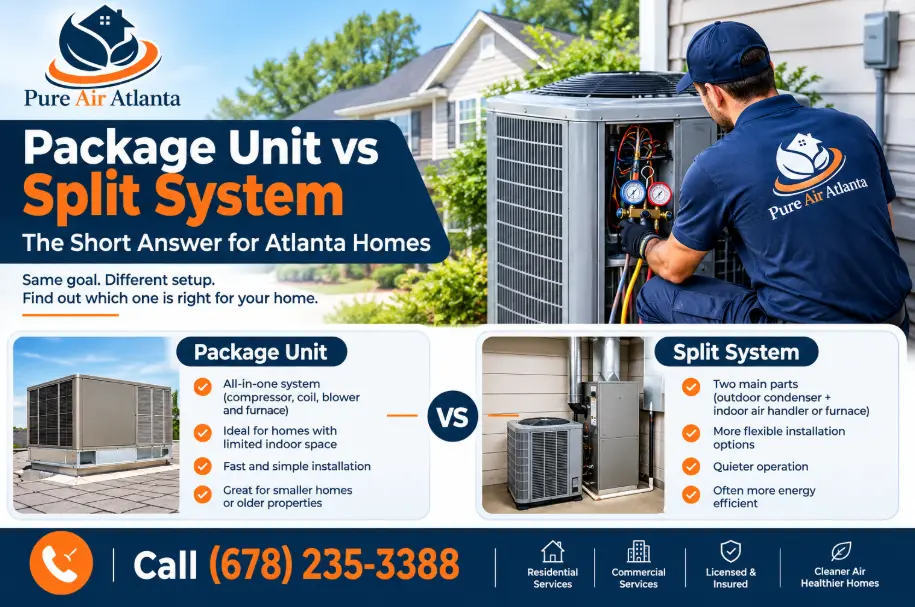
If you are comparing a package unit vs split system Atlanta for your Georgia home, the honest answer is that neither one wins everywhere. A package unit puts everything (compressor, coil, blower and heat) in one outdoor cabinet. A split system divides the equipment between an outdoor condenser and an indoor air handler or furnace. Which one fits your house depends on where your ducts run, how much indoor space you can spare, and how hard Atlanta’s long, humid summers push your equipment.
Quick verdict
- Pick a package unit if you have no attic, basement or closet for an air handler, live on a slab or over a crawlspace, or want every moving part outside the living space.
- Pick a split system if you already have an indoor air handler or furnace location, want the widest range of efficiency and variable-speed options, or prefer ground-level, sheltered service access.
- Do not switch types just because a brochure says so. Changing from one type to the other means new ductwork connections, a new pad or closet layout, and possibly a new permit.
- What a package unit is (and how to tell what you have)
- Package unit vs split system side by side
- Why Georgia’s climate changes the answer
- Efficiency and SEER2 in the Southeast
- What drives the price
- Maintenance and lifespan
- Can you switch from one to the other?
- Atlanta permits, licensing and code
- How to choose for your house
- Package unit vs split system FAQs
What Is a Package Unit, and How Do You Know If You Have One?
A package unit (also called a packaged HVAC unit or packaged system) is a single cabinet that holds the compressor, condenser coil, evaporator coil, blower and heating section. It sits on a concrete pad beside the house, or on a roof curb on some flat-roof townhomes and condos, and connects to your home through supply and return ducts. There is no separate indoor air handler.
Homeowners often search for “packaged unit vs central air Georgia,” but both are central air. A package unit is one type of central system and a split system is the other, so the real question is where the equipment sits, not whether you have central air.
Three versions are common in a package unit home in Atlanta:
- Packaged heat pump: cools in summer and heats by moving heat in winter, usually with electric heat strips as backup on the coldest nights.
- Gas/electric package unit: electric air conditioning with a gas heating section built into the same cabinet.
- Dual fuel package unit: a heat pump that hands off to gas heat when outdoor temperatures drop.
A split system, by contrast, has two main pieces joined by refrigerant lines: an outdoor condenser and an indoor air handler or furnace with the evaporator coil. If your outdoor equipment is a standalone box with copper lines running into the house, you have a split. If one big cabinet has ducts running straight into its side or bottom, you have a package unit.
Package Unit vs Split System Side by Side
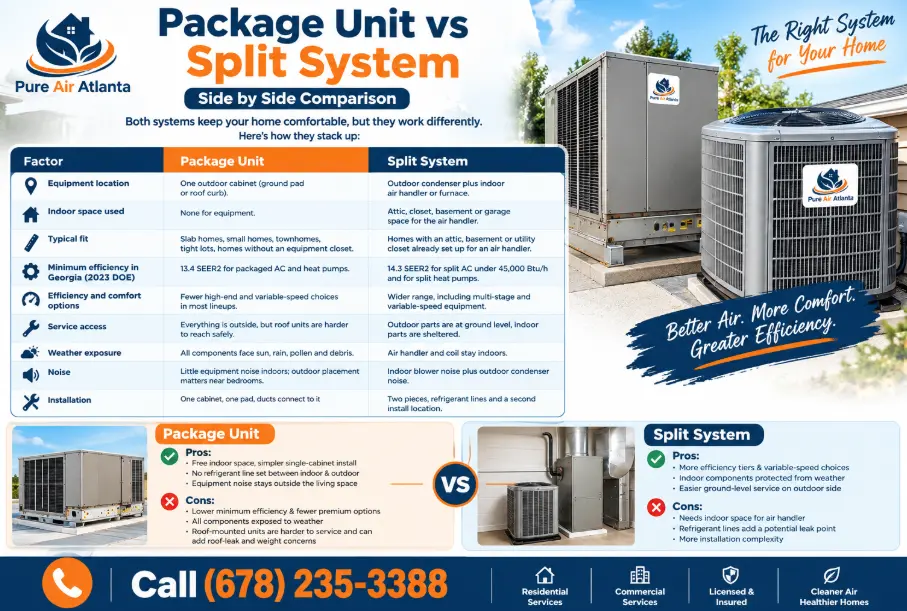
This table covers the package unit pros and cons that matter most when you are standing in your yard looking at the space you have.
| Factor | Package unit | Split system |
|---|---|---|
| Equipment location | One outdoor cabinet (ground pad or roof curb) | Outdoor condenser plus indoor air handler or furnace |
| Indoor space used | None for equipment | Attic, closet, basement or garage space for the air handler |
| Typical fit | Slab homes, small homes, townhomes, tight lots, homes without an equipment closet | Homes with an attic, basement or utility closet already set up for an air handler |
| Minimum efficiency in Georgia (2023 DOE) | 13.4 SEER2 for packaged AC and heat pumps | 14.3 SEER2 for split AC under 45,000 Btu/h and for split heat pumps |
| Efficiency and comfort options | Fewer high-end and variable-speed choices in most lineups | Widest range, including multi-stage and variable-speed equipment |
| Service access | Everything is outside, but roof units are harder to reach safely | Outdoor parts are at ground level, indoor parts are sheltered |
| Weather exposure | All components face sun, rain, pollen and debris | Air handler and coil stay indoors |
| Noise | Little equipment noise indoors; outdoor placement matters near bedrooms | Indoor blower noise plus outdoor condenser noise |
| Installation | One cabinet, one pad, ducts connect to it | Two pieces, refrigerant lines and a second install location |
Package unit pros and cons
- Pros: frees indoor space, simpler single-cabinet install, no refrigerant line set between indoor and outdoor pieces, and equipment noise stays outside the living space.
- Cons: lower minimum efficiency and fewer premium options, all components exposed to weather, and roof-mounted units are harder to service and can add roof-leak and weight concerns.
Split system pros and cons
- Pros: more efficiency tiers and variable-speed choices, indoor components protected from weather, and easier ground-level service on the outdoor side.
- Cons: needs indoor space, attic installs can run in extreme heat, and refrigerant lines add a potential leak point.
Why Georgia’s Climate Changes the Answer
Most comparison articles on this topic are written for the whole country, so they skip the details that matter in metro Atlanta. Here is where our climate and housing stock shift the decision.
Summer humidity is a sizing and airflow problem, not a cabinet problem
Atlanta summers are hot and sticky, so your system spends months removing moisture as well as heat. Humidity control depends far more on correct sizing, duct airflow and fan speed than on whether the equipment is a package unit or a split. An oversized unit of either type cools the air quickly, shuts off and leaves moisture behind. According to the U.S. Department of Energy’s heat pump overview, high-efficiency air-source heat pumps dehumidify better than standard central air conditioners, which is one reason packaged heat pumps and split heat pumps are both popular here. If clammy air or a musty smell is your main complaint, read about mold in an HVAC system before you assume the equipment type is the cause.
Slab-on-grade homes
If your house sits on a slab with no attic or basement space for an air handler, a package unit is often the cleaner fit. Everything stays outside, and the ducts enter the house through the slab, wall or attic, depending on your layout.
Crawlspace homes
Many older Atlanta houses have ductwork running through a crawlspace. A ground-mounted package unit beside the house can connect to that existing duct system without taking up a closet. The catch is the ducts themselves: if they leak, any system will struggle. Learn how leaky ducts waste energy and consider professional duct sealing when you replace equipment.
Attic air handlers
A split system’s air handler often lives in an attic that can get far hotter than the outdoor air in July and August. Hot attics make the equipment and any attic ducts work harder, which is one reason some homeowners prefer moving all the equipment outdoors. If you stay with a split, insulated and sealed ducts matter even more.
Winter is mild, so heat pump packages make sense
Atlanta winters have cold snaps, but long freezing stretches are uncommon. That favors heat pumps (packaged or split) and dual fuel setups for many homes. If you are weighing electric heat against gas, our guide to heat pump vs furnace in Atlanta and our notes on Atlanta winter weather and your furnace will help.
Pollen and debris hit outdoor coils harder
Spring pollen, leaves and cottonwood fluff clog outdoor coils. A package unit has both its condenser and evaporator side in the weather, so keeping the cabinet clean matters. Regular air conditioning cleaning helps either system keep its rated performance.
Tight, newer homes: if your house is very airtight, the equipment type is not the only comfort question. Stale air and humidity can build up without controlled ventilation. See the signs a home is too airtight and whether you need an ERV in Atlanta, or read about ERV installation.
Efficiency and SEER2: What the Southeast Rules Mean for You
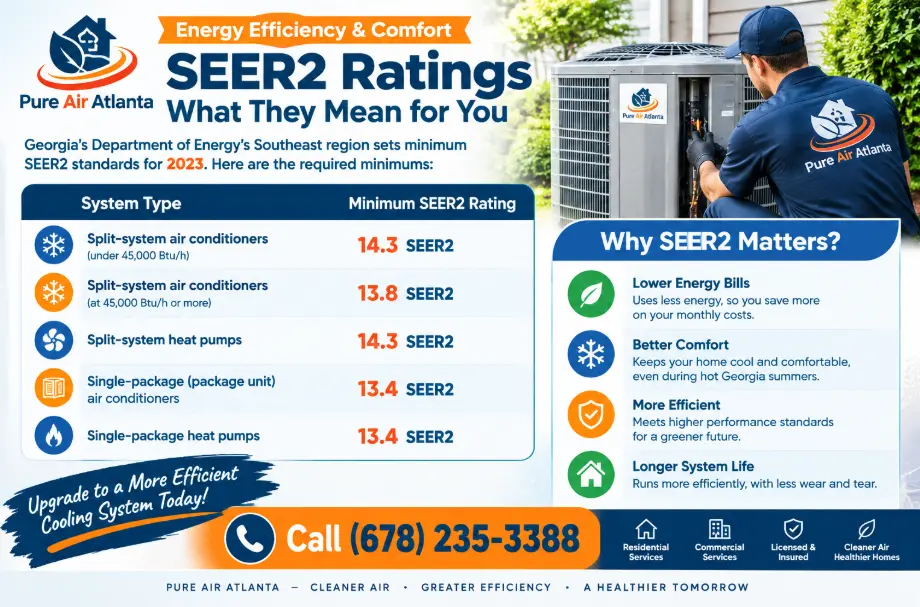
Georgia sits in the Department of Energy’s Southeast region. The DOE’s 2023 central air conditioner standards FAQ lists these minimums for the region:
- Split-system air conditioners under 45,000 Btu/h: 14.3 SEER2
- Split-system air conditioners at 45,000 Btu/h or more: 13.8 SEER2
- Split-system heat pumps: 14.3 SEER2, 7.5 HSPF2
- Single-package (package unit) air conditioners: 13.4 SEER2
- Single-package heat pumps: 13.4 SEER2, 6.7 HSPF2
These are legal minimums, not what every unit delivers. Many package units exceed them, and many split systems go far beyond. Still, the gap tells you something: if your goal is the highest possible efficiency for a Georgia cooling season that runs from spring through fall, split systems generally have more premium options. If your home layout points to a package unit, choose the most efficient model you can reasonably afford and make sure it is installed with sealed ducts.
Real-world efficiency also depends on installation quality. ENERGY STAR’s central air conditioner guidance notes that a new air conditioner reaches its rated efficiency only when paired with a compatible system, and recommends hiring a qualified contractor and sealing ducts for better performance. A 16-SEER2 unit connected to leaky ducts will lose much of its advantage.
Package Unit vs Split System Cost: What Actually Drives the Price
We are not going to quote a single price for a package unit vs split system, because the same equipment type can swing widely from house to house. These are the factors that move your quote:
- Equipment tier: basic single-stage, multi-stage or variable-speed.
- Heating type: heat pump with electric strips, gas/electric, or dual fuel.
- Tonnage and load: your house size, insulation, windows and ducts decide the right capacity, not your old unit’s label.
- Existing connections: reusing a pad, ducts and gas line is cheaper than relocating them.
- Access: roof units may need a crane and curb work; tight side yards slow ground installs.
- Duct condition: repairs or sealing add cost now but protect efficiency for years.
- Permits and code work: required work that your contractor should include in the written quote.
For real local numbers, see our pricing page, plus our cost breakdowns for AC replacement in Smyrna and AC replacement in Alpharetta. If you are replacing a split system with a gas furnace, furnace installation costs in Atlanta will round out the picture. When you are ready for a quote, our AC replacement in Atlanta page explains how we price a job.
About rebates: the federal 25C home improvement tax credit expired for upgrades completed after December 31, 2025, so do not count on it for a new install. Utility and manufacturer incentives change often, so ask any contractor which ones apply before you sign. If a ductless system is on your shortlist, see mini split rebates in Georgia.
Maintenance and Lifespan: What to Expect Year to Year
Both systems need the same basics: clean filters, a clear condensate drain, clean coils, and a technician check at least once or twice a year. The difference is exposure. A package unit keeps every component outdoors, so sun, rain, pollen and debris reach the coil, electrical parts and blower section. Budget Heating’s package unit vs split system comparison makes the same point: outdoor exposure can shorten the life of a packaged unit, while a split system’s air handler stays protected inside.
Practical steps for a package unit home in Atlanta:
- Change the filter on schedule and keep at least two to three feet of clearance around the cabinet.
- Rinse light debris off the coil gently and schedule professional cleaning when buildup is heavy.
- Check the pad for settling and the cabinet for rust, loose panels or standing water.
- Book seasonal service through our AC maintenance service in Atlanta.
If a package unit starts to struggle, run through what to check when a package unit is not cooling before calling. When it needs hands-on help, our package unit repair in Atlanta team handles both rooftop and ground-mounted equipment, and our AC repair in Atlanta page covers split systems.
Refrigerant is the other long-term question. New residential equipment is moving to lower-global-warming-potential refrigerants such as R-454B and R-32, so ask your installer which refrigerant any unit uses and what service will look like in ten years. For older equipment, see what an AC freon recharge costs in Atlanta and our freon recharge service.
Can You Switch From a Package Unit to a Split System (or Back)?
Yes, but it is a bigger job than a like-for-like swap. Going from a package unit to a split means finding indoor space for an air handler, running refrigerant lines, reworking duct connections and often changing the electrical and drain layout. Going from a split to a package unit means a new pad or roof curb, new duct entry points and removing the indoor equipment.
Because of this, most replacements stay with the same type unless there is a clear reason to change, such as a closet being reclaimed, a failed attic install or a major renovation. Before you commit to either path, ask your contractor to inspect the existing ducts. If they are dirty or contaminated, air duct cleaning before the new system goes in keeps old debris from circulating through brand-new equipment.
Atlanta Permits, Licensing and Code: What to Check
An equipment swap is not just a product choice. It is regulated work, and a few official sources are worth knowing:
- City permits and inspections: the City of Atlanta’s Office of Buildings issues building permits, conducts inspections and enforces codes. Ask your contractor whether your job needs a mechanical permit and who pulls it. The city’s listed contact line for electrical, plumbing and HVAC permits is (404) 865-8550.
- Contractor licensing: the Georgia State Board of Conditioned Air Contractors runs licensing for conditioned air companies. Confirm your contractor’s license before work starts.
- State code: the Georgia Department of Community Affairs lists the codes and amendments effective January 1, 2026, including the 2024 International Mechanical Code with Georgia Amendments. Your installer should work to the code in effect.
- Efficiency guidance: ENERGY STAR, an EPA program, lists qualifying central air conditioners and installation guidance.
Package Unit vs Split System: How to Choose for Your House
Run through these questions. They usually settle the decision faster than a spec sheet.
A package unit is likely your fit if…
- You have no attic, basement or closet space for an air handler.
- Your home is on a slab or you want all equipment outside.
- Your current system is already a package unit with ducts that are in good shape.
- You live in a townhome or small home with limited interior space.
A split system is likely your fit if…
- You already have an indoor air handler or furnace location.
- You want a higher-efficiency or variable-speed setup.
- Your attic, basement or closet is well insulated and accessible.
- You prefer sheltered indoor components and ground-level outdoor service.
Whichever way you lean, one question outweighs the rest: is the equipment sized to your home? A proper load calculation (often called a Manual J) and a duct inspection should come before any quote. For help narrowing options in your area, browse our Atlanta neighborhoods or the wider metro Atlanta service areas.
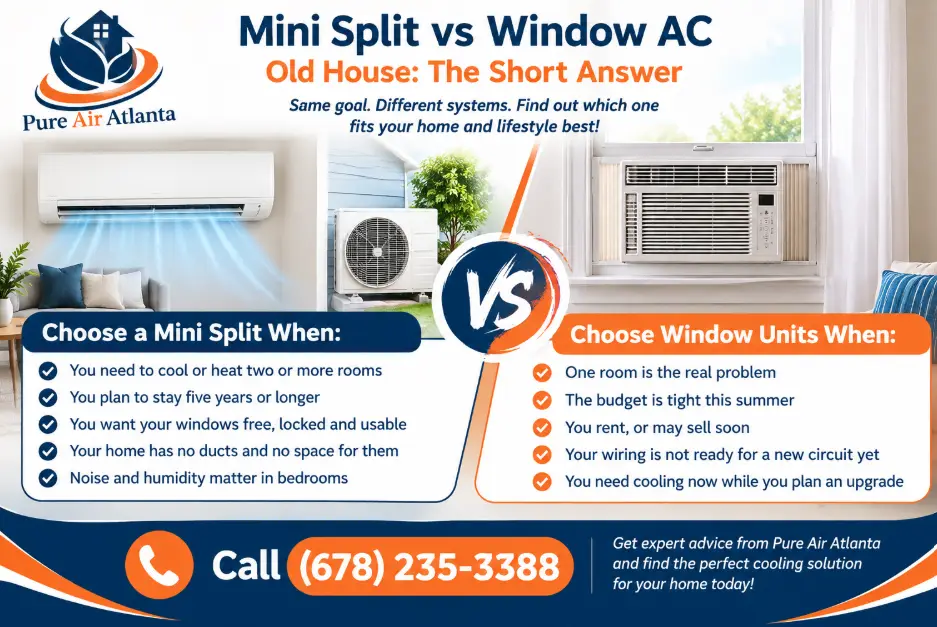
What about a ductless mini split?
If you have no usable ducts at all, a ductless system may beat both options. We compare it with window units in mini split vs window AC for an older Atlanta house and break down the ductless mini split installation cost in Atlanta.
Questions to ask before you sign a quote
- Did you perform a load calculation instead of matching my old unit’s size?
- What is the SEER2 rating, and does this model meet Southeast requirements?
- Will you inspect and seal the ducts?
- Which refrigerant does the equipment use?
- Who pulls the permit, and is it in the price?
- What does the warranty cover, for how long, and who handles service?
Package Unit vs Split System FAQs
What is the main difference between a package unit and a split system?
A package unit keeps the compressor, coils, blower and heat in one outdoor cabinet connected to your ducts. A split system divides them between an outdoor condenser and an indoor air handler or furnace joined by refrigerant lines.
Is a package unit or split system better for Georgia humidity?
Neither type is automatically better. Humidity control depends on correct sizing, duct airflow and fan operation. The Department of Energy notes that high-efficiency air-source heat pumps dehumidify better than standard central air conditioners, so a well-installed packaged or split heat pump can both perform well in our climate.
Do package units cost less than split systems?
Sometimes. A package unit can simplify installation when there is no indoor air handler space, but roof access, equipment tier, ductwork condition and permits all change the final price. Compare written quotes for your specific house.
Which lasts longer, a package unit or a split system?
Maintenance and installation quality matter more than type, but packaged units carry all their components outdoors, so weather exposure can shorten their life compared with a split system whose air handler stays inside.
What SEER2 do I need in Georgia?
The DOE’s Southeast minimums are 14.3 SEER2 for split AC under 45,000 Btu/h and for split heat pumps, and 13.4 SEER2 for packaged AC and heat pumps. Many models exceed these, and ENERGY STAR lists higher-efficiency options.
Can I replace my package unit with a split system?
Yes, though it usually requires indoor space for an air handler, refrigerant lines and duct changes. Most homeowners stay with the same type unless layout or efficiency goals justify the extra work.
Do I need a permit to replace HVAC equipment in Atlanta?
Ask your contractor to confirm what your job requires. The City of Atlanta’s Office of Buildings handles permits and inspections, and its listed line for HVAC permit questions is (404) 865-8550.
Talk to a Local HVAC Pro Before You Choose
Not sure whether a package unit or split system fits your house? Pure Air Atlanta can look at your ducts, space and load, then give you a clear recommendation and a written quote.
Call (678) 235-3388 Request a quote onlineQuestions first? Visit our HVAC FAQ or see how our package unit repair service works.
Sources: U.S. DOE 2023 Central Air Conditioner Standards FAQ · U.S. DOE Heat Pump Systems · ENERGY STAR Central Air Conditioner · City of Atlanta Office of Buildings · Georgia Board of Conditioned Air Contractors · Georgia DCA codes effective January 1, 2026 · Budget Heating, package unit vs split system. Equipment rules, rebates and permit requirements change, so confirm current details with the source before you buy.
HVAC Service Area — ZIP Code Directory
92 ZIP codes served · Tap any ZIP to call +1 (678) 235-3388 · pureairatlanta.com