

Mini Split vs Window AC Old House Atlanta: The Short Answer
If you own a 1920s bungalow or a Victorian-era home in Atlanta with no ductwork, the mini split vs window AC old house Atlanta decision comes down to three questions: how many rooms you need to cool, what your wiring and windows can safely carry, and how long you plan to stay.
For most owners who want comfort in several rooms, a ductless mini split is the better long-term system. It is quiet, it heats as well as cools, and it leaves your sash windows alone. A window unit still wins for one hot room, a tight budget, a short stay or a rental. The rest of this guide covers what national comparisons skip: knob-and-tube wiring, plaster walls, wooden sashes, Atlanta humidity, historic district review and permits.
Choose a mini split when
- You need to cool or heat two or more rooms
- You plan to stay five years or longer
- You want your windows free, locked and usable
- Your home has no ducts and no space for them
- Noise and humidity matter in bedrooms
Choose window units when
- One room is the real problem
- The budget is tight this summer
- You rent, or may sell soon
- Your wiring is not ready for a new circuit yet
- You need cooling now while you plan an upgrade

Why a Pre-War Atlanta Bungalow Changes the Math
Most online comparisons assume a house with standard windows, modern wiring and an attic or crawlspace that can hold ducts. Intown Atlanta rarely matches that picture. Bungalows in Virginia-Highland, Candler Park and East Atlanta were built before residential air conditioning existed. Victorian homes in Inman Park and Grant Park add tall ceilings, plaster walls and decorative trim worth protecting.
Four features of these homes decide which system works:
- No duct pathways. Retrofitting central ducts into plaster-and-lath walls often means dropped ceilings or boxed-in chases. That is why ENERGY STAR lists older homes with no existing ductwork as good candidates for ductless systems.
- Original wooden sash windows. They were designed to slide and swing on cords and weights, not to carry a 50 to 100 pound appliance for five months.
- Older electrical service. Two-prong outlets, shared circuits, fuse boxes and, in the oldest houses, knob-and-tube wiring all limit what you can plug in or add.
- A leaky, lightly insulated envelope. Attic heat, single-pane glass and air gaps mean the cooling load per square foot is often higher than in a newer home.
If your home also runs on radiators, our guide to radiator heat in a historic Atlanta home explains how the heating side fits into the same decision.
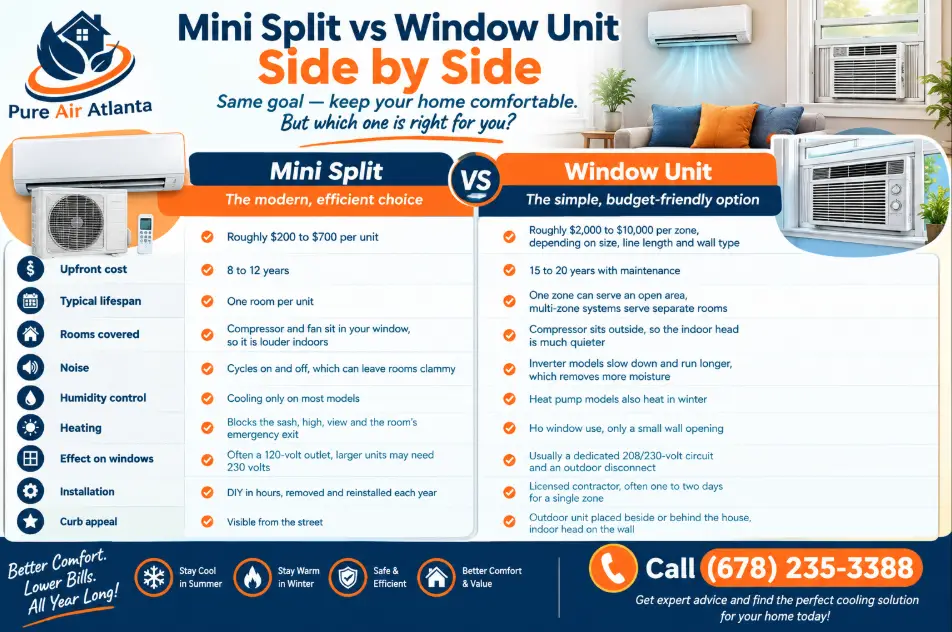
Mini Split vs Window Unit, Side by Side
This table compares the two options on the points that matter most in an older house. Dollar and lifespan figures are national ranges from published cost guides, so treat them as planning numbers, not quotes.
| Factor | Window unit | Ductless mini split |
|---|---|---|
| Upfront cost | Roughly $200 to $700 per unit | Roughly $2,000 to $10,000 per zone, depending on size, line length and wall type |
| Typical lifespan | 8 to 12 years | 15 to 20 years with maintenance |
| Rooms covered | One room per unit | One zone can serve an open area, multi-zone systems serve separate rooms |
| Noise | Compressor and fan sit in your window, so it is louder indoors | Compressor sits outside, so the indoor head is much quieter |
| Humidity control | Cycles on and off, which can leave rooms clammy | Inverter models slow down and run longer, which removes more moisture |
| Heating | Cooling only on most models | Heat pump models also heat in winter |
| Effect on windows | Blocks the sash, light, view and the room’s emergency exit | No window use, only a small wall opening |
| Electrical need | Often a 120-volt outlet, larger units may need 230 volts | Usually a dedicated 208/230-volt circuit and an outdoor disconnect |
| Installation | DIY in hours, removed and reinstalled each year | Licensed contractor, often one to two days for a single zone |
| Curb appeal | Visible from the street | Outdoor unit placed beside or behind the house, indoor head on the wall |
One honest caution: a modern ENERGY STAR window unit is more efficient than the old units many people remember, and the efficiency gap against a mini split is smaller than sales brochures suggest. The bigger mini split advantages in an old house are quiet operation, humidity control, heating, zoning and the fact that your windows stay free.
Electrical First: What Your Old Panel and Wiring Can Handle
Before comparing prices, look at your electrical system. In a house built before the 1950s it can decide the whole project.
Window units on old circuits
Small and mid-size window units usually run on a standard 120-volt outlet, but they pull steady power for hours. On an old shared circuit with a lamp, a fan and a television, that load can trip breakers or overheat aging wires. Never plug a window unit into an ungrounded two-prong outlet with an adapter, and never use a household extension cord, because manufacturers warn against both. Larger window units often need a 230-volt outlet that older homes do not have.
Mini splits and the panel
Most mini splits need their own dedicated circuit, usually 208/230 volts, plus a disconnect at the outdoor unit. That is a cleaner, safer load than a window unit, but it needs a breaker slot and enough capacity in your panel. Check three things:
- The amperage on your main breaker (many pre-war homes still have 60 or 100 amp service)
- Whether you have a breaker panel or an old fuse box
- Whether the wiring in the house is modern cable or knob-and-tube
Plan the electrical work in the budget. If a licensed electrician finds a fuse box, a full panel or knob-and-tube wiring on the path, add that cost before you compare options. Atlanta’s current Georgia minimum codes for construction list the National Electrical Code for electrical work.
What Each Option Does to Your Windows, Plaster and Original Features
Window units and wooden sashes
- Weight on old sashes. A heavy unit can strain sash cords, loosen joints and crack glazing unless it is properly supported.
- Sill damage. Window units drain condensation outward. If the unit is not tilted correctly, water runs onto a wooden sill and starts rot you will not see until later.
- Security and exit. A unit in a bedroom window blocks the room’s emergency exit and leaves a gap that is hard to secure.
- Light and view. The best window in a small room becomes a metal box for the whole summer.
If you go the window route, size it correctly first. Our guide on how to size a window AC for Atlanta heat and humidity explains BTU choices, and our window AC installation service in Atlanta handles safe mounting. Renters should also read the window air conditioner rules for Atlanta apartments.
Mini splits and plaster walls
- Small wall opening. A ductless system connects indoors and outdoors through a hole of only a few inches, so original trim and most of the plaster stay untouched.
- Careful routing. Plaster-and-lath cracks if it is cored carelessly. Ask the installer how they core, where refrigerant lines run and how they will cover the exterior line set.
- Concealed options. Slim-duct indoor units can hide in a closet or attic space to serve a few small rooms when you do not want a wall-mounted head.
- Outdoor unit placement. ENERGY STAR advises keeping the outdoor unit away from doors and windows because it releases water during defrost cycles in winter, and it needs clear airflow.
- Lead paint. Homes built before 1978 may have lead-based paint. Ask your contractor how they control dust when they drill.
Humidity: The Atlanta Factor Most Comparisons Skip
Atlanta summers are hot and humid, and an old house leaks humid air constantly. Cooling alone is not enough. If the system cools the air quickly and shuts off, moisture stays behind. Rooms feel cool but sticky, and humidity can reach plaster, closets and wooden floors.
Window units tend to short-cycle in small rooms, especially when they are oversized. Inverter mini splits slow their compressor to match the load, so they run longer at a gentle speed and remove more moisture. That longer run time is one reason many owners say a mini split “feels” different even when the thermostat reads the same temperature.
Whichever system you choose, keep filters and coils clean. A dirty coil or blower wheel is a common cause of musty smells and weaker cooling. Our mini split cleaning service in Atlanta clears coils, blower wheels and drain pans before mold becomes a smell problem.
Ten-Year Cost Thinking: Beyond the Sticker Price
A window unit looks cheaper because it is. The right comparison covers everything you will pay over about ten years:
- Equipment. One unit per room for windows, or one outdoor unit plus indoor heads for a mini split.
- Installation extras. Electrical upgrades, wall repair, line-set covers, a condensate drain and permits.
- Electricity. Running cost depends on efficiency, run time and how well the house holds cool air.
- Replacement. A window unit may need replacing once within ten years, a mini split usually does not.
- Heating value. A heat pump mini split can also warm the rooms it serves, which window units generally cannot.
Rule of thumb. If you cool one room for a few weeks each year, windows win on cost. If you cool three or more rooms every summer and want winter heat as well, a mini split usually pays you back in comfort, quiet and lifespan, even when the payback is not purely financial.
For current Atlanta pricing and the factors that move a quote, read our breakdown of ductless mini split installation cost in Atlanta and our pricing page. Federal and utility incentives for heat pumps have changed recently, so confirm what is available today before you count on a rebate. If you are weighing heating options too, see heat pump vs furnace in Atlanta.
Historic Districts, Permits and Licensing in Atlanta
Old-house work in Atlanta comes with three layers of rules. Ask about each before you buy equipment.
1. Historic district review
Some intown neighborhoods, such as Inman Park and Grant Park, include locally designated historic districts where exterior changes can need design review. Whether a visible outdoor unit, a line-set cover or a window unit on a street-facing window is covered depends on your district and your property. The City of Atlanta’s historic preservation homeowner resources list the Certificate of Appropriateness reference guide and staff contacts. Ask before you order anything.
2. Permits and inspections
The City’s Office of Buildings issues building permits and handles inspections and code enforcement. A licensed contractor should tell you which permit applies to your installation and pull it for you. Skipping permits can cause trouble at resale or in an insurance claim.
3. Contractor licensing
Georgia licenses conditioned air contractors through the Secretary of State. You can check a contractor on the Georgia State Board of Conditioned Air Contractors page, which links to the license search. Verify the license before work starts.
Which Option Fits Your Old House? Six Real Scenarios
One hot bedroom or sunroom
A correctly sized window unit solves one problem room at the lowest cost. If you will stay for years, a single-zone mini split avoids blocking the window.
Whole three-bedroom bungalow, staying 5+ years
Start with the main living space and the primary bedroom, then add zones later. This is where ductless gives the best comfort and the most value.
Tight budget or short stay
Size each unit carefully, support it properly and use a dedicated outlet. Treat it as a bridge, not a permanent fix.
Locally designated historic district
Confirm design review requirements before you order. A discreetly placed outdoor unit and a covered line set are easier to approve than street-facing window units.
Radiators or old boiler with no cooling
A heat pump mini split can add cooling and supplemental heat without ducts. If the boiler still serves you, keep it healthy with our boiler repair service in Atlanta.
Fuse box or knob-and-tube wiring
Do not add a new load to doubtful wiring. Have a licensed electrician evaluate it, then choose the system.
Common Old-House Cooling Mistakes to Avoid
- Oversizing the equipment. Bigger is not better in a humid climate. An oversized unit cools fast, shuts off and leaves the air damp. Ask for a proper load calculation. ENERGY STAR advises that a contractor should verify sizing with a Manual J calculation.
- Skipping the envelope. Attic insulation and air sealing often cut the load enough to let you buy smaller equipment.
- Using extension cords or adapters. This is a fire risk with any air conditioner, and old outlets make it worse.
- Hiring an unlicensed installer. Poor line-set work and bad drains cause leaks, wall damage and early failure.
- Placing the outdoor unit badly. Keep it clear of bedroom windows, doors and crawlspace vents, with room for airflow.
- Forgetting maintenance. Filters need regular cleaning, and coils need periodic professional service.
Keep Either System Running Well
Window units need seasonal filter cleaning, a clear drain path and a seal check at the start of each summer. Mini splits need frequent filter cleaning and a yearly professional check. If something goes wrong, these guides cover the most common problems:
- Mini split not cooling in Atlanta: causes and fixes
- Why a mini split leaks water and what to do
- Mini split repair in Atlanta when you need a technician
- AC repair in Atlanta for central and other cooling systems
Get an Honest Recommendation for Your Old House
Tell us your home’s age, the rooms that run hot and your electrical panel, and we will tell you whether a mini split, window units or a staged plan fits. See our mini split services or browse HVAC service by Atlanta neighborhood.
Call (678) 235-3388 Request a VisitMini Split vs Window AC Old House Atlanta: Frequently Asked Questions
Is a mini split better than a window unit for an old house with no ductwork?
For cooling more than one room, usually yes. A mini split needs no ducts, keeps your windows free, runs quietly and also heats. A window unit is better for a single room, a short stay or a rental.
Can one mini split cool an entire old bungalow?
Only if the layout is open. One indoor head cools the space it can reach, and rooms with closed doors will lag. Most closed-plan bungalows need a multi-zone system or a slim-duct unit that serves several small rooms.
Will a mini split damage plaster walls or historic character?
A careful installer needs only a small wall opening and can route refrigerant lines through the least visible path. The risk is in sloppy coring and exterior line sets, so ask how the contractor protects plaster and trim.
Can my old electrical panel handle a mini split?
It depends on the panel size, free breaker slots and the wiring on the circuit path. Most mini splits need a dedicated circuit, so have a licensed electrician check capacity first, especially if you have a fuse box or knob-and-tube wiring.
How long does mini split installation take?
A single-zone installation often takes one to two days. Multi-zone systems, long line sets and electrical upgrades add time.
Do I need a permit and a licensed contractor in Atlanta?
Georgia licenses conditioned air contractors, and the City of Atlanta Office of Buildings handles permits and inspections. Your contractor should confirm which permit applies and pull it, and you can verify the license through the Georgia Secretary of State.
Can I use window air conditioners in an Atlanta historic district?
Rules depend on your district and property, and a unit in a street-facing window may draw attention. Contact the City’s historic preservation staff before installing, and check HOA or lease rules too.

HVAC Service Area — ZIP Code Directory
92 ZIP codes served · Tap any ZIP to call +1 (678) 235-3388 · pureairatlanta.com