
Do I Need an ERV in Atlanta? The Short Answer
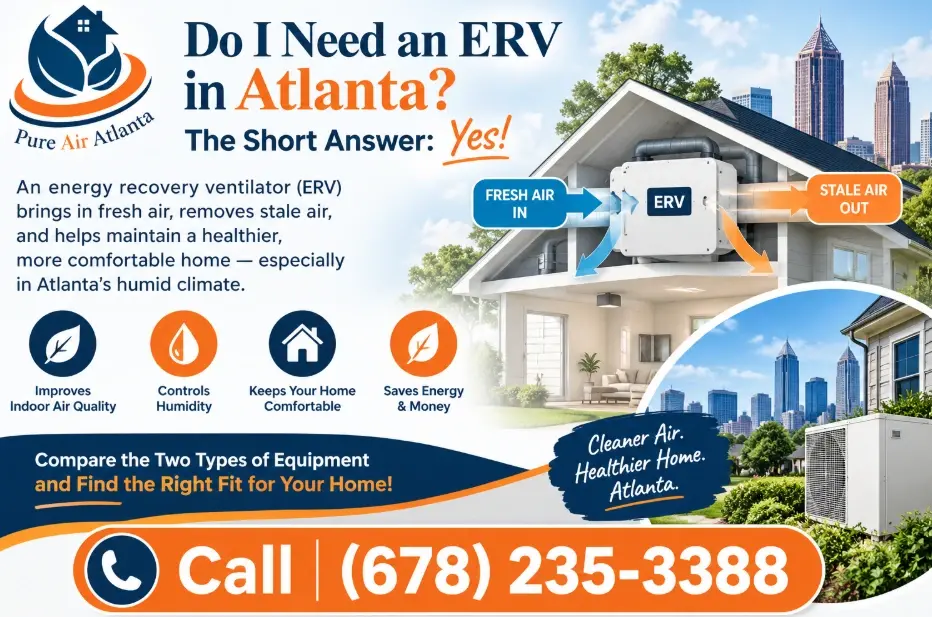
Do I need an ERV in Atlanta? You probably do if your home is tight: newly built, recently remodeled, heavily air-sealed, or a condo where the windows stay shut for most of the year. You probably do not need one first if you live in a leaky older house, because fixing moisture, ducts and pollution sources usually gives you more for your money.
An energy recovery ventilator (ERV) is one way to bring in controlled fresh air. It is not the only way, and it is not a dehumidifier. The rest of this guide shows you how to decide, using a simple scorecard, a home-type table and the facts behind Georgia’s own code.
Most Atlanta homeowners ask this question after a contractor mentions “fresh air ventilation,” after an energy audit, or after sealing the house and noticing it feels stuffy. The national articles that answer it are written for every climate at once. Atlanta is not every climate. We sit in the mixed-humid zone, with long, wet summers and a real heating season, so ventilation here has to manage humidity as well as air quality.
If you already know you need ventilation and want to compare the two types of equipment, read our ERV vs HRV guide for Georgia’s humid climate. This page answers the earlier question: should you be shopping for ventilation at all?
Why Tight Atlanta Homes Need Fresh Air in the First Place
A house breathes through cracks, gaps and leaky ducts. That “accidental ventilation” is wasteful, but it does replace stale indoor air. When a home is air-sealed, insulated and fitted with better windows, the accidental airflow drops, and so does the fresh air your family breathes. Cooking fumes, carbon dioxide from sleeping people, moisture from showers, and chemicals from new flooring, paint and cabinets all stay indoors longer.
The U.S. Environmental Protection Agency points out that most home heating and cooling systems do not bring in fresh air on their own. Your air conditioner recirculates the same indoor air through the same filter all day. That is why whole home fresh air ventilation has become a standard topic for new construction and energy upgrades.
What Georgia’s energy code says about tight homes
Georgia is not silent on this. Under the state’s 2020 amendments to the 2015 International Energy Conservation Code, new one- and two-family homes in climate zones 2, 3 and 4 must test below five air changes per hour at 50 pascals (ACH50) in a blower-door test run by a certified verifier. The same amendments require the building to have ventilation that meets the International Residential Code or International Mechanical Code, or ASHRAE 62.2-2016, or another approved method. In plain language: a new Georgia home is built tight on purpose, and the code expects a ventilation plan to go with it.
Code compliance and real-world performance are two different things. The Department of Energy’s study of 51 recently built homes in Florida, Georgia and South Carolina found that most homes could not meet ASHRAE 62.2 ventilation requirements. Homes with properly working whole-house ventilation were associated with lower levels of carbon dioxide, radon, nitrogen dioxide and formaldehyde. The researchers also noted that the equipment in many homes was not set up or used correctly. Installing the right system is only half the job; commissioning it is the other half.
The 6-Question Test: Do You Need an ERV?
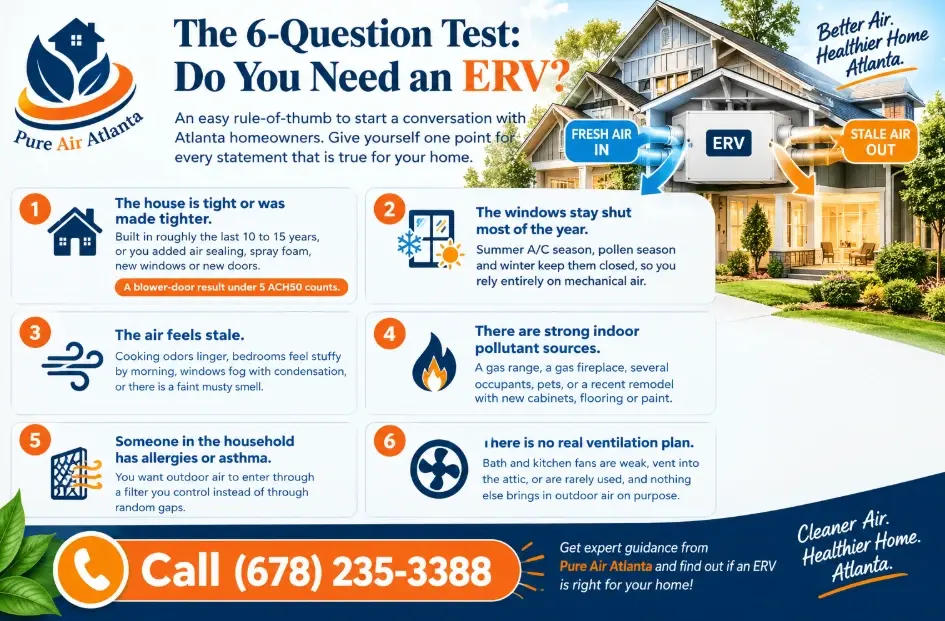
This is a rule-of-thumb scorecard we use to start a conversation with Atlanta homeowners. It is not a code test, and it does not replace a blower-door test or an on-site assessment. Give yourself one point for every statement that is true for your home.
- The house is tight or was made tighter. It was built in roughly the last 10 to 15 years, or you added air sealing, spray foam, new windows or new doors. A blower-door result under 5 ACH50 counts.
- The windows stay shut most of the year. Summer A/C season, pollen season and winter keep them closed, so you rely entirely on mechanical air.
- The air feels stale. Cooking odors linger, bedrooms feel stuffy by morning, windows fog with condensation, or there is a faint musty smell.
- There are strong indoor pollutant sources. A gas range, a gas fireplace, several occupants, pets, or a recent remodel with new cabinets, flooring or paint.
- Someone in the household has allergies or asthma. You want outdoor air to enter through a filter you control instead of through random gaps.
- There is no real ventilation plan. Bath and kitchen fans are weak, vent into the attic, or are rarely used, and nothing else brings in outdoor air on purpose.
A high score does not automatically mean an ERV. It means you need some controlled ventilation, and the ERV is the option that handles Atlanta’s humidity best. We compare the options further down.
Which Atlanta Homes Need an ERV, and Which Can Skip It?
Housing in the city ranges from 1920s bungalows to new infill homes and high-rise condos, so the honest answer depends on the building. Use this table as a starting point.
| Home type | Need for an ERV | What we usually recommend first |
|---|---|---|
| New construction or major remodel, air-sealed | Likely yes | Confirm the ventilation plan that went with the blower-door test, then commission it so it actually runs. |
| Condo or loft with limited window airflow | Often yes | Check whether there is duct, shaft or ceiling space for equipment. Our Midtown HVAC service page and Old Fourth Ward page cover the building types we see there. |
| Older house that was recently air-sealed or re-windowed | Maybe | Measure first. If the blower-door number dropped a lot, add ventilation. |
| 1980s to 2000s suburban home, never sealed | Usually not yet | Seal the ducts, then reassess. See duct sealing in Atlanta. |
| 1920s to 1950s bungalow with a leaky envelope | Rarely first | Control moisture and pollution sources. The house already exchanges plenty of air. |
| Any home with an active mold or humidity problem | Not the first fix | Find the moisture source. An ERV is not a dehumidifier. Start with mold in the HVAC system and HVAC cleaning. |
Larger homes in areas such as Buckhead and newly built infill near West Midtown often fall into the first row. If your home is on our list of Atlanta neighborhoods we serve, we can tell you which row fits your block.
Signs Your Home May Need Mechanical Ventilation
Symptoms alone cannot diagnose a ventilation problem, but a cluster of them is a strong hint. Watch for these:
- Windows with morning condensation in winter, or a house that feels clammy even when the A/C is running.
- A musty smell from the AC vents that returns after you change the filter. This can be a duct or coil issue, a humidity issue, or both.
- Cooking, pet and bathroom odors that hang around for hours.
- Headaches or a “heavy” feeling in closed bedrooms overnight. A low-cost carbon dioxide meter can show whether levels climb while you sleep.
- New or renovated rooms that smell like paint, glue or new flooring for months.
ERV vs Other Ways to Ventilate: Your Real Options
An ERV is the premium answer to tight house ventilation, but it is not the only legal or sensible one. Here is how the main choices compare in a hot, humid climate.
| Option | How it works | Strengths | Trade-offs in Atlanta |
|---|---|---|---|
| Exhaust-only fan | A fan pushes indoor air out and replacement air leaks in. | Lowest equipment cost. | Makeup air arrives unfiltered through gaps, including humid summer air and attic air. |
| HVAC fresh-air intake | A duct brings outdoor air to the return side of the system. | Air passes through the system filter. | No energy recovery, so a humid summer day adds a large moisture load for the A/C. |
| Ventilating dehumidifier | Dehumidifier that also draws in outdoor air. | Controls humidity and ventilates in one unit. | Uses more electricity than a simple fan. Good fit for some homes, not all. |
| ERV | Balanced supply and exhaust through a core that transfers heat and some moisture. | Filtered, balanced airflow that recovers part of the heating and cooling energy. | Higher equipment cost, needs space and ducting, and the core and filters need regular care. |
Is an ERV worth it in Atlanta?
Whether an ERV is worth it comes down to three things: how tight the home is, how much of the year the windows stay closed, and how humid the outdoor air is when the system runs. Atlanta has all three working in favor of an ERV for tight homes, because the moisture transfer reduces how much extra humidity your air conditioner has to remove. An ERV still cannot dehumidify your house. If indoor humidity stays high, you may also need correct A/C sizing, duct sealing or a dedicated dehumidifier. The Department of Energy describes an ERV as a ventilator that limits energy loss while bringing in fresh air, and one that moves only a certain amount of water vapor.
If you are replacing an older system anyway, planning ventilation at the same time is far cheaper than retrofitting it later. Ask about it when you price an AC replacement in Atlanta.
What an ERV Will Not Fix
An ERV helps with
- Stale, stuffy air in a sealed house
- Diluting carbon dioxide, cooking fumes and chemical off-gassing
- Bringing in outdoor air through a filter
- Reducing the energy penalty of fresh air
An ERV does not fix
- Dirty ducts, mold on the coil or musty returns
- A bad humidity problem or an oversized A/C
- Pollen or dust coming from leaky ducts in the attic
- Pollutants at the source, such as a gas range with no hood
Think of ventilation as one layer in a stack. Clean ducts, sealed ducts, a good filter and humidity control all come first or run alongside it. Our guides to how HVAC cleaning improves indoor air quality in Atlanta and indoor air solutions for mold show how the layers fit together. If allergies are the main driver, read about air duct cleaning for allergy and asthma and our air purification service in Atlanta. Air cleaners and ventilation solve different problems: the EPA notes that air cleaners are generally not designed to remove gaseous pollutants, which is where dilution with fresh air helps.
What Happens During a Ventilation Assessment
Before recommending equipment, a good contractor should do more than sell you a box. A proper assessment for a tight Atlanta home covers:
- Tightness. Review the blower-door report if one exists, or recommend one.
- Existing airflow. Check bath fans, the range hood, the dryer vent and any fresh-air intake. A clogged dryer vent changes how air moves through the home.
- Humidity behavior. Look at how the A/C handles moisture in July and how dry the house gets in January.
- Duct condition. Leaky or dirty ducts defeat a ventilation upgrade, so we look at air duct cleaning and sealing needs first.
- Equipment location. Confirm there is room for the unit, ducts, condensate handling and service access.
- Commissioning plan. Set airflow, controls and a filter schedule, then show you how to run it. The DOE study shows why this last step matters.
Mechanical work is also a permit and inspection question. The City of Atlanta’s Office of Buildings issues building permits and carries out inspections and code enforcement, and permit applications go through the city’s online permitting portal. You can also read about the city’s inspections and code enforcement process. Your installer should tell you up front whether your project needs a permit.
Cost, Timing and What to Ask Before You Buy
We do not quote a fixed ERV price in a blog post, because the number depends on duct access, equipment size, controls and whether the home already has a ventilation path. You can see our general pricing approach on the pricing page, or review how we install systems on our ERV installation in Atlanta page. Before you accept any quote, ask:
- What airflow rate is the system sized for, and how was that number calculated?
- Will the unit be balanced, and who will test the airflow after installation?
- Where will the intake and exhaust terminate, and how far apart are they?
- How do I change the filter and clean the core, and how often?
- What happens to indoor humidity in July if this unit is running all day?
- Does the project need a permit, and who pulls it?
Frequently Asked Questions About ERVs in Atlanta
Do I need an ERV in an older Atlanta home?
Usually not as a first step. Older homes tend to leak enough air to ventilate themselves. Seal ducts, control moisture and fix pollution sources first. If you later air-seal and replace windows, measure again and reconsider.
Is an ERV worth it for a new home in Atlanta?
For a tightly built new home, it often is. Georgia’s energy code expects a tight envelope and a ventilation method that meets the residential code, mechanical code or ASHRAE 62.2. An ERV delivers that ventilation while limiting the energy and humidity penalty of outdoor air.
Can I just open the windows instead?
Windows help on mild days, and the EPA lists them as a way to raise the outdoor air rate. In Atlanta they stay closed during hot, humid summers and cold snaps, and pollen season adds another reason to keep them shut. A mechanical system works every day, whatever the weather.
Does an ERV remove humidity from my house?
No. An ERV transfers some moisture between the outgoing and incoming air so the incoming air is less humid than raw outdoor air would be. It is not a dehumidifier, so persistent indoor humidity still needs to be handled by correct A/C sizing, duct sealing or a dehumidifier.
Will an ERV replace duct cleaning or an air purifier?
No. An ERV dilutes indoor air with filtered outdoor air. Duct cleaning removes buildup from the system itself, and air purification treats the air that circulates inside. They solve different problems and work well together.
Does a new Atlanta home already include a ventilation system?
It should have a ventilation method under the energy code, but that method can be as basic as a bath fan on a timer. Ask your builder for the blower-door report and the ventilation design, and confirm that the system actually runs.
Not Sure Whether You Need an ERV?
Tell us about your home and your score on the 6-question test. We will give you a straight answer, even when the answer is “fix the ducts first.”
Browse all Pure Air Atlanta services or read our frequently asked questions.
Bottom Line: Do You Need an ERV in Atlanta?
If your home is tight and your windows stay shut, yes, you almost certainly need controlled ventilation, and an ERV is the best fit for Atlanta’s humid summers. If your home is older and leaky, start with sealing, moisture control and clean ducts, and measure again before you spend money on ventilation equipment. Either way, the right answer comes from your house, not from a one-size-fits-all rule.
Sources
- Georgia State Supplements and Amendments to the International Energy Conservation Code (2020), hosted by Southface
- City of Atlanta, Office of Buildings
- City of Atlanta, Online Permitting
- U.S. Department of Energy, Ventilation and Indoor Air Quality in Recently Constructed U.S. Homes
- U.S. Department of Energy, HVAC Energy Recovery Ventilation
- U.S. EPA, Improving Indoor Air Quality
- Energy Vanguard, Why You Probably Need an ERV, Not an HRV
HVAC Service Area — ZIP Code Directory
92 ZIP codes served · Tap any ZIP to call +1 (678) 235-3388 · pureairatlanta.com