

Home Too Airtight Signs Atlanta: What Atlanta Homeowners Should Watch For
The most reliable home too airtight signs are stuffy bedrooms in the morning, window condensation in cold weather, odors that will not clear, a musty smell, and humidity that stays high even when the A/C runs. A house is never really “too tight.” It is under-ventilated, and the fix is controlled fresh air, not new gaps.
Some of these signs also have other causes, such as dirty ducts, an oversized air conditioner or a plumbing leak. This guide shows you how to tell the difference with simple tests you can run this week.
If you recently air-sealed, added spray foam, replaced windows or bought a newly built home, you may have noticed that the house feels different. It is quieter and more comfortable, but the air can feel flat. That is the trade-off of a tight envelope: the accidental airflow that used to replace stale air is gone, and nothing has replaced it on purpose.
Georgia builds tight homes deliberately. Under the state’s 2020 amendments to the 2015 International Energy Conservation Code, new one- and two-family homes in climate zones 2, 3 and 4 must test below five air changes per hour at 50 pascals (ACH50), and the building must have ventilation that meets the residential code, the mechanical code or ASHRAE 62.2-2016. If your home is new or newly sealed, ventilation should be part of the design. In practice, that part is often missing or switched off.
8 Warning Signs Your Home Is Too Airtight
Stuffy bedrooms and groggy mornings
Sleeping people exhale carbon dioxide into a closed room all night. If you wake up with a heavy head or the room feels stale, CO2 may be climbing. A meter can confirm it.
Condensation on the inside of windows
Moist indoor air condenses when it meets a cold surface. A Green Building Advisor editor calls window condensation in cold weather and lingering odors the two most common signs that a house needs ventilation.
Odors that will not leave
Cooking smells, pet odors and bathroom humidity hang around for hours or days. A leaky house would have flushed them out; a tight one holds them.
A musty smell or mildew spots
Check bathroom ceilings, closets on exterior walls and the area around supply vents. Persistent dampness is a sign that moisture has nowhere to go.
High humidity even when the A/C runs
If indoor humidity sits above 60% in summer, the house is holding moisture. It can also mean an oversized system or leaky ducts, so test before assuming.
Chemical smells that last for months
New cabinets, flooring, paint and furniture release compounds for a long time. In a tight home those compounds stay at higher concentrations.
Doors that pull shut or whistle
When the range hood or bath fans run, they push air out. If outdoor air cannot enter easily, the house goes under negative pressure and doors resist opening or whistle at the gaps.
Combustion warning signs
Back-drafting from a furnace, water heater or gas fireplace, soot, a pilot that keeps going out, or a carbon monoxide alarm that sounds. This is a safety issue, not a comfort issue. See the box below.
Is It Really Airtightness? How to Tell the Difference
Every symptom above has at least one other cause. Treat this table as a triage guide before you spend money.
| Symptom | Could point to a tight house | Could also be | First thing to check |
|---|---|---|---|
| Stuffy bedroom | Rising CO2 overnight | Poor airflow to that room | Overnight CO2 reading with the door open and closed |
| Window condensation | Moisture trapped indoors | Single-pane or failed window seals | Humidity reading and which windows fog first |
| Musty smell from vents | High indoor humidity | Dirty coil, duct mold or a clogged drain | Duct and coil inspection. See musty smell from AC vents |
| Humidity above 60% | Little moisture removal by fresh air | Oversized A/C or leaky return ducts | A/C run times and duct leakage |
| Lingering odors | No fresh-air path | Weak kitchen hood or fan that vents into the attic | Where the fans terminate and how much air they move |
| Dust and allergy symptoms | Indoor pollutants not diluted | Dirty ducts or poor filtration | Filter condition and duct cleanliness |
Five Simple Tests You Can Run This Week
- Overnight CO2 test. Place a CO2 meter in the bedroom and sleep with the door closed, as you normally would. Note the reading before bed and at wake-up. Repeat with the door cracked. A big drop with the door open tells you the room needs airflow.
- One-week humidity log. Put a hygrometer in the main living area and one in the bathroom hallway. The EPA recommends keeping relative humidity below 60 percent and ideally between 30 and 50 percent, and notes that a humidity meter costs under $50.
- Kitchen fan door test. Close the windows and run the range hood on high. If an exterior door becomes hard to open or you hear whistling, your home is going under negative pressure.
- Shower test. Time how long the mirror stays fogged and how long the bathroom stays damp after the fan runs. If it takes more than a few minutes to clear, the fan may be weak, undersized or restricted.
- Paper check. Ask your builder or energy rater for the blower-door report and the ventilation design. If you cannot find either, assume nothing is running.
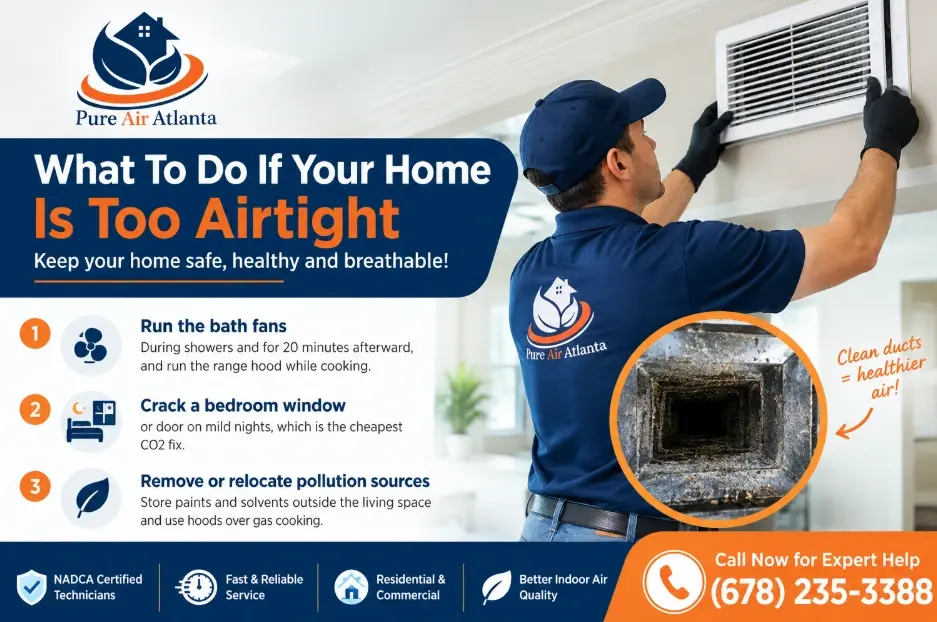
What To Do If Your Home Is Too Airtight
Step 1: Free fixes that help right away
- Run bath fans during showers and for 20 minutes afterward, and run the range hood while cooking.
- Crack a bedroom window or door on mild nights, which is the cheapest CO2 fix.
- Remove or relocate pollution sources: store paints and solvents outside the living space and use hoods over gas cooking.
Step 2: Repair problems that mimic tightness
Before adding equipment, rule out other causes. Leaky ducts pull attic air into the home, so start with duct sealing in Atlanta. Dirty coils and returns create musty smells, so consider air duct cleaning or a full HVAC cleaning. If you suspect biological growth, read about mold in air ducts and our mold in HVAC system service. An oversized system that cools quickly and shuts off leaves humidity behind, which a professional AC repair visit can help diagnose. If a gas furnace is involved, schedule a furnace maintenance tune-up so the combustion system is checked.
Step 3: Add controlled ventilation
If the tests point to a real ventilation shortfall, the permanent answer is a system that brings in filtered outdoor air on purpose. That can be a timed fresh-air intake, a ventilating dehumidifier or an energy recovery ventilator. In Atlanta’s humid summers, an ERV is often the strongest option because it transfers some moisture and recovers part of the energy, though it is not a dehumidifier. Compare it with the alternative in our ERV vs HRV guide for Georgia, or see how we handle ERV installation in Atlanta.
The U.S. Department of Energy studied 51 recently built homes in Florida, Georgia and South Carolina. Most did not meet the ASHRAE 62.2 ventilation standard, and homes with properly working whole-house ventilation were associated with lower levels of carbon dioxide, radon, nitrogen dioxide and formaldehyde. The researchers also found that equipment was often not used or operated correctly, so insist on airflow testing and a clear schedule after any installation.
Who Is Most Likely To Have a Too-Tight Home in Atlanta?
- New construction and infill homes built to the state’s tight-envelope code, including many homes in West Midtown and Old Fourth Ward.
- Condos and lofts where windows are small, fixed or rarely opened, common near Midtown and Downtown Atlanta.
- Older homes after energy upgrades, such as spray foam, new windows and air sealing, in historic areas like Inman Park and Virginia-Highland.
- Larger remodeled homes in Buckhead and similar areas with multiple HVAC zones.
You can find your area on our Atlanta neighborhoods page. Mechanical upgrades may also involve permits, so check with the City of Atlanta’s Office of Buildings or its online permitting portal, and ask your installer who will pull the permit.
Home Too Airtight Signs: Frequently Asked Questions
Can a house be too airtight?
A house cannot be too tight, but it can be under-ventilated. Tightness is good for comfort and energy use. Problems appear only when no controlled fresh-air path replaces the air that used to leak in.
What are the first home too airtight signs to look for?
Start with stuffy bedrooms, window condensation in cold weather, odors that linger and a musty smell. Then measure humidity and carbon dioxide to confirm.
What carbon dioxide level means my house needs ventilation?
There is no single cutoff. Outdoor air is around 420 ppm, many guides aim to keep occupied rooms under 1,000 ppm, and some practitioners suggest acting at lower readings. Use a meter to watch trends, and remember that low-cost meters can be inaccurate.
Is a musty smell a sign of a tight house or a duct problem?
It can be either. High indoor humidity in a tight home can cause it, but so can a dirty coil, a clogged drain or mold in the ducts. Inspect the system before assuming the house is the cause.
Should I open windows in my airtight house?
On mild days it helps, and cracking a bedroom window is a free way to lower overnight CO2. In Atlanta’s hot, humid summers, open windows let in moisture, so a mechanical system is a better long-term answer.
Does my new Atlanta home already have ventilation?
It should have a ventilation method under the energy code, but it may be as basic as a bath fan. Ask for the blower-door report and ventilation design, and confirm the system actually runs.
Think Your Home Is Too Airtight?
Share your symptoms and test readings. We will tell you whether you need ventilation, duct work or something else entirely.
See our HVAC and air quality services, our pricing and our FAQ. For broader air quality advice read how HVAC cleaning improves indoor air quality.
Sources
- Georgia State Supplements and Amendments to the International Energy Conservation Code (2020), hosted by Southface
- City of Atlanta, Office of Buildings
- City of Atlanta, Online Permitting
- U.S. Department of Energy, Ventilation and Indoor Air Quality in Recently Constructed U.S. Homes
- U.S. EPA, Mold Course Chapter 2: Moisture Control
- U.S. Consumer Product Safety Commission, Carbon Monoxide Information Center
- Green Building Advisor, When Do You Need to Add Mechanical Ventilation? (practitioner discussion)
- Rise, Indoor CO2 Levels: Safe Ranges, Symptoms and Fixes (home-products retailer)

HVAC Service Area — ZIP Code Directory
92 ZIP codes served · Tap any ZIP to call +1 (678) 235-3388 · pureairatlanta.com