Rooftop Unit Repair Atlanta Restaurants and Retailers Need: The Short Version
If you are searching for rooftop unit repair Atlanta businesses can act on today, the real problem is rarely just a broken part. A dead rooftop unit (RTU) means a hot dining room, a stalled lunch rush or a retail floor customers walk out of, and it also raises a second question straight away: who pays for the roof equipment, you or your landlord? This guide covers both. It walks through what to do in the first thirty minutes, what usually fails on a rooftop unit in Atlanta’s humid heat, how repair and replacement differ, what Atlanta and Georgia expect on permits and licensing, and how to read your lease before the invoice arrives.
- Check the thermostat, then the unit’s breaker once. Do not keep resetting it.
- Photograph the thermostat reading and the unit, and notify your landlord or property manager in writing the way your lease requires.
- Call a Georgia-licensed contractor for package unit and rooftop repair and send the nameplate photo if you have one.
- Who pays depends on your lease: the lease wording decides it, not the type of unit. See the table in the landlord section below.
Emergency Rooftop AC Repair in Atlanta: The First 30 Minutes
When an emergency rooftop AC repair Atlanta call is coming, the steps you take before the technician arrives decide how fast the problem is found and who ends up responsible for it. Work through these in order. None of them requires going on the roof.
- Confirm the thermostat. Check that it is set to Cool, that the setpoint is below the room temperature, that any schedule or “hold” is not overriding it, and that battery-powered thermostats have fresh batteries.
- Check the breaker one time. Look at the breaker or disconnect labeled for the rooftop unit. If it tripped, reset it once. If it trips again, stop. A breaker that keeps tripping is protecting the unit from a real electrical fault, usually a failing compressor, capacitor or motor.
- Look for water and ice. Water stains on the ceiling near the unit’s supply duct point to a clogged condensate drain. Ice on refrigerant lines or visible coils means airflow or refrigerant is off. If you see ice, switch the thermostat to Fan only so the coil can thaw, and tell the technician.
- Check indoor filters and vents. If your return filters are reachable from inside, a badly clogged filter can freeze the coil and shut the unit down. Do not run the unit without a filter.
- Document everything. Take photos of the thermostat reading, any error codes, ceiling leaks and the unit if it is safely visible. Write down the time it stopped. This record matters when you notify the landlord and when you compare quotes.
- Notify in writing, then call. Send the landlord or property manager a short email or portal request, copying the notice address your lease names. Then call a licensed contractor. For after-hours situations, see our emergency AC repair in Atlanta page.
Call a technician immediately if you notice
- A burning or electrical smell
- Water coming through the ceiling or light fixtures
- Repeated breaker trips
- A humming compressor that will not start
- Oily residue on lines or the cabinet
- Any gas odor with a gas-heat unit (leave the area and call the gas utility)
Do not
- Climb onto the roof without the landlord’s permission and fall protection
- Reset a tripping breaker over and over
- Spray water on a running condenser
- Bypass or jumper a safety switch
- Add refrigerant yourself. Handling refrigerant requires EPA Section 608 certification
Commercial RTU Repair: What Actually Fails on Atlanta Rooftops
Rooftop units sit in full sun, absorb heavy spring pollen and run hard through a long, humid cooling season. Restaurant units also pull in kitchen heat and grease-laden air. Most commercial RTU repair calls trace back to a short list of parts. The table below matches common symptoms to likely causes. If your unit is simply blowing warm air, our guide to package unit not cooling troubleshooting goes deeper on diagnosis.
| What you see | Common causes | Who handles it |
|---|---|---|
| Fans run but air is warm | Failed run capacitor or contactor, dirty condenser coil, low refrigerant | Technician |
| Unit will not start, no sound | Tripped disconnect, failed control board, tripped condensate safety switch | Check power first, then technician |
| Water dripping inside | Clogged condensate drain, overflowing pan, leak at the roof curb | Technician, and the roofer or landlord if the curb leaks |
| Ice on coil or lines | Restricted airflow, low refrigerant, failing blower | Fan only, then technician |
| Short cycling or breaker trips | Failing compressor, weak capacitor, electrical fault | Technician (see AC compressor repair) |
| Humid, clammy space with cool air | Economizer damper stuck open, oversized or short-cycling unit | Technician |
| Squealing or rattling | Worn belt, blower bearing, fan motor | Technician |
| No heat in winter | Gas ignition fault, limit switch, cracked heat exchanger, failed heat strip | Technician |
Low refrigerant is never “just a top-off”. A unit only loses refrigerant through a leak, so adding charge without finding the leak is a short-term fix. If you want a sense of how that work is priced, read what an AC freon recharge costs in Atlanta and our refrigerant recharge service page.
Rooftop Unit Repair vs Replacement: How to Decide
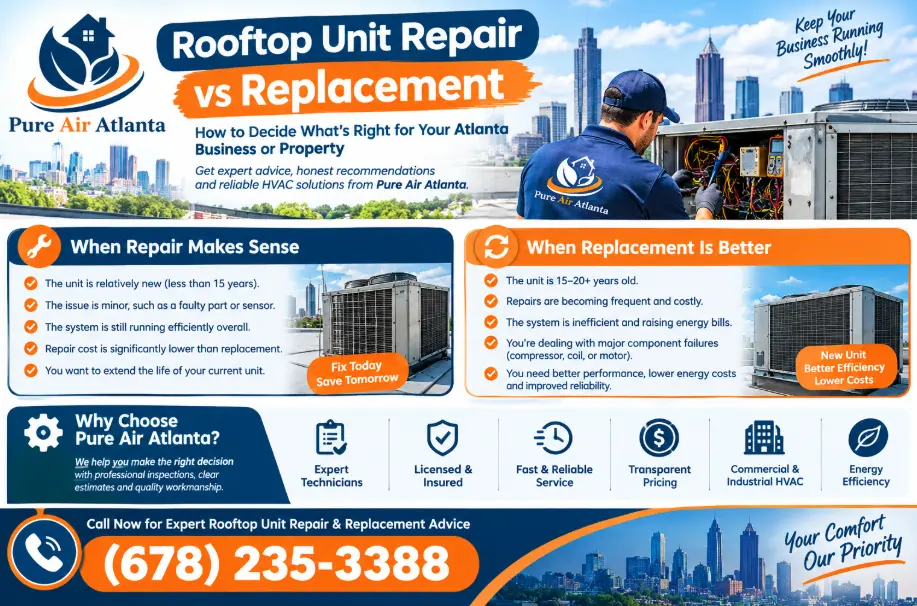
Every rooftop unit repair Atlanta owners approve should come with the same question: is this worth fixing, or is it time to budget for a new unit? There is no single formula, but these points usually settle it:
- Age and condition. Rooftop units are often cited as lasting around 15 to 20 years, and less where coils were neglected or the unit works in a hot kitchen exhaust zone. An old unit with several failing parts is a worse bet than a younger unit with one bad motor.
- Cost of the repair against replacement. A common contractor rule of thumb is that when repairs approach roughly half the cost of a replacement, ask for a replacement quote before approving the work.
- Major component failure. A compressor or heat exchanger failure on an older unit often tips the balance toward replacement.
- Refrigerant type. Older units that use R-22 are expensive to keep charged, because new R-22 production ended in 2020.
- Lease terms. Replacement is often the landlord’s capital expense, while repair may be yours. The next section explains why this matters before you approve anything.
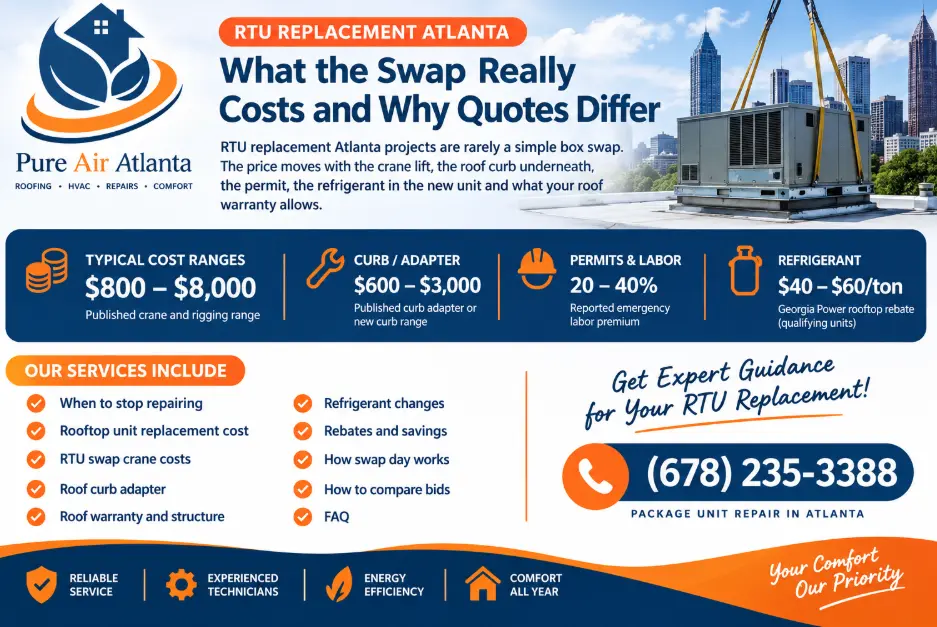
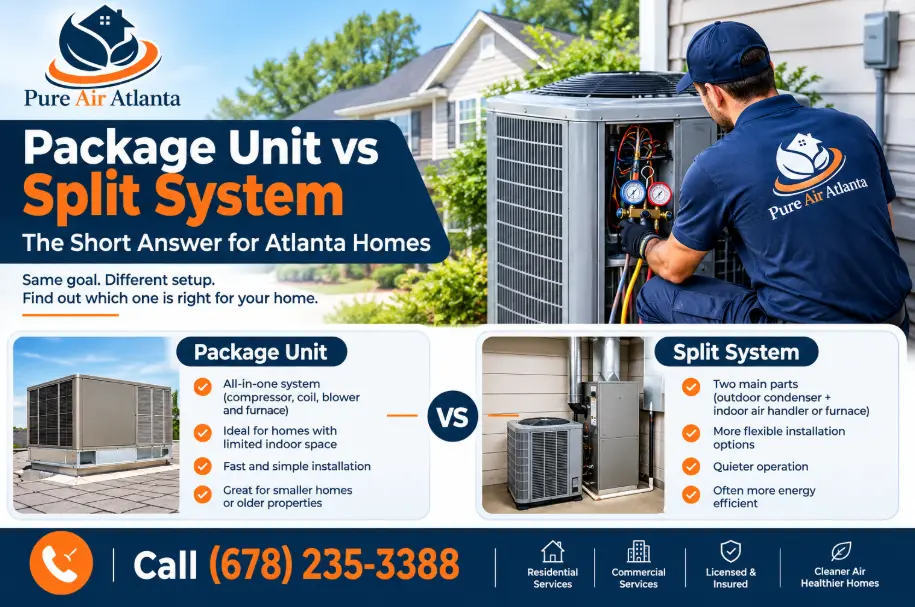
If replacement is on the table, read our guide to RTU replacement in Atlanta for crane lifts, roof curbs and what the swap involves. If you are comparing system types for a small space, the package unit vs split system comparison covers the trade-offs.
Landlord Tenant HVAC Responsibility: Who Pays for the Rooftop Unit?
The unit sits on the landlord’s roof, but you cool your space with it, so the bill can land on either side. In a commercial lease, the written lease generally controls, and the lease type tells you where to start. The patterns below are general, so confirm them against your own document.
| Lease type | Routine service and small repairs | Major repair or replacement | Roof and curb leaks |
|---|---|---|---|
| Gross / full service | Usually landlord, recovered through the base rent | Usually landlord | Usually landlord |
| Modified gross | Split as negotiated. Read the HVAC clause. | Split as negotiated | Usually landlord, unless tenant work caused it |
| Triple net (NNN) | Usually tenant | Depends on wording. “Maintain, repair and replace” can make the tenant pay for a full replacement. | Often landlord, but some NNN leases pass roof costs through |
Clauses to look for before you approve a repair
- Repair vs capital replacement. Some leases set a dollar threshold, or say replacement of an entire system is the landlord’s cost. A compressor change on an old unit sits in the gray zone.
- Approved vendors. Some landlords require you to use their contractor, or to get approval for repairs above a set amount.
- Notice requirements. The lease says how and to whom to give notice, and how long the landlord has to respond.
- Self-help rights. Some leases let the tenant make an urgent repair and deduct or recover the cost if the landlord does not act in time.
- Cost caps and pass-throughs. Look for annual caps on tenant repair costs and for HVAC charges in common area maintenance (CAM) bills.
- Roof access rules. Many landlords control roof access because unauthorized work can affect the roof warranty.
Permits, Licensing and Roof Access for Rooftop Repairs in Atlanta
Permits
The City of Atlanta publishes a Work Exempt from Permit list from the Office of Buildings. It states that repair work under $10,000 in total valuation does not need a permit or fee on non-residential structures, provided the work is otherwise lawful and still meets minimum code. A like-for-like part change usually falls under that. A full unit replacement, new equipment or a crane lift is a different matter. Atlanta handles those through the City of Atlanta online permitting portal, where HVAC appears under Commercial Trades. If you are unsure which side your job falls on, the Express Permitting line listed in the city’s documents is 404-330-6907. Your contractor should confirm and pull any permit needed.
Contractor licensing
Georgia requires an active conditioned air contractor license to perform this work, and the Secretary of State’s conditioned air contractor guide describes two classes. Class I covers systems up to 175,000 BTU of heating and 60,000 BTU of cooling. Class II has no size limit. Sixty thousand BTU is a five-ton unit, so many restaurant and retail rooftop units larger than five tons need a Class II contractor. You can confirm a license on the state’s license lookup page before you sign anything.
Roof access and warranty
Get the landlord’s permission before anyone goes on the roof, and ask whether the roof has a warranty that requires approved contractors or notification. Take photos of the roof surface around the unit before and after the visit. If water enters at the curb afterward, those photos show what changed.
Rooftop Unit Problems for Restaurants vs Retail Tenants
The same failed unit hurts differently depending on what you sell.
- Restaurants. Kitchen heat and grease loads push the RTU harder than a typical office unit. A failed unit means an uncomfortable dining room first. Your food safety equipment is separate, but it is worth knowing the standard: the Georgia Department of Agriculture states that cold-holding equipment must keep food at 41°F or colder. If the problem is in the kitchen cooler rather than on the roof, see our pages on walk-in cooler repair, a walk-in cooler not cooling and Georgia walk-in cooler temperature requirements.
- Retail. Customers leave when a store gets stuffy, and shared roofs in strip centers mean several tenants may depend on the same landlord for access. Humidity also affects stock, especially paper goods, fabrics and electronics. For routine coverage across a storefront, see our commercial AC service in Atlanta page.
We work across the city’s commercial corridors, including Midtown, Buckhead, West Midtown and Downtown Atlanta. You can see the full list on our Atlanta neighborhoods we serve page.
How to Avoid the Next Emergency Rooftop Unit Repair
Most no-cooling calls on a rooftop unit have a warning period. A tune-up before the hot season is cheaper than an emergency visit in July. A good AC maintenance service visit on an RTU should cover:
- Condenser and evaporator coil cleaning
- Filter and belt inspection, and blower bearing check
- Condensate drain and pan clearing
- Capacitor, contactor and motor amp readings against the nameplate
- Refrigerant pressure and leak check
- Economizer damper operation
- Gas valve, ignition and heat exchanger inspection before winter
Also ask who is responsible for these visits under your lease. If you are tenant-responsible, put the service dates in writing. If you are landlord-responsible, request the service records so a pattern of repeat failures can be documented. Buildings with dirty supply ducts as well can pair this with commercial duct cleaning.
What a Good Rooftop Repair Visit Looks Like
A trustworthy contractor for rooftop unit repair Atlanta businesses hire will:
- Show a valid Georgia conditioned air license and proof of insurance
- Photograph the nameplate, the failed part and the roof around the unit
- Explain the cause, not just the part, and say whether it will recur
- Give a written quote that separates repair from replacement options
- State the parts and labor warranty in writing
- Tell you honestly when a unit is near the end of its life
Read our pricing page to see how we quote, or compare general AC repair in Atlanta service details.
Rooftop Unit Repair Atlanta FAQ: Cost, Permits, Licensing
How fast can a rooftop unit be repaired in Atlanta?
It depends on the failed part. Capacitors, contactors, belts and motors are often handled in a single visit when the technician carries the part. Compressors, control boards and heat exchangers can require ordering, so ask for an estimated timeline when you get the diagnosis.
Who pays for rooftop unit repair, the landlord or the tenant?
Your lease decides. Gross leases usually leave HVAC with the landlord, triple net leases usually put routine repairs on the tenant, and replacement is often disputed. Read the repair, replacement and notice clauses before approving the work.
Do I need a permit to repair a rooftop unit in Atlanta?
The City of Atlanta’s exempt-work list says repair work under $10,000 in total valuation does not need a permit on non-residential structures if it is otherwise lawful. Replacements, new equipment and crane lifts go through the city’s permitting process. Your contractor should confirm this for your job.
What license should my HVAC contractor hold in Georgia?
A Georgia conditioned air contractor license. Class I covers up to 60,000 BTU of cooling, which is five tons, and Class II has no size limit. Look the license up on the Secretary of State’s website.
Can my staff repair the rooftop unit themselves?
Staff can check the thermostat, the breaker and the filters. Refrigerant, electrical, gas and roof work should be left to a licensed professional. Refrigerant handling also requires EPA Section 608 certification.
Should I repair or replace an old rooftop unit?
Compare the repair cost with replacement, the unit’s age, the refrigerant type and which party the lease makes responsible. If the quote approaches about half of a replacement, ask for a replacement quote too.
What temperature must restaurant cold storage hold in Georgia?
The Georgia Department of Agriculture states that cold-holding equipment must keep food at 41°F or colder. A rooftop unit failure affects dining room comfort, while walk-in coolers are separate equipment with their own repair path.
Need rooftop unit repair Atlanta restaurants and shops can count on?
Send us the unit’s nameplate photo and a short description of the problem, and we will tell you what to check next.
Call (678) 235-3388 Request rooftop unit service
HVAC Service Area — ZIP Code Directory
92 ZIP codes served · Tap any ZIP to call +1 (678) 235-3388 · pureairatlanta.com