

Walk In Cooler Not Cooling Atlanta? Start Here
A walk in cooler not cooling Atlanta kitchens deal with every summer is a food-safety emergency first and a repair problem second. In Georgia, cold-held food must stay at 41°F or below, so every hour the box runs warm puts product, inspection scores and service at risk. This guide walks you through what to do in the first 15 minutes, the 10 causes we see most often in Atlanta kitchens, the checks that are safe to do yourself, and the exact moment to stop and call a technician.
The most common reasons behind a walk in cooler not cooling Atlanta businesses report are a dirty condenser coil, a failed condenser or evaporator fan motor, an iced-up evaporator coil from a defrost failure, a bad door gasket, a low refrigerant charge, or a compressor that will not start. If the box is above 41°F and you cannot find an obvious cause in five minutes, move the food and call a pro for walk in cooler repair in Atlanta or dial +1 678-235-3388.
Call 678-235-3388- What to do in the first 15 minutes
- 10 causes of a walk in cooler not cooling Atlanta owners see
- Symptom-to-cause cheat sheet
- Safe checks before you call
- When to stop and call a technician
- Why Atlanta kitchens push walk-ins harder
- Georgia food-safety rules and permits
- Maintenance schedule that prevents breakdowns
- Service areas across Metro Atlanta
- Frequently asked questions
What to Do in the First 15 Minutes
Before you open a panel or reset a breaker, protect what is inside. A warm walk-in cooler can ruin a week of inventory quickly, and repair is much easier once the food is safe.
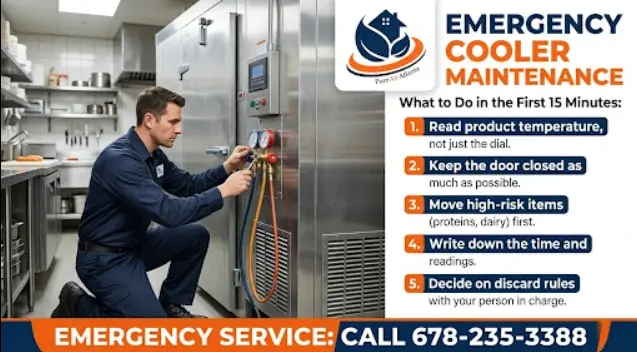
- Read the temperature at the product, not just the dial. Use a probe thermometer on a case of dairy or protein. The wall display can lag or read the wrong spot.
- Keep the door closed as much as possible. A closed box holds cold for a surprisingly long time. Every extra opening dumps humid kitchen air onto the coil.
- Move high-risk items first. Raw proteins, dairy, cut produce and prepared foods go to reach-ins, a second cooler or ice-packed insulated containers.
- Write it down. Log the time you noticed the problem, the readings and what you moved. If an inspector asks, a clear record shows you acted fast.
- Decide on discard rules with your person in charge. A common industry rule is that time and temperature controlled food held above 41°F for more than four hours is discarded, but confirm your own protocol with your health inspector.
Safety note: Turn off and lock out the electrical disconnect before touching any fan, coil or wiring. Handling refrigerant legally requires EPA Section 608 certification, so refrigerant work is never a do-it-yourself job.
10 Causes of a Walk In Cooler Not Cooling Atlanta Owners See
Walk-ins fail in patterns. Here are the ten causes we see most, ordered from the easiest to spot to the ones that need gauges and a licensed technician.
1. Dirty condenser coil
Very commonOften preventableThe condenser rejects heat from the refrigeration system. When grease, lint, pollen or dust blankets the coil, heat cannot escape. Head pressure climbs, the compressor works harder, and cooling capacity drops, especially in the afternoon. A coil that looks like felt is a coil that is costing you money and shortening compressor life. Cleaning is routine work, and our guide to coil cleaning costs in Atlanta explains what the job involves.
2. Condenser fan motor or capacitor failure
CommonIf the condensing unit is running but the fan is not turning, the system overheats and may trip on high pressure. A weak run capacitor can also leave the fan spinning slowly. Never push a fan blade by hand while power is on. Replacing a motor or capacitor is a quick fix when caught early, but a long run with no condenser airflow can damage the compressor.
3. Frozen evaporator coil from a defrost failure
CommonLooks scary, fixableThe evaporator is the coil inside the box. If a defrost timer, heater or termination switch fails, frost builds until the fins are a solid block of ice and air cannot pass. The box warms even though the compressor runs all day. Humid Atlanta summers make this worse because every door opening brings in moisture. Do not chip ice with a screwdriver, since the coil tubing is thin and easy to puncture.
4. Evaporator fan not running
CommonAn evaporator fan not running is one of the clearest symptoms to describe on the phone. The coil may be cold, but no air is moving, so the room stays warm and the coil can ice over. Failed motors, tripped fan delay controls and ice jamming a blade are the usual suspects. If you hear nothing from the fans inside the box, tell your technician right away.
5. Low refrigerant charge or a leak
Needs a proRefrigerant does not get used up. If the charge is low, there is a leak somewhere. Signs include long run times, an oily residue at fittings, hissing, a frosted suction line and a coil that is only partly cold. Adding refrigerant without finding the leak just delays the next failure. A proper freon recharge in Atlanta starts with leak detection and repair, then a correct charge by weight.
6. Compressor not starting or tripping
Needs a proWhen a walk-in cooler compressor is not starting, the cause is often a start capacitor, contactor, overload or relay rather than the compressor itself. A humming sound followed by silence, or a unit that clicks on and off, points to this group. Technicians test the electrical parts before condemning the compressor, which is the most expensive component in the system. Our overview of how compressor problems are diagnosed shows the same logic used in commercial work.
7. Door gasket, strip curtain or door closer problems
Easy to spotA torn gasket, a door that does not self-close, or missing strip curtains lets warm, wet air pour in continuously. You may see condensation around the frame, frost near the door or a heater cable that is no longer doing its job. This is a cheap repair that quietly causes big temperature swings, so inspect the seal with a flashlight at the bottom and corners.
8. Overstocked shelves and blocked airflow
Easy to fixFreeCases stacked against the evaporator or pushed in front of the return air path stop cold air from circulating. The part of the box near the fans freezes lettuce while the back corner stays warm. Keep product off the floor, leave a clear gap around the evaporator and avoid stacking to the ceiling. Delivery days are when this problem appears most.
9. Thermostat, controller or sensor trouble
Sometimes overlookedWrong setpoints, a sensor mounted in the airstream or near the door, or a failing controller can make a box run warm or short-cycle. A good first check is whether the setpoint was changed during cleaning or a power blip. Typical cooler setpoints sit in the mid to upper 30s°F, comfortably below the 41°F limit. If the display and a calibrated thermometer disagree by several degrees, have the sensor tested.
10. Expansion valve (TXV) restriction or failure
Needs a proThe thermostatic expansion valve meters refrigerant into the evaporator. If it sticks, clogs or loses its charge, the coil is starved or flooded. The symptoms mimic a refrigerant leak: poor cooling, frosting in odd places and unstable pressures. Only gauges and temperature readings separate the two, which is why guessing at this one gets expensive.
Symptom-to-Cause Cheat Sheet
Use this table to match what you see and hear to the likely cause. It will not replace a service call, but it will help you describe the problem clearly and cut diagnostic time.
| What you notice | Likely cause | DIY check or call? |
|---|---|---|
| Compressor runs all day, box slowly warms | Dirty condenser, low charge or iced coil | Check coil visually, then call |
| Outdoor unit hums but fan is still | Condenser fan motor or capacitor | Call, power off first |
| Ice or frost covering the inside coil | Defrost failure or door infiltration | Call, do not chip ice |
| No air movement inside the box | Evaporator fan not running | Call |
| Clicking, humming, nothing starts | Capacitor, contactor, overload or compressor | Call, power off |
| Frost or condensation around the door | Gasket, closer or strip curtain | DIY inspection, then repair |
| Cold near the fans, warm in the back | Blocked airflow from overstocking | DIY, rearrange product |
| Display and thermometer disagree | Sensor or controller | Verify with a calibrated probe |
Safe Checks Before You Call
These five steps take about five minutes, need no tools and do not put you near moving parts or refrigerant. They also give your technician useful information.
- Confirm power. Check the wall breaker and the disconnect near the condensing unit. If a breaker has tripped, reset it once only. A breaker that trips again means a real electrical fault.
- Check the setpoint. Make sure the controller is set where it should be and not in defrost or off mode.
- Look at the door. Does it close and seal fully? Is the gasket torn, flattened or iced?
- Clear the airflow. Move product away from the evaporator and the return path. Leave a gap around the fans.
- Look at the outdoor condenser. With power off, check whether the coil is clogged with debris and whether the area is blocked by boxes, grease or vegetation.
If none of these fixes the problem, you have just narrowed the cause for the technician. Tell them what you saw, when it started and whether the compressor was running.
When to Stop and Call a Walk-In Cooler Technician in Atlanta
Call immediately if any of these apply:
- The box is above 41°F and you cannot fix the cause in five minutes
- You see heavy ice, oil, or hear hissing, buzzing or grinding
- Breakers trip more than once
- The compressor or condenser fan will not start
- The same problem returned within a few weeks of a previous fix
For restaurants, grocers and caterers, our team handles commercial walk in cooler repair in Atlanta and can usually tell you over the phone whether the problem is likely electrical, airflow or refrigeration. For after-hours situations, see our page on emergency HVAC repair in Atlanta. You can also review our pricing ranges and meet our technicians before you book.
Why Atlanta Kitchens Push Walk-Ins Harder
Atlanta is hard on commercial refrigeration for reasons that do not show up in generic national guides. These local conditions are why a walk in cooler not cooling Atlanta owners report so often traces back to the condenser coil, the door seal or defrost.
- Heat and humidity. Long, humid summers raise condensing temperatures and bring extra moisture into the box every time the door opens. That means more frost and longer run times.
- Pollen season. Heavy spring pollen and cottonwood-type debris coat outdoor condenser coils faster than many owners expect.
- Hot kitchens. Condensing units mounted on rooftops, in alleys or beside fryer exhaust live in much hotter air than their design assumes.
- Storms and brief outages. Power flickers can trip protection devices or reset controller settings. Always check setpoints after an outage.
If your dining room HVAC is also struggling, the building load may be part of the story. Our team also services package unit repair for restaurants and retail spaces, and our commercial AC service in Atlanta guide explains how those systems are maintained.
Georgia Food-Safety Rules and Permits
Georgia food service establishments operate under the Department of Public Health food service rules (Chapter 511-6-1). Those rules require potentially hazardous foods to be cold held at 41°F or below, which is why a failing walk-in cooler can turn into an inspection problem very quickly. The state publishes its rules and guidance on the Georgia Department of Public Health food service page.
Inspections in Fulton County are handled by the county health department, and the Fulton County restaurant inspection program lists permit information and inspection scores. Parts of the City of Atlanta fall in DeKalb County, so confirm which health authority covers your address.
If your repair involves new equipment or changes to a mechanical system, ask the City of Atlanta whether a permit is needed. The city publishes an HVAC permit application, and your contractor can confirm what applies to your job.
Maintenance Schedule That Prevents Breakdowns
Most walk-in failures are slow-motion problems. A simple routine catches them before food is at risk.
| How often | Task | Why it matters |
|---|---|---|
| Daily | Log temperature, check the door closes fully | Catches drift before it becomes spoilage |
| Weekly | Inspect gaskets, clear airflow around the evaporator | Prevents frost and uneven cooling |
| Monthly | Look at the condenser coil and fan, check for oil or frost | Spots early refrigerant and airflow problems |
| Quarterly | Professional coil cleaning, fan, electrical and defrost check | Protects the compressor, the most costly part |
| Before summer | Full tune-up and charge verification | Prepares the system for peak load |
Booking planned visits through our preventive maintenance service is cheaper than an emergency call, and it gives you a documented service history to show inspectors. Buildings with commercial kitchens also benefit from regular commercial duct cleaning in Atlanta, which keeps grease and dust from reaching your HVAC equipment.
Service Areas Across Metro Atlanta
We serve restaurants, hotels, grocers and offices throughout the metro area. Busy dining districts that call us most include Midtown, Buckhead, Downtown Atlanta, West Midtown and Old Fourth Ward. You can see every area on our Atlanta neighborhoods page.
We also work in Sandy Springs, Marietta, Smyrna and Decatur. For the complete list, visit our locations page or browse all HVAC and refrigeration services.
Frequently Asked Questions About a Walk In Cooler Not Cooling Atlanta
Why is my walk-in cooler running but not cooling?
A running compressor with a warm box usually points to a dirty condenser, a frozen evaporator coil, a failed fan, a low refrigerant charge or blocked airflow. Check the door seal and clear airflow first, then call a technician if the temperature keeps rising.
How warm can a walk-in cooler get before food is unsafe?
Georgia requires cold-held foods to stay at 41°F or below. Foods that have been above that temperature for an extended period may need to be discarded, so confirm your discard policy with your local health authority.
Why is my walk-in cooler freezing up?
Ice usually comes from a defrost failure, a leaking door gasket or humid air entering the box. Heavy frost blocks airflow, which makes the box warm even while the compressor runs.
Can I add refrigerant myself?
No. Adding refrigerant requires EPA Section 608 certification, and a low charge means there is a leak that needs to be found and repaired first.
How often should a walk-in cooler be serviced?
At minimum, plan a professional check each quarter, with coil cleaning and a full inspection before summer. Kitchens with heavy grease or dust may need more frequent visits.
Is it worth repairing an older walk-in cooler?
Often yes. Fans, controls, gaskets and defrost parts are inexpensive compared with replacing the box. A technician can tell you whether a major component failure makes replacement more sensible. For general questions, see our frequently asked questions page.
Walk In Cooler Not Cooling Atlanta Right Now?
Move your high-risk food first, then call us. Describe what you see and hear, and we will tell you what to check while we get a technician moving.
Call 678-235-3388 Request Service OnlineContact us online or read what customers say on our testimonials page.
HVAC Service Area — ZIP Code Directory
92 ZIP codes served · Tap any ZIP to call +1 (678) 235-3388 · pureairatlanta.com