
Atlanta Historic District AC Replacement: The Short Answer
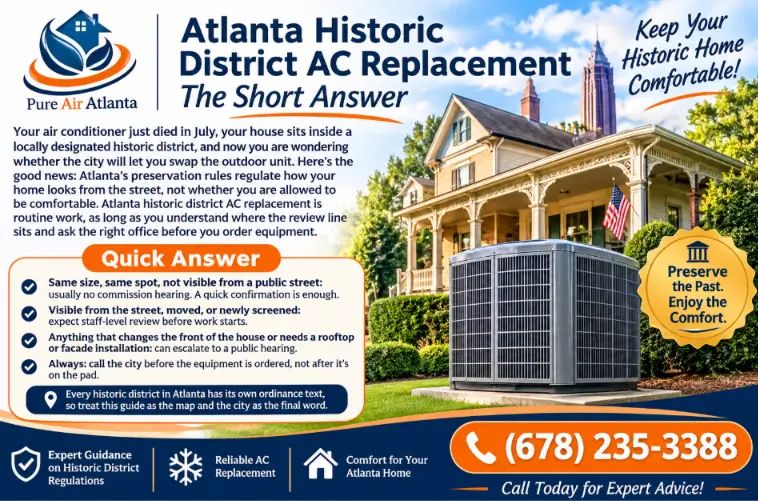
Plain-English guide for Atlanta homeownersYour air conditioner just died in July, your house sits inside a locally designated historic district, and now you are wondering whether the city will let you swap the outdoor unit. Here is the good news: Atlanta’s preservation rules regulate how your home looks from the street, not whether you are allowed to be comfortable. Atlanta historic district AC replacement is routine work, as long as you understand where the review line sits and ask the right office before you order equipment.
Quick answer
- Same size, same spot, not visible from a public street: usually no commission hearing. A quick confirmation from preservation staff is still smart.
- Visible from the street, moved, or newly screened: expect staff-level review before the work starts.
- Anything that changes the front of the house or needs a rooftop or facade installation: can escalate to a public hearing.
- Always: call the city before the equipment is ordered, not after it is on the pad.
Every historic district in Atlanta has its own ordinance text, so treat this guide as the map and the city as the final word.
How Atlanta’s Urban Design Commission and Certificate of Appropriateness Process Works
Atlanta protects its older neighborhoods through local historic district overlays. Inside one, exterior changes can need a certificate of appropriateness, often shortened to COA. The City’s Office of Design (Historic Preservation Studio) staff reviews smaller requests, and the Atlanta Urban Design Commission (UDC) holds public hearings on larger ones. You can see the real workload on the Urban Design Commission meeting agendas published by the City of Atlanta, where applications are labeled Type II or Type III.
The type numbers matter because they decide who looks at your project. Atlanta’s zoning ordinance spells out the tiers district by district. The Atkins Park chapter is a clear example, and it uses four levels:
- Type I: ordinary repairs and maintenance. In that chapter, a Type I certificate is not required.
- Type II: minor alterations visible from a public street. The list includes fences, walls, decks, solar panels, shutters, accessory structures, and mechanical and communication equipment. A staff director decides these, with a 14-day clock after a complete application.
- Type III: major alterations, additions and new principal structures.
- Type IV: demolition, moving, or major alterations to a principal structure.
One more rule from that same chapter is worth knowing: a certificate is not required unless the work would otherwise require a building permit. You can read the full text in Chapter 20O of Atlanta’s zoning ordinance for the Atkins Park Historic District. Other districts have their own chapters, so the details can differ. The Inman Park Neighborhood Association puts the general idea simply: any work that requires a building permit might require a Certificate of Appropriateness.
Local district vs. National Register: National Register listing recognizes a neighborhood’s significance, but it is the local historic district overlay that regulates exterior changes day to day. Also check your HOA or private covenants, which are a separate layer of design review.
Does Replacing an AC Condenser Need a Certificate of Appropriateness?
It depends on three things: whether the new condenser is visible from a public street, whether it stays in the same location, and whether the install changes anything else on the exterior. Use this table as a starting point, then confirm with staff.
| Your project | Likely review | Why it lands there |
|---|---|---|
| Same-size condenser, same pad, not visible from a public street | Often no certificate beyond the building permit. Confirm with staff. | The Type II category targets mechanical equipment visible from a public street. |
| Same spot, but the unit can be seen from the street | Staff-level (Type II style) review is likely. | Street-visible mechanical equipment is the exact item the tier lists. |
| Moving the condenser to a new location or new pad | Depends on visibility. Side or rear placement is the safe direction. | Ordinances prefer the least visible location. |
| Adding a fence, wall or lattice to screen the unit | Review if the screen is visible from the street. | Fences and walls are listed alongside mechanical equipment. |
| Wall-mounted ductless outdoor units on a visible elevation | Expect questions about the line set and the wall location. | Facade changes draw the most attention. |
| Rooftop or front-facade equipment | Harder to approve and more likely to reach the Commission. | City guidance points equipment toward non-primary, non-visible locations. |
| A system change that forces new openings or a chase on a street-facing wall | Can be treated as a major alteration (Type III). | Major exterior alterations go to the Commission. |
Staff, not a blog post, make the call on your specific house. What this table gives you is the right vocabulary and the right expectations so the phone call takes five minutes instead of five rounds of emails.
Historic Home Condenser Placement: Where the Unit Can Go
Placement is where most approvals are won or lost. Atlanta’s own guidance is consistent on this. The City’s guidance for work in designated districts and buildings advises installing mechanical equipment on a non-primary facade that is invisible from the public right-of-way. The Atkins Park ordinance goes further for heating and cooling systems: locate them to the side or rear of the principal structure, in the spot least visible from a public street, and screen them with plant material or fencing if they can still be seen.
The placement ladder, best to worst
- Rear yard or rear corner, out of sight from any street.
- Side yard behind the front plane of the house, especially behind a fence or gate.
- Side yard that is visible, but screened with a fence, lattice or evergreen planting.
- Front yard or primary facade: last resort, and the one most likely to be refused.
Screening without suffocating the unit
This is where a historic-district project can go wrong in a way no reviewer will notice until August. A condenser rejects heat by pulling air through its coil. Box it in too tightly and the unit runs hotter, works harder and wears out sooner. Follow the clearances in the manufacturer’s installation manual, leave open space above the fan, and choose open slat or louvered screens over solid panels. Keep shrubs back from the coil as well, since leaves and cottonwood fluff clog it quickly.
Think about the line set, too
The refrigerant lines and electrical disconnect are part of the picture. Routing them through a side or rear wall, and covering them with a cover that matches the siding, keeps the exterior clean. The longer the line run, the more it affects installation detail and performance, so a spot that is close to the air handler is often better than a spot that is simply hidden.
Not sure where your unit can go?
Send us a photo of your yard and your current condenser. We will talk through placement, clearances and what to ask preservation staff before you commit to equipment.
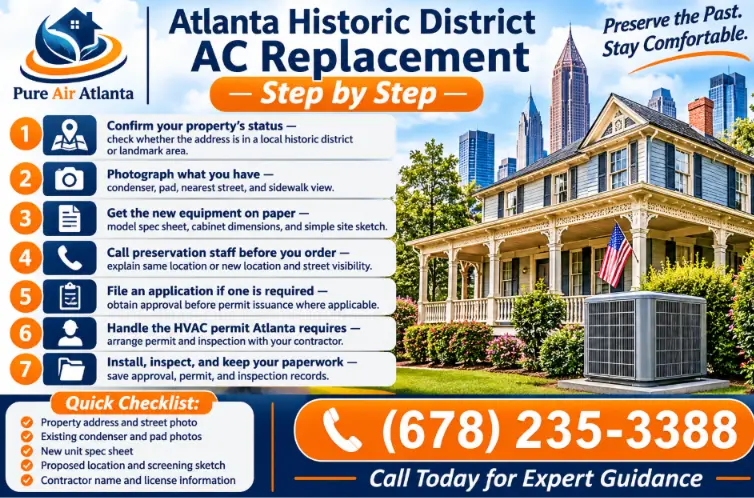
Atlanta Historic District AC Replacement, Step by Step
- Confirm your property’s status. Check whether your address is inside a local historic district, a landmark property, or only a National Register area. If you are unsure, ask City preservation staff. Parcels near district edges and county lines can surprise people.
- Photograph what you have. Take pictures of the current condenser, the pad, the nearest street, and the view from the sidewalk. These are the first documents staff will ask for.
- Get the new equipment on paper. Ask your contractor for the model’s spec sheet with cabinet dimensions, and a simple site sketch showing the pad, property lines and any screening.
- Call preservation staff before you order. Describe the project in plain terms: replacing, same location or new location, visible from the street or not. Ask which review tier applies.
- File the application if one is required. When a certificate is needed, plan to have it in hand before the permit is issued. The City’s own guidance says solar permits need their certificate before other permits can be issued, and the same order is the safe assumption for exterior mechanical work.
- Handle the HVAC permit Atlanta requires. A full AC replacement in Atlanta typically comes with a permit and inspection. Ask your contractor who pulls the permit and how the inspection is scheduled so nothing is left to chance. (Questions about the HVAC permit in Atlanta can go to the City’s Office of Buildings.)
- Install, inspect, and keep your paperwork. Save the approval, permit and inspection records. They protect you at resale and if a neighbor ever questions the work.
What to bring to the call or application
- Property address and a photo from the street
- Photos of the existing condenser and its pad
- Spec sheet with the new cabinet dimensions
- A sketch of the proposed location and any screening
- Your contractor’s name and license information
Equipment Choices That Make Approval Easier
Good planning for an Atlanta historic district AC replacement starts with the equipment. The equipment you pick can make the review smoother or harder. Three decisions are worth thinking through before you sign a proposal.
Match the footprint
High-efficiency condensers are often larger than the 15-to-20-year-old unit they replace. Check the new cabinet against the existing pad and the space beside the house.
Go quieter
Sound matters in tight in-town lots. Ask about sound ratings and variable-speed models, especially for a unit that will sit near a neighbor’s bedroom window.
Consider ductless
For homes with plaster, no attic space or no ducts at all, ductless can avoid cutting into historic fabric. Read our guide to mini split vs window AC for an old Atlanta house.
If your system still uses R-22, you are likely looking at a replacement anyway. Our breakdown of whether to repair or replace an R-22 AC system in Atlanta walks through that decision, and our explainer on R-454B refrigerant for Atlanta homeowners covers what the newer systems use. For ductless projects, the ductless mini split installation cost in Atlanta guide and the page on mini split rebates in Georgia help you budget.
Could a repair avoid the question entirely?
Sometimes. If the condenser is the right size and the problem is a part, an in-place repair does not change the exterior. A technician can tell you quickly whether you are looking at a failing capacitor or a failing compressor. Start with AC repair in Atlanta, or check the signs your AC is low on freon before assuming the worst. If the house relies on radiators for heat, our post on keeping radiator heat in a historic Atlanta home covers the heating side.
Five Mistakes That Cause Stop-Work Orders and Delays
- Ordering equipment first. A condenser that is two inches too tall for the approved screening is a returnable mistake only if the box is still sealed.
- Assuming “like-for-like” means “no review.” Whether a swap counts as ordinary maintenance is the staff’s call, and the answer can depend on visibility and the district.
- Skipping the permit. Staff reports from the Office of Design show how often work done without approval ends up in front of the Commission. Many of the Office of Design staff reports for the Urban Design Commission concern unpermitted exterior work that led to stop-work orders.
- Forgetting the HOA. Covenants can be stricter than the city, and they are enforced separately.
- Over-screening. A solid fence hugging the unit solves the review and creates a hot, short-lived condenser.
Intown Atlanta Neighborhoods Where This Comes Up Most
Historic overlays are concentrated in the older intown neighborhoods. If you live in one of them, our local pages cover the area and the services we offer there:
- HVAC service in Inman Park, a Victorian-era district
- HVAC service in Grant Park, known for Victorians and bungalows
- HVAC service in Candler Park
- HVAC service in Virginia-Highland
- HVAC service in Old Fourth Ward, where historic buildings mix with newer infill
- HVAC service in Midtown
You can also browse all HVAC services by neighborhood in Atlanta to find your area. Whether you are in a district or not, pricing questions are covered on our HVAC pricing page.
Ready to replace your AC the right way?
Tell us your neighborhood and what you have now. We will help you plan the replacement so it works for your comfort and for the review.
Frequently Asked Questions About Replacing AC in an Atlanta Historic District
Do I need a certificate of appropriateness to replace my AC in an Atlanta historic district?
Not always. In the Atkins Park ordinance, a certificate is only required when the work needs a building permit, and the tier for mechanical equipment covers units visible from a public street. A like-for-like swap in a hidden spot often needs no hearing, but staff decides, so confirm before you order equipment.
Can I put the new condenser in the same spot as the old one?
In most cases that is the easiest path, because nothing about the exterior is changing. If the old location was visible from the street, expect staff to ask about screening or a less visible spot.
How long does historic district review take?
It varies by tier. In the Atkins Park chapter, the director has 14 days from a complete Type II application to issue or deny. Cases that go to the Urban Design Commission take longer because they require a public hearing, so build that into your schedule if the AC is not an emergency.
Does National Register listing mean I cannot change my AC?
No. National Register listing recognizes significance but does not by itself regulate private owners. A local historic district overlay, a landmark designation, or an HOA is what usually controls exterior changes.
Can I switch to a ductless mini split in a historic district?
Often yes, but the outdoor unit and line set are what get reviewed. Place the outdoor unit on a side or rear elevation, keep the line set short and covered, and ask staff about any unit visible from the street.
Is an HVAC permit required in Atlanta for a replacement?
A full condenser or system replacement typically comes with a permit and inspection. Ask your contractor to confirm and manage it, and check with the City’s Office of Buildings if you have questions.
Sources and further reading
- City of Atlanta Office of Resilience: guidance for designated districts and buildings
- City of Atlanta Office of Design: Urban Design Commission agenda
- City of Atlanta Office of Design: staff reports to the Urban Design Commission
- Atlanta zoning ordinance, Chapter 20O: Atkins Park Historic District regulations
- Inman Park Neighborhood Association: historic preservation and zoning
This guide is general information, not legal advice. Historic district rules are written district by district and are updated from time to time, so confirm your exact requirements with the City of Atlanta’s Office of Design before starting work.

HVAC Service Area — ZIP Code Directory
92 ZIP codes served · Tap any ZIP to call +1 (678) 235-3388 · pureairatlanta.com