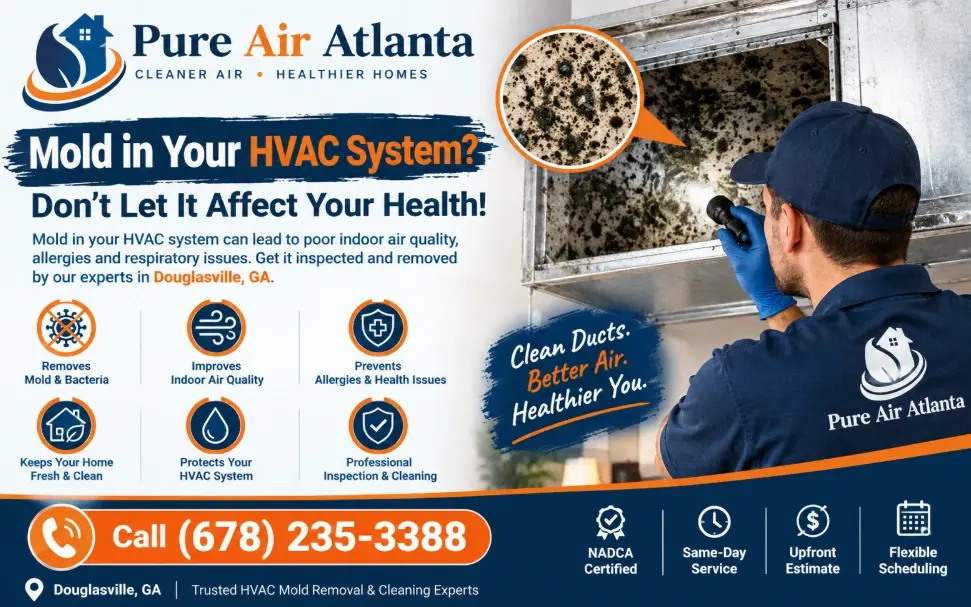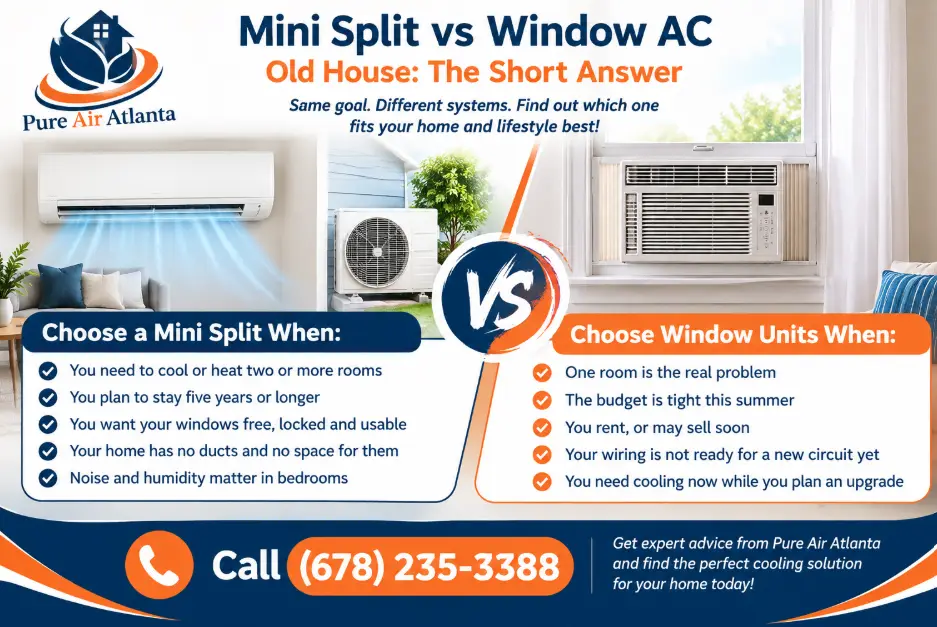
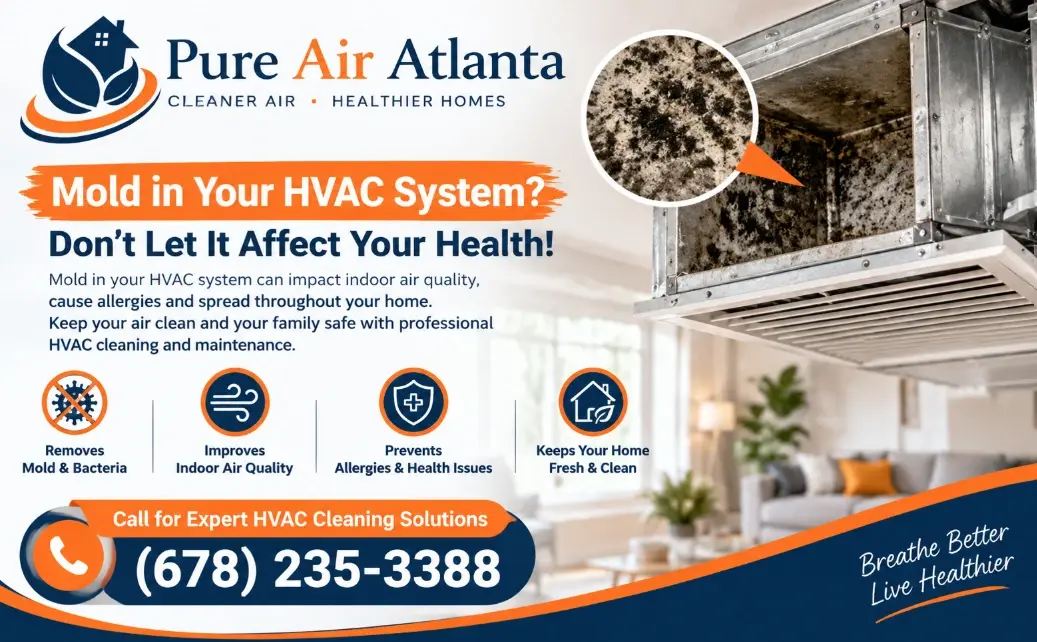
A musty smell when the AC kicks on is easy to ignore, until it is not. Mold in HVAC system Douglasville GA homeowners find is rarely a one-time event. Georgia’s long, humid summers give moisture plenty of chances to collect on cold coils, in drain pans and on ducts, and once mold starts growing, your system spreads its spores and odor to every room it serves.
This guide explains where mold grows inside an HVAC system, the warning signs, what causes it, what to do the moment you suspect it, how professionals handle removal, and how to keep it from coming back. Pure Air Atlanta serves homes across Douglasville, GA, and the advice below is built around local conditions.
- Mold needs moisture. In an HVAC system that usually means condensation, a clogged drain, a wet duct or high indoor humidity.
- Typical signs are a musty odor, visible growth on vents or coils, and allergy-like symptoms that ease when you leave the house.
- The EPA says controlling moisture is the most effective way to prevent growth in ducts. If you do not fix the source, mold will likely return.
- The EPA advises not running the HVAC system if you know or suspect it is contaminated with mold. Call a qualified professional first.
Mold in HVAC System Douglasville GA: Why Georgia Humidity Makes It Common
Your air conditioner works by pulling heat and moisture out of indoor air. The evaporator coil gets cold, water condenses on it, and that water is supposed to drain away through a pan and drain line. In a humid climate like Douglas County’s, a system can produce a lot of condensate for months at a time. Any weak point in that chain, such as a clogged drain line, a dirty coil or a poorly insulated duct, leaves damp surfaces and dust in a dark space, which is exactly what mold needs.
The EPA notes that wet ducts raise the potential for microbial growth, and it points out that cooling coils are designed to remove water from the air, so they deserve particular attention during maintenance. Standing water or debris near the coil, the EPA says, signals a problem that needs immediate attention.
Where Mold Grows Inside Your HVAC System
| Location | Why mold grows there | What you may notice |
|---|---|---|
| Evaporator coil | Cold, wet surface that collects dust and condensation | Musty odor when the AC starts, reduced cooling |
| Drain pan and condensate line | Standing water from a clogged or poorly sloped drain | Water around the air handler, slimy buildup |
| Supply ducts and registers | Condensation where cold air meets warm, humid surroundings | Dark spots on vent covers, sweating ducts |
| Return plenum and filter area | Humid air plus trapped dust | Dust, odor at return grilles |
| Fiberglass duct liner or duct board | Porous material holds moisture once it gets wet | Persistent odor even after surface cleaning |
Porous materials matter. The EPA, NADCA and NAIMA recommend replacing wet or moldy fiberglass duct material rather than trying to clean it. Bare sheet metal ducts can often be cleaned and treated, but only after the moisture source is fixed.
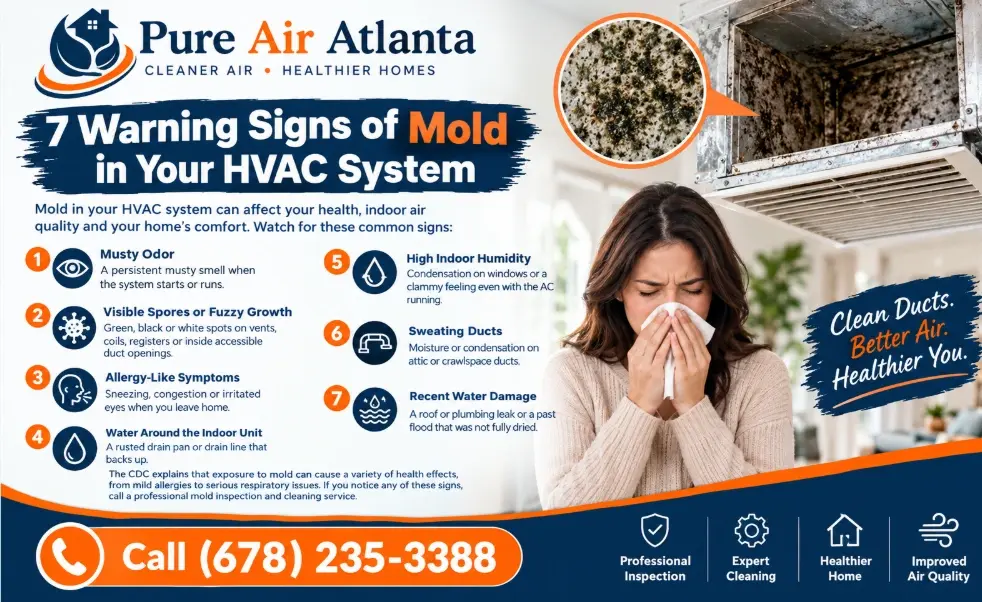
7 Warning Signs of Mold in Your HVAC System
- A musty or earthy smell when the system starts or runs for a while.
- Visible spots or fuzzy growth on vent covers, registers or inside accessible duct openings.
- Allergy-like symptoms such as sneezing, congestion or irritated eyes that improve when you leave home.
- Water around the indoor unit, a rusted drain pan or a drain line that backs up.
- Persistently high indoor humidity, condensation on windows or a clammy feel even while the AC runs.
- Sweating ducts in the attic or crawlspace, or wet insulation around them.
- Recent water damage, a roof or plumbing leak, or a past flood that was not fully dried.
The CDC explains that exposure to damp and moldy environments may cause a variety of health effects, or none at all, and that people with asthma or mold allergies can have severe reactions. People who are immune-compromised or have chronic lung disease can be at higher risk of lung infections. If anyone in your home falls into those groups, take a suspected mold problem seriously and get it checked promptly.
Musty odor alone does not always mean mold in the system. Our guide to the signs you need air duct cleaning in Douglasville helps separate dust and debris problems from moisture problems.
What to Do if You Suspect Mold in Your HVAC System
- Turn the system off if you know or suspect contamination. The EPA advises against running an HVAC system that may be mold-contaminated, because it can spread spores through the home. If it is extreme heat or a medical need, call us first and we will advise on safe next steps.
- Look for the moisture source. Check around the air handler for water, check the drain line, and note any attic or crawlspace leaks.
- Do not use steam or water-based cleaning inside ducts. The EPA says steam cleaning and other methods involving moisture should not be used on any kind of ductwork.
- Do not disturb visible growth. Scrubbing or blowing air across it can release spores.
- Call a qualified HVAC cleaning professional for an inspection of the coil, drain pan, ducts and air handler.
- Dry any water damage quickly. The EPA recommends drying water-damaged areas and items within 24 to 48 hours to prevent mold growth.
Do you need mold testing?
The two federal sources say different things, and both are worth knowing. The CDC does not recommend mold testing and advises removing the mold and preventing regrowth. The EPA notes that a positive determination of whether growth is mold can be made only by an expert, and that lab analysis may be needed in some cases. In practice, if you can see or smell it, fix the moisture problem and clean the affected components. Testing is a judgment call for a qualified professional, not a requirement for taking action.
Smell mold in your vents?
Call Pure Air Atlanta for an inspection of your Douglasville HVAC system. We check the coil, drain pan and ducts, then tell you honestly what needs to be cleaned, repaired or replaced.
Call (678) 235-3388 Request a Free EstimateWhat Causes Mold to Grow in HVAC Systems
- Clogged condensate drain lines or pans. Standing water is the most direct path to growth near the coil.
- Dirty coils and filters. Dust and debris feed mold on any damp surface.
- Uninsulated or poorly insulated ducts. Cold ducts in a hot attic sweat, and sweat means moisture.
- High indoor humidity. The EPA recommends keeping indoor relative humidity below 60 percent, ideally between 30 and 50 percent.
- Short-cycling or poorly matched equipment. A system that shuts off before it dehumidifies properly can leave rooms damp.
- Duct leaks. Leaky return ducts can pull humid attic or crawlspace air into the system. See how this drives energy loss in our duct sealing in Douglasville guide.
- Past water damage. Roof, plumbing or flood moisture that was not dried promptly can seed mold in insulation and duct material.
How Professionals Remove Mold From an HVAC System
Real remediation is more than spraying a product into a vent. A thorough job typically follows this order:
- Inspect and locate the moisture source so the fix does not fail in a few months.
- Correct the cause, such as clearing the drain, repairing leaks or improving duct insulation.
- Clean the coil, drain pan and air handler with appropriate methods for each surface.
- Clean and treat sheet metal ducts. The EPA says cleaning and treatment with an EPA-registered biocide are possible for bare sheet metal.
- Remove and replace moldy porous material. The EPA says moldy fiberglass duct material should be removed and replaced by a qualified heating and cooling contractor.
- Confirm the system is dry and draining properly before it goes back into normal use.
You can see how these services fit together on our mold in HVAC system service page for Douglasville, which covers what a visit involves. Related services include air duct cleaning in Douglasville, air conditioning cleaning in Douglasville and full-system HVAC cleaning in Douglasville. For Metro Atlanta coverage, see our mold in HVAC system hub.
What does it cost?
Cost depends on how much of the system is affected, whether porous duct material has to be replaced and whether the moisture source needs repair. Our air duct cleaning mold removal cost guide and HVAC cleaning cost guide for Douglasville explain the factors, and our pricing page shows how we quote. If the cause is a failing AC component, check AC repair costs in Douglasville too.
How to Prevent Mold in Your HVAC System
- Keep humidity in range. Aim for under 60 percent and ideally 30 to 50 percent relative humidity, per the EPA.
- Keep drip pans clean and drain lines flowing. The EPA lists this as a core moisture-control step.
- Change filters on schedule and use the right size so air does not bypass the filter.
- Schedule regular maintenance that includes cleaning the cooling coil and drain pan.
- Insulate and seal ducts in attics and crawlspaces to cut condensation and humid air intrusion.
- Dry water damage within 24 to 48 hours.
- Consider air treatment. UV and filtration can support cleaner air once moisture is under control. Learn more in our air purification guide for Douglasville homes.
Local and Trusted Resources
For authoritative background, read the EPA’s guidance on whether you should have your air ducts cleaned, its brief guide to mold, moisture and your home and the CDC’s overview of mold and health. If remediation grows into repairs such as replacing ductwork or equipment, check requirements with Douglas County’s Building Permits & Inspections office.
Nearby homeowners can read how we handle the same problem in Lawrenceville, Alpharetta and Smyrna, or learn the difference between black mold in air ducts and other growth.
Mold in HVAC System FAQ for Douglasville Homeowners
How do I know if there is mold in my HVAC system?
Common signs are a musty smell when the system runs, visible spots on vents or coils, water near the air handler, high indoor humidity and allergy-like symptoms that ease when you leave the house. A professional inspection of the coil, drain pan and ducts confirms what is going on.
Is mold in my air conditioner dangerous?
It can be, depending on who lives in the home. The CDC says exposure to damp and moldy environments may cause a variety of health effects, or none at all, and that people with asthma, mold allergies, chronic lung disease or weakened immune systems can be more affected. If you suspect mold, have it addressed promptly.
Should I keep running my HVAC if I suspect mold?
The EPA advises not running the HVAC system if you know or suspect it is contaminated with mold, since it can circulate spores. Contact a qualified professional before using the system again.
Can mold in ducts be cleaned, or must it be replaced?
Bare sheet metal ducts can often be cleaned and treated with an EPA-registered biocide after the moisture source is fixed. The EPA, NADCA and NAIMA recommend replacing wet or moldy fiberglass duct material. Steam cleaning and other moisture-based methods should not be used on ductwork.
Do I need to test for mold first?
Not necessarily. The CDC does not recommend mold testing and says to remove the mold and prevent regrowth. The EPA notes that only an expert can positively determine whether growth is mold. A qualified technician can advise whether testing makes sense in your situation.
How do I stop mold from coming back?
Fix the moisture source first, then keep indoor humidity below 60 percent, ideally 30 to 50 percent, keep drip pans clean and drain lines flowing, change filters regularly and schedule routine maintenance. The EPA says that if the underlying cause is not fixed, the problem will likely recur.
Get your Douglasville HVAC system checked
Do not let a musty smell turn into a bigger problem. Pure Air Atlanta will inspect, explain and fix the cause, not just the symptom.
Call (678) 235-3388 See Mold Service DetailsSources: U.S. EPA, Should You Have the Air Ducts in Your Home Cleaned? and A Brief Guide to Mold, Moisture and Your Home; CDC, About Mold and Your Health; Douglas County, GA, Building Permits & Inspections.
Douglasville, GA Service Area — ZIP Code Directory
2 ZIP codes served · Tap any ZIP to call +1 (678) 235-3388 · pureairatlanta.com