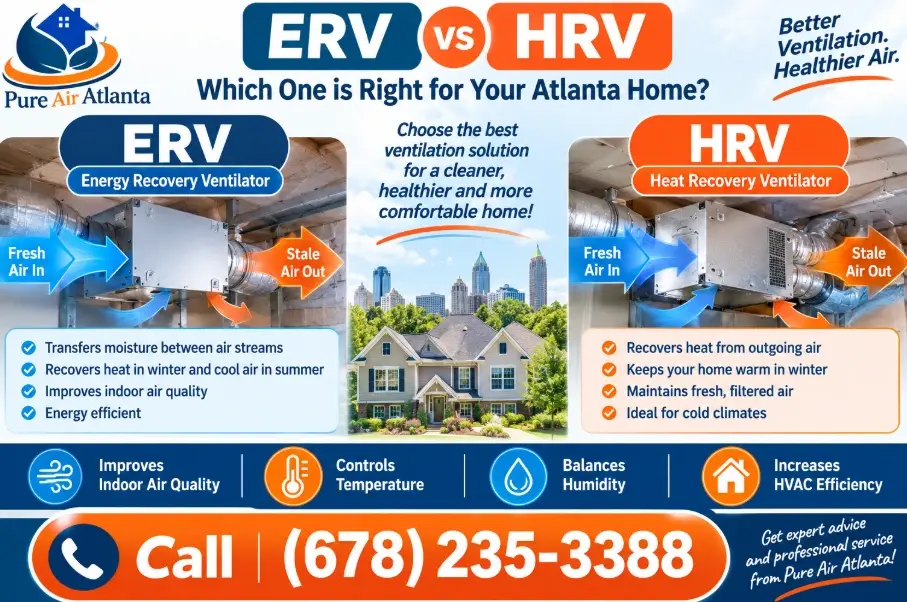
ERV vs HRV humid climate Atlanta: the short answer for Atlanta homes
In a humid climate like Georgia’s, an ERV is usually the better choice. Both machines swap stale indoor air for fresh outdoor air and recover heat on the way. The difference is moisture: an ERV also slows down the water vapor that tries to ride in with the fresh air, while an HRV lets it straight through. In an Atlanta summer, that moisture is the part your air conditioner struggles with most. If you are ready to price one, see our ERV installation in Atlanta page.
If you searched for an ERV vs HRV humid climate comparison, you have probably noticed that most articles are written for Canada, the Pacific Northwest or “everywhere.” Atlanta is none of those. Our summers are long and sticky, our winters are short and cool, and a lot of the newer housing between Midtown and the Old Fourth Ward is built tight. That combination changes the answer, and this guide explains how.
What an ERV and an HRV actually do
Modern, tightly built homes do not leak enough air to stay fresh on their own. A balanced ventilator fixes that with two fans and a core. One fan pushes stale indoor air out, the other pulls fresh outdoor air in, and the two airstreams pass through the core without mixing. The core hands energy from one stream to the other so you do not throw away all the heating or cooling you paid for. The U.S. Department of Energy describes both machine types this way in its overview of HVAC energy recovery ventilation.
HRV: heat only
A heat recovery ventilator transfers temperature between the airstreams. It does not transfer moisture, so humid air stays humid when it comes in.
ERV: heat and moisture
An energy recovery ventilator transfers heat and a controlled amount of water vapor. That limits how much humidity the fresh air adds in summer.
Why humid climates need moisture transfer
Cooling air and drying air are two different jobs. Your air conditioner handles both, but when outdoor air is muggy, drying it takes most of the work. Bring in a steady stream of unconditioned humid air through an HRV and the AC has to remove that extra moisture on top of everything else. An ERV passes part of that moisture back outside before it ever reaches the evaporator coil.
Atlanta falls in what the Department of Energy’s Building America program calls the mixed-humid region (see its building science climate maps). That means we get hot, wet summers and a real heating season. Both seasons matter, and an ERV helps in each:
- Summer: it reduces the humid-air load that fresh ventilation puts on your cooling system.
- Winter: it keeps some of the indoor moisture that would otherwise leave with the exhaust, which helps with dry, scratchy winter air in a sealed house.
- Shoulder seasons: spring and fall in Atlanta still bring damp days when the AC barely runs, which is when humidity creeps up unnoticed.
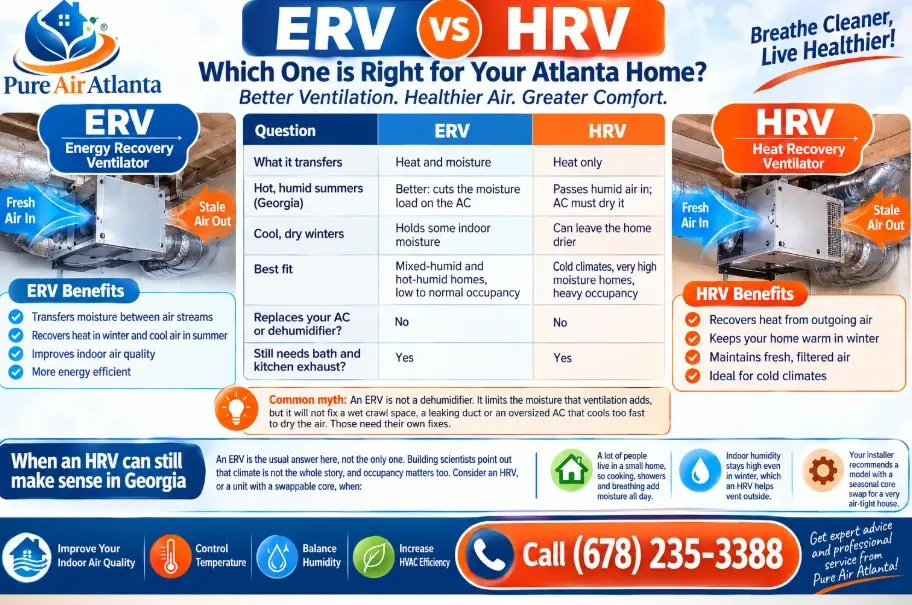
The ERV vs HRV humid climate comparison at a glance
| Question | ERV | HRV |
|---|---|---|
| What it transfers | Heat and moisture | Heat only |
| Hot, humid summers (Georgia) | Better: cuts the moisture load on the AC | Passes humid air in; AC must dry it |
| Cool, dry winters | Holds some indoor moisture | Can leave the home drier |
| Best fit | Mixed-humid and hot-humid homes, low to normal occupancy | Cold climates, very high moisture homes, heavy occupancy |
| Replaces your AC or dehumidifier? | No | No |
| Still needs bath and kitchen exhaust? | Yes | Yes |
Common myth: an ERV is not a dehumidifier. It limits the moisture that ventilation adds, but it will not fix a wet crawl space, a leaking duct or an oversized AC that cools too fast to dry the air. Those need their own fixes.
When an HRV can still make sense in Georgia
An ERV is the usual answer here, not the only one. Building scientists point out that climate is not the whole story, and occupancy matters too. Consider an HRV, or a unit with a swappable core, when:
- A lot of people live in a small home, so cooking, showers and breathing add moisture all day.
- Indoor humidity stays high even in winter, which an HRV helps vent outside.
- Your installer recommends a model with a seasonal core swap for a very airtight house.
The opposite case is common too. A small, airtight home with two people can feel too damp with the wrong setup, and an ERV helps there. This is why a short site visit beats a rule of thumb.
What the research says about ventilation in Southeastern homes
The Department of Energy summarized a Florida Solar Energy Center study of 51 recently built homes in Florida, Georgia and South Carolina. Homes with properly operating whole-house ventilation had measurably lower pollutant levels, including about 30% less carbon dioxide and 7% less formaldehyde. The same study found that most of the homes did not meet the ASHRAE 62.2 ventilation standard, and that homes with ERVs or ventilating dehumidifiers were more often compliant. You can read the details in DOE’s summary of the Southeastern homes ventilation study.
The takeaway is simple. A ventilator only helps if it is sized correctly, installed correctly and actually turned on. The EPA also notes that ventilation dilutes indoor pollutants, and that controlling the source is usually the most effective step; see its guide to improving indoor air quality.
Which Atlanta homes benefit most from an ERV
Newer and renovated tight homes
New townhomes, infill houses and gut renovations leak very little air. If you live in one of the newer buildings around HVAC service in Old Fourth Ward or West Midtown HVAC services, ventilation is often the missing piece and an ERV is a natural match.
Condos and lofts
High-rise and loft living limits open-window airflow. In Midtown HVAC services territory, a small ducted ERV (where the building allows it) keeps fresh air coming in without a humid surprise.
Older bungalows with leaky envelopes
Homes in places like Virginia-Highland HVAC services already trade a lot of air through gaps. The ERV payoff is smaller there, and sealing leaky ducts or fixing moisture sources often comes first. See our duct sealing in Atlanta service before you add ventilation.
Not sure where your home fits? Browse our Atlanta neighborhoods HVAC hub to find your area.
Signs you may need whole-house ventilation
- The air feels stuffy or smells stale even after you clean.
- Windows fog or you see condensation on cold surfaces.
- A musty smell comes from the vents; our guide to a musty smell from AC vents covers the likely causes.
- Mold is showing up in corners or inside ductwork, which our post on mold in air ducts in Atlanta explains.
- Your home is new or recently sealed and nobody has checked its ventilation.
Ventilation brings in fresh air, but it does not clean dirty ducts. If your system is dusty, start with our overview of how HVAC cleaning improves indoor air quality in Atlanta, and consider air purification in Atlanta if allergies are a concern.
What to ask before you buy or install
- Does the home need it? A load and leakage check beats guessing.
- Is it sized for the house? Too big wastes energy and too small under-ventilates.
- Where will it connect? Ducting design decides how well it works. Dedicated supply and exhaust, or a tie into your existing ductwork, each have trade-offs.
- How will you maintain it? Filters need regular attention and the core needs periodic cleaning. Your installer should show you how.
- Do you need a permit? Rules vary by project. The City of Atlanta’s Office of Buildings and its online permitting pages are the official place to confirm permit requirements for your address.
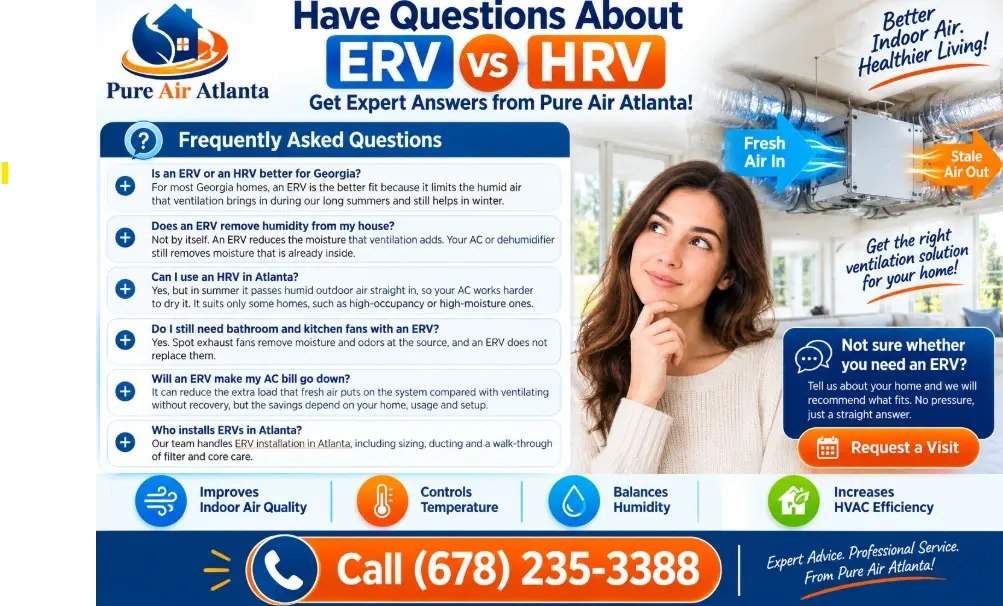
Frequently asked questions
Is an ERV or an HRV better for Georgia?
For most Georgia homes, an ERV is the better fit because it limits the humid air that ventilation brings in during our long summers and still helps in winter. An HRV can work for crowded homes or very damp ones, so confirm with a site visit.
Does an ERV remove humidity from my house?
Not by itself. An ERV reduces the moisture that ventilation adds. Your air conditioner or a dehumidifier still removes moisture that is already inside.
Can I use an HRV in Atlanta?
Yes, but in summer it passes humid outdoor air straight in, so your AC works harder to dry it. It suits only some homes, such as high-occupancy or high-moisture ones.
Do I still need bathroom and kitchen fans with an ERV?
Yes. Spot exhaust fans remove moisture and odors at the source, and an ERV does not replace them.
Will an ERV make my AC bill go down?
It can reduce the extra load that fresh air puts on the system compared with ventilating without recovery, but the savings depend on your home, usage and setup. Anyone quoting a fixed number without seeing your house is guessing.
Who installs ERVs in Atlanta?
Our team handles ERV installation in Atlanta, including sizing, ducting and a walk-through of filter and core care.
Not sure whether you need an ERV?
Tell us about your home and we will recommend what fits. No pressure, just a straight answer.
Call (678) 235-3388 Request a visitBottom line
For an ERV vs HRV humid climate decision in Atlanta, start with an ERV unless your home has unusually high moisture or occupancy. Make sure the unit is sized right, ducted well and maintained, and fix leaks and moisture sources first. If you have questions about pricing, check our HVAC pricing page or our frequently asked questions.
Sources
- U.S. Department of Energy: HVAC Energy Recovery Ventilation
- U.S. Department of Energy: Ventilation and Indoor Air Quality in Recently Constructed U.S. Homes
- U.S. Department of Energy: Building Science-Based Climate Maps
- U.S. EPA: Improving Indoor Air Quality
- City of Atlanta: Office of Buildings and Online Permitting
General information, not a site-specific design. Verify local permit and code requirements before any installation.
HVAC Service Area — ZIP Code Directory
92 ZIP codes served · Tap any ZIP to call +1 (678) 235-3388 · pureairatlanta.com