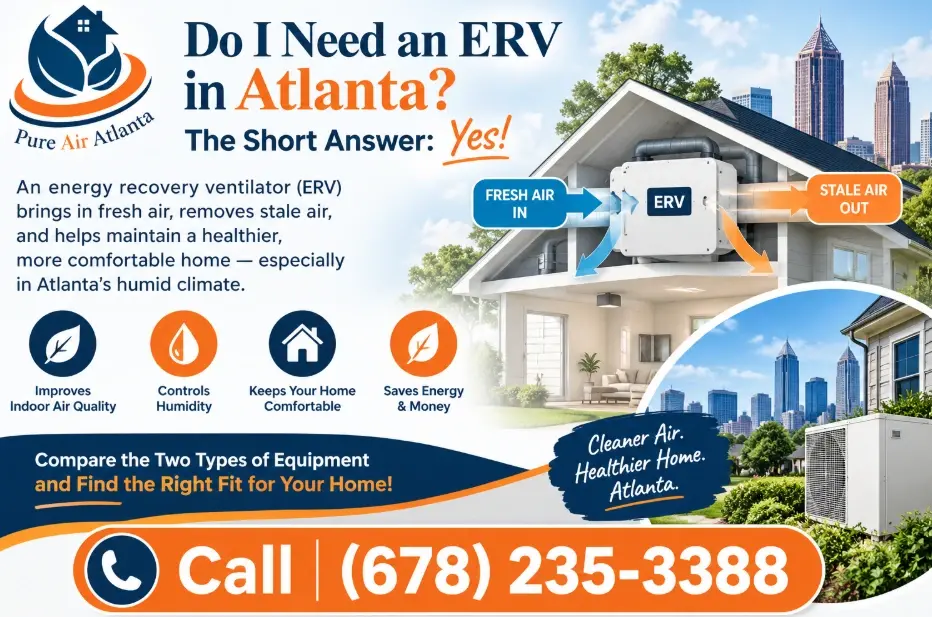



Window AC Size BTU Atlanta: The Short Answer for Local Homes
Choosing the right window AC size BTU Atlanta homeowners need is the single decision that decides whether your room feels cool and dry, or cold and clammy. In Atlanta, where summer days stack heat on top of heavy humidity, the wrong size is a bigger problem than it would be in a dry climate. A unit that is too small runs all afternoon and never catches up. A unit that is too big cools the air so fast that it shuts off before it has pulled the moisture out.
Quick answer: For window AC size BTU Atlanta rooms, measure the room in square feet, match it to the BTU chart below (for example, 250 to 300 sq ft needs about 7,000 BTU and 400 to 450 sq ft needs about 10,000 BTU), then adjust up or down for sun, people, and kitchen heat. If the room is more than 700 sq ft, or the same room is hot every summer, a single window unit is usually the wrong tool.
Want a pro to size it for you? Call us for a fast, honest answer.
📞 Call 678-235-3388 Request a Free QuoteWindow AC Size BTU Atlanta Chart by Room Size
BTU stands for British Thermal Unit. For an air conditioner, it is the amount of heat the unit can remove from a room in one hour. More BTUs means more cooling capacity. The chart below follows the room-size bands published by ENERGY STAR guidance on room air conditioners, which assume a standard 8-foot ceiling.
| Room size (sq ft) | BTU per hour needed |
|---|---|
| 100 to 150 | 5,000 |
| 150 to 250 | 6,000 |
| 250 to 300 | 7,000 |
| 300 to 350 | 8,000 |
| 350 to 400 | 9,000 |
| 400 to 450 | 10,000 |
| 450 to 550 | 12,000 |
| 550 to 700 | 14,000 |
| 700 to 1,000 | 18,000 |
Not sure of your square footage? Multiply the room length by the width, both in feet. A bedroom that measures 14 by 16 feet is 224 square feet, which lands in the 6,000 BTU band. Keep in mind that the chart is a starting point. It does not know whether your room faces west, sits under an attic, or has a TV and two desktop computers running all day. That is what the next sections cover.
Free Window AC BTU Calculator
Enter your room details and the calculator applies the same chart and the same adjustments explained below.
Window AC BTU Calculator
Got your number? We can install it, or tell you if a different system fits better.
📞 Call 678-235-3388 Book Window AC InstallationAdjustments That Matter for Atlanta Rooms
Getting the window AC size BTU Atlanta rooms need right means more than reading a chart. Once you have the base number, adjust it for the conditions inside the room. ENERGY STAR recommends these corrections:
- Very sunny room: increase capacity by about 10 percent.
- Heavily shaded room: decrease capacity by about 10 percent.
- More than two regular occupants: add about 600 BTU for each extra person.
- Kitchen use: add about 4,000 BTU for the heat from the stove, oven, and appliances.
Upstairs and attic rooms
Heat collects under the roof, so a second-floor bedroom often feels like it needs a bigger unit than the chart suggests. Treat it as a very sunny room.
West-facing rooms
Afternoon sun in an Atlanta summer is intense. Add the 10 percent sun adjustment and close blinds before 2 PM.
Older homes and condos
Older houses in neighborhoods like Virginia-Highland and Inman Park often have leaky windows, thin insulation, and no ducts in some rooms, which raises the real cooling load.
Home offices and media rooms
Computers, monitors, and TVs all add heat. Keep lamps and TVs away from the thermostat sensor so the unit does not misread the room.
Why Oversizing Hurts in Humid Georgia Weather
Many people assume that more BTUs is always better. In a humid climate, it is not. An oversized unit drops the air temperature quickly, reaches the thermostat setting, and shuts off. That short cycle does not give the coil enough time to condense moisture out of the air. ENERGY STAR notes that an oversized unit cools the room before it removes humidity, which can leave the space feeling damp and clammy. The U.S. Department of Energy makes the same point in its guide to purchasing energy-efficient room air conditioners: oversized units cost more to buy, use more energy, and remove humidity poorly.
Moisture is not just a comfort issue. The EPA recommends keeping indoor relative humidity below 60 percent, ideally between 30 and 50 percent, to limit mold growth (see the EPA guidance on mold and moisture control). A bedroom that stays damp can develop musty smells, and the same moisture can show up elsewhere in the house. If you already notice odors, read our guide on the musty smell from AC vents and our explanation of mold in air ducts in Atlanta.
Atlanta tip: On muggy days, run the window unit on a low fan speed. Slower airflow gives the coil more contact time with the air, so more moisture comes out. Use a small separate fan to move the cooled air around the room.
Whole-home humidity is a bigger topic than one room. If you are weighing fresh-air ventilation for a tight, humid house, our comparison of ERV vs HRV in Atlanta’s humid climate explains which system handles moisture better.
How to Find Your Window AC Size BTU Atlanta Homes Need in 5 Steps
- Measure the room. Multiply length by width in feet. For an irregular room, split it into rectangles and add them.
- Find the base BTU. Match your square footage to the chart above.
- Adjust for sun. Add 10 percent for very sunny rooms, subtract 10 percent for shaded rooms.
- Adjust for people and heat sources. Add 600 BTU for each person beyond two, and 4,000 BTU for a kitchen.
- Pick the closest available size. Window units come in steps such as 5,000, 6,000, 8,000, 10,000, 12,000, and 14,000 BTU. Choose the nearest one rather than jumping two sizes up.
For example, a 300-square-foot, west-facing living room with three regular occupants has a base of about 8,000 BTU. Add 10 percent for sun (about 800 BTU) and 600 BTU for the extra person, and you land near 9,400 BTU. A 10,000 BTU unit is the right fit.
Window Type, Power, and Installation Checks
Window AC size BTU Atlanta shoppers compare is only half of the decision. Before you buy, confirm the unit will physically and electrically work in your space:
- Window style. Most standard units are built for double-hung windows that open vertically. Casement windows and horizontal sliders often need a special model or a different solution.
- Electrical circuit. Smaller units run on a standard 115-volt outlet. Larger units can need a dedicated circuit or a 230-volt outlet. Check the nameplate and have an electrician confirm before you buy.
- Seal and level. Use the included insulation panels and foam. ENERGY STAR notes that a poorly sealed unit can leak air like a hole several inches wide, and a unit that is not level may not drain correctly.
- Efficiency rating. Look for the ENERGY STAR label, and use the ENERGY STAR Rebate Finder to check for utility offers in your ZIP code.
- Building rules. Condos, apartments, and HOA communities can restrict what hangs out of a window. Permanent work, such as new wall sleeves or electrical changes, may require a permit. The City of Atlanta publishes details on online permitting through the Department of City Planning.
If you would rather not lift, level, and seal the unit yourself, our team handles window AC installation in Atlanta, including the sizing check, secure mounting, and a drainage test.
When a Window AC Is the Wrong Answer
A window unit is a good, affordable fix for one bedroom or a small apartment. It is a poor fit in these situations:
- The room is over roughly 700 square feet. You would need an 18,000 BTU unit or more, and cooling will still be uneven.
- The same rooms are hot every summer. That points to a duct, insulation, or equipment problem, not a missing window unit.
- You want quiet, year-round comfort. Window units are loud, block the view, and only cool.
- You are cooling an addition, sunroom, or garage conversion. These spaces often have no ductwork and a high heat load.
For chronic hot rooms, a ductless system is usually the better long-term answer. It cools and heats, runs quietly, controls humidity more steadily, and does not occupy a window. See what to budget in our breakdown of ductless mini split installation cost in Atlanta. If you already have one that is struggling, these guides cover why a mini split is not cooling and our mini split repair service.
If your central system is the real issue, start with the basics. A rooftop or ducted system that cannot keep up may need an AC repair visit in Atlanta, a tune-up through our AC maintenance service, or in older systems a full AC replacement. A clogged condensate line can also cause water problems, which our AC drain line cleaning service addresses, and dirty coils reduce cooling, which is where air conditioning cleaning helps.
Room hot every summer? Let us look at a ductless mini split for it.
📞 Call 678-235-3388 See Mini Split CostsQuick comparison: window AC vs mini split
| Factor | Window AC | Ductless mini split |
|---|---|---|
| Best for | One small room, short term | Chronic hot rooms, additions, long term |
| Upfront cost | Low | Higher, professionally installed |
| Humidity control | Cycles on and off | Steadier, inverter driven |
| Noise | Louder | Quiet indoors |
| Heating | Cooling only | Cooling and heating |
| Blocks a window | Yes | No |
Planning for winter as well? Our comparison of a heat pump vs furnace in Atlanta will help you choose a system that covers both seasons.
Prepare Your Atlanta Home Before the Heat Peaks
Sizing is easier when the room is already working with you instead of against you. Before you plug in a new unit, take these steps:
- Seal gaps around the window frame and any nearby doors.
- Close blinds or hang reflective shades on sun-facing glass.
- Check the forecast. The National Weather Service Atlanta forecast office posts heat advisories so you can prepare before a heat wave.
- Clean or replace the filter at the start of the season and every few weeks while it runs.
- Remove the unit or cover it from the outside in winter to stop drafts.
Cooling needs vary a lot across the metro area. If you want a pro to look at your specific home, see our Atlanta neighborhoods and service locations pages, or check typical rates on our pricing page.
Window AC Size BTU Atlanta: Frequently Asked Questions
What size window AC do I need for a 300 square foot room?
A 300 to 350 square foot room typically needs about 8,000 BTU, and a room right at 300 square feet can use 7,000 to 8,000 BTU depending on sun and occupants. Add about 10 percent for a very sunny room.
Is it better to get a bigger window AC for Atlanta humidity?
No. An oversized unit cools the air quickly and shuts off before it removes much moisture, which leaves the room feeling damp. Match the BTU to the room and use a low fan speed on muggy days.
How many BTU do I need per square foot?
A common rule of thumb is about 20 BTU per square foot, but the ENERGY STAR chart uses fixed bands by room size, so use the chart above and then adjust for sun, occupants, and kitchen heat.
What size window AC cools 500 square feet?
The 450 to 550 square foot band calls for about 12,000 BTU. Open floor plans and rooms with sun exposure may need more, and at that size consider whether a ductless system would cool the space more evenly.
Can a window AC cool more than one room?
Only if the rooms are open to each other and the unit is sized for the combined area. A unit in one bedroom will not cool a closed room down the hall.
Should I choose a window AC or a mini split in Atlanta?
A window AC suits one small room or a short-term fix. If a room is hot year after year, or you want heating and cooling with better humidity control, a ductless mini split is usually the better long-term choice.
Do I need a permit to install a window AC in Atlanta?
A standard window unit generally does not need one, but building rules, HOA rules, and any electrical changes can. Check with the City of Atlanta and your property manager before making permanent changes.
Not Sure What Your Rooms Really Need?
Our NADCA-certified team can check your cooling load, airflow, and humidity, then tell you honestly whether a window AC, a mini split, or a repair is the right move. Have questions first? Browse our FAQ page.
📞 Call 678-235-3388 Request a Cooling Check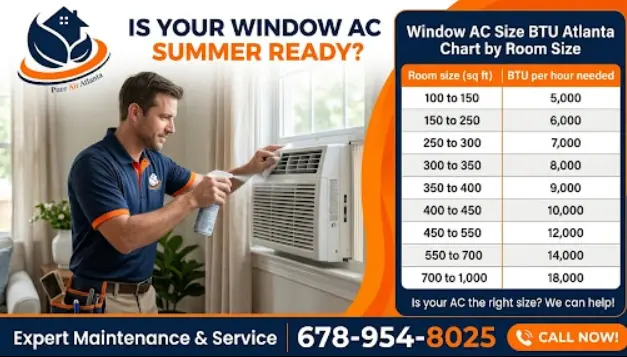
HVAC Service Area — ZIP Code Directory
92 ZIP codes served · Tap any ZIP to call +1 (678) 235-3388 · pureairatlanta.com