

Window Air Conditioner Rules Apartments Atlanta Renters Need to Know
The window air conditioner rules apartments Atlanta residents deal with come from three places at once: your lease, your building’s own rules, and Georgia and City of Atlanta law. Most renters only find out which one applies after a manager sends a violation notice. This guide sorts out who actually decides whether you can put a window unit in, what safety rules apply either way, and what to do if the answer is no.
Short answer:
- Georgia does not require landlords to provide air conditioning, and we found no state law that gives every renter the right to install a window unit.
- Your lease and building or HOA rules usually decide, so read them before you buy.
- If your rental came with AC, the landlord generally has to repair it. A broken built-in system is a different situation from wanting to add your own unit.
Call (678) 235-3388 Talk to an Atlanta AC Technician
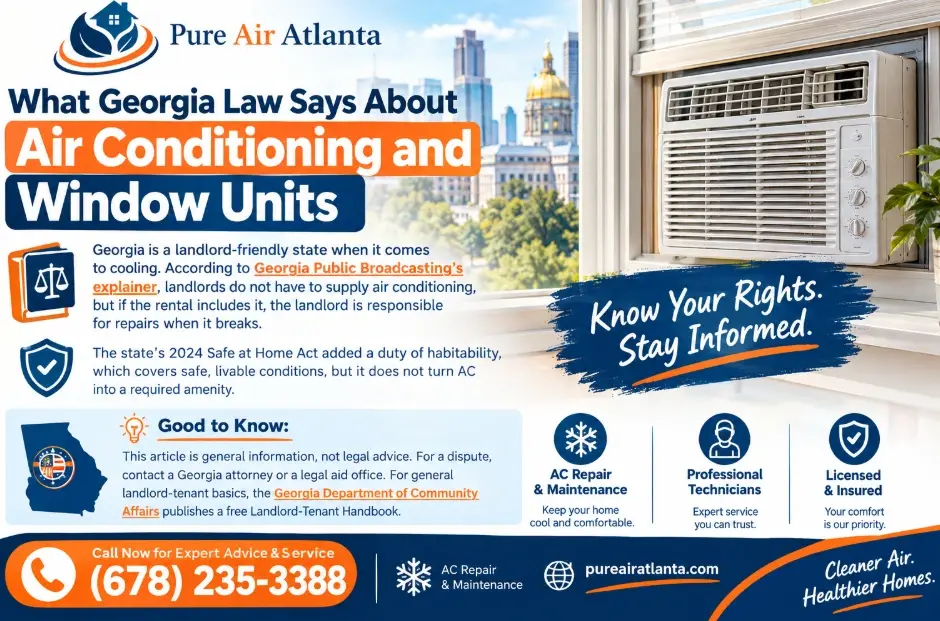
What Georgia Law Says About Air Conditioning and Window Units
Georgia is a landlord-friendly state when it comes to cooling. According to Georgia Public Broadcasting’s explainer, landlords do not have to supply air conditioning, but if the rental includes it, the landlord is responsible for repairs when it breaks. The state’s 2024 Safe at Home Act added a duty of habitability, which covers safe, livable conditions, but it does not turn AC into a required amenity.
Just as important for this topic, we did not find a Georgia statute that guarantees tenants the right to install their own window unit, and we did not find one that bans it either. That silence matters. It means your lease is the controlling document. If it says nothing about air conditioners, you still need written permission before you cut, drill or modify a window frame.
How to Check Your Lease for Window AC Rules
Before you spend money on a unit, scan your lease and any community rules addendum for these items. Managers often tuck AC language into sections about alterations, windows, balconies or “appliances.”
- Alterations clause: Does it forbid anything that is installed in or attached to a window or wall?
- Approved equipment: Some communities allow only portable floor units, or cap size at a set BTU rating.
- Exterior appearance: Rules about what can be visible from outside are common in newer mid-rise and high-rise buildings.
- Seasonal removal: Some properties require you to take the unit out when cooling season ends.
- Fees and deposits: Look for a window-unit fee or a damage charge for sills and frames.
- Insurance and liability: A unit that falls from an upper floor creates serious liability, so many managers require secure mounting.
If your building already has central air, a landlord is much more likely to ban window units. If the building has no central system, such as many older converted homes and walk-ups in neighborhoods like Old Fourth Ward and Virginia-Highland, window units are far more common and more often tolerated.
Condos, HOAs and Co-Ops: Who Decides?
Owners are not automatically free to install whatever they like. In a condo or HOA, the declaration, bylaws and rules and regulations control exterior changes, and a window unit counts as one. That matters in dense areas like Midtown and Downtown Atlanta, where associations often restrict anything visible on the facade. If you rent from an owner in an association, you are bound by both the lease and the association’s rules.
| Where you live | Who usually decides | What to check first |
|---|---|---|
| Apartment community | Property manager through the lease | Lease, rules addendum, alterations clause |
| Small landlord or house rental | Landlord through the lease | Written permission before installing |
| Condo you rent | Owner plus the association | Lease and association rules |
| Condo or HOA home you own | The association’s governing documents | Declaration, bylaws, architectural rules |
| Subsidized or housing-authority unit | The program’s own policy | Written air conditioner policy |
Disability-related cooling needs
If extreme heat is a medical risk for you, federal fair housing rules allow you to request a reasonable accommodation, such as permission for a unit a building would normally prohibit. Put the request in writing and attach a note from your doctor. A landlord can still propose an alternative that meets the need.
Safety Rules That Apply Even When a Window Unit Is Allowed
Permission is only half of it. A badly installed unit can drop out of a window, leak into the wall, or block your escape route. Follow these basics whether your building has written rules or not:
- Do not block an escape window. In a bedroom, the window you would use in a fire is the worst place for a permanent unit. Choose another window.
- Mount it securely. Use the brackets and side panels that come with the unit. On upper floors, ask the manager what support is required.
- Plug directly into the wall. Avoid extension cords and power strips for a high-draw appliance, and check that the circuit can carry the load.
- Keep it level. The ENERGY STAR room AC fact sheet notes that a level unit drains properly, and that a poor seal can leak as much air as a hole about six square inches in size.
- Handle the drip. Water should not run onto a neighbor’s balcony, a shared walkway or a wall.
- Size it correctly. The ENERGY STAR sizing guidance warns that an oversized unit cools quickly without removing enough humidity, which leaves a room feeling clammy. That is a real issue in Atlanta’s humid summers.
Window units also collect dust and moisture. If you notice a sour or earthy odor, read our guide to the musty smell from AC vents and clean the filter and coils before the problem spreads.
How to Ask Your Landlord for Permission to Install a Window AC
A polite, documented request works better than installing first and explaining later. Follow these steps:
- Read the lease and rules. Know exactly which clause applies before you write.
- Send the request in writing. Email or the resident portal creates a record. Include the unit’s BTU rating, size and where it will go.
- Offer safety details. Mention that you will use the supplied mounting kit, avoid your escape window, and plug into a wall outlet.
- Ask for the answer in writing. A verbal “fine” is hard to prove later.
- Offer a fix for common objections. Propose professional installation, a drip tray or seasonal removal.
- Keep copies. Save photos of the window before and after installation to protect your deposit.
If the cooling system that came with your unit is the problem, document it too. Send repair requests in writing and keep dates. For housing-code problems inside city limits, the City of Atlanta’s Housing Code Enforcement Division inspects residential structures and issues notices of non-compliance, as described on the City of Atlanta FAQ page. You can also use the Department of City Planning’s report a code violation page, or dial 311 from within the city.
If the Answer Is No: Better Options Than a Window Unit
When a building bans window units, you still have choices:
- Portable AC: It sits on the floor and vents through a window kit, so some buildings that ban window units allow it. It is usually less efficient.
- Built-in through-wall or PTAC units: If your building has them, a technician can fix performance problems. See our PTAC unit repair in Atlanta page and the PTAC not cooling troubleshooting guide.
- Ductless mini split: Common in homes and small commercial spaces with no ductwork. Review the ductless mini split installation cost in Atlanta before you ask an owner or association.
- Replacing an aging central system: If you own the home, our AC replacement service in Atlanta covers properly sized whole-home options.
When to Call a Professional
A basic window unit is a do-it-yourself job, but call a licensed technician if you see any of these signs:
- The unit trips a breaker or the outlet feels hot.
- Water leaks inside the wall or the sill is rotting.
- The unit runs constantly and the room never cools.
- You want a permanent installation or a through-wall sleeve.
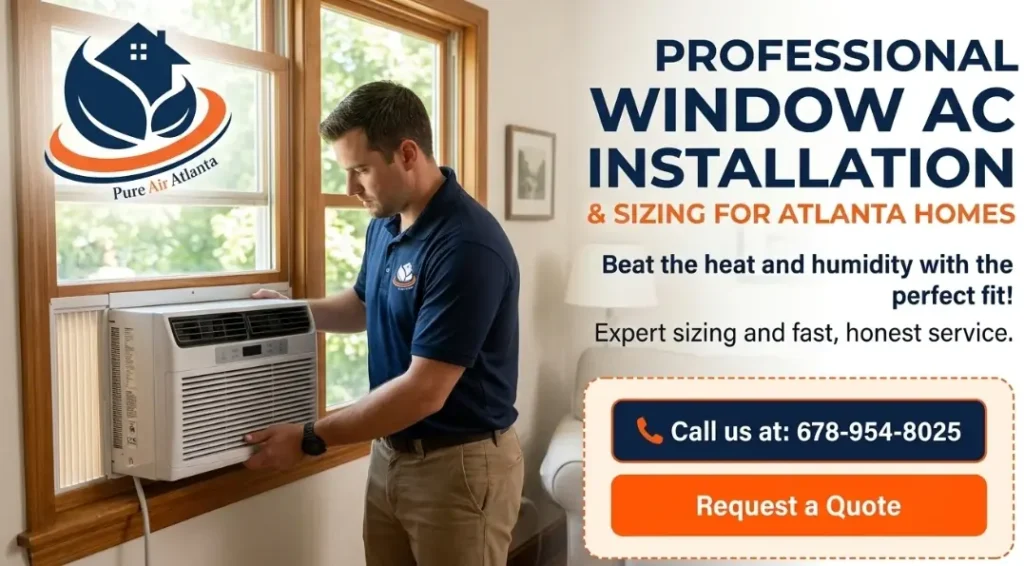
Pure Air Atlanta handles window AC installation in Atlanta, along with AC repair and mini split repair. If your cooling fails in a heat wave, see our emergency AC repair in Atlanta, GA. To know what to budget, check our AC repair cost guide for Atlanta or the pricing page.
Not sure what your building allows, or need a unit installed safely?
Call (678) 235-3388 Book Window AC Help TodayWindow Air Conditioner Rules in Atlanta: Frequently Asked Questions
Can my landlord ban window air conditioners in Atlanta?
In most cases, yes, if the lease or building rules prohibit it. We found no Georgia statute that gives renters a general right to install one, so the lease usually controls. Disability-related requests are handled separately as reasonable accommodations.
Does my Atlanta landlord have to provide air conditioning?
No. Georgia law does not require landlords to provide AC. If the rental came with it, the landlord is generally responsible for repairing it.
Can an HOA stop me from installing a window AC?
Often, yes. Association rules commonly restrict exterior changes, including anything visible in a window. Review the declaration and rules before you buy a unit.
Who pays if my window AC damages the window?
Usually the tenant, because damage from an installation is typically charged against the deposit. Photograph the window before and after, and use the mounting hardware the manufacturer supplies.
What size window AC do I need?
A common rule is about 20 BTU per square foot of living space, adjusted up for sunny rooms and down for shaded ones. Do not oversize, since a unit that is too large cools fast but leaves the air damp.
Who do I contact about a housing code problem in Atlanta?
Use the City of Atlanta’s code violation reporting page or dial 311. Send your landlord a written repair request first and keep a copy.
Still have questions about cooling your Atlanta rental, condo or home? Call Pure Air Atlanta at (678) 235-3388 or contact our team. You can also browse the Pure Air Atlanta FAQ.
HVAC Service Area — ZIP Code Directory
92 ZIP codes served · Tap any ZIP to call +1 (678) 235-3388 · pureairatlanta.com