
PTAC not cooling: the 10-minute checklist for Atlanta property managers
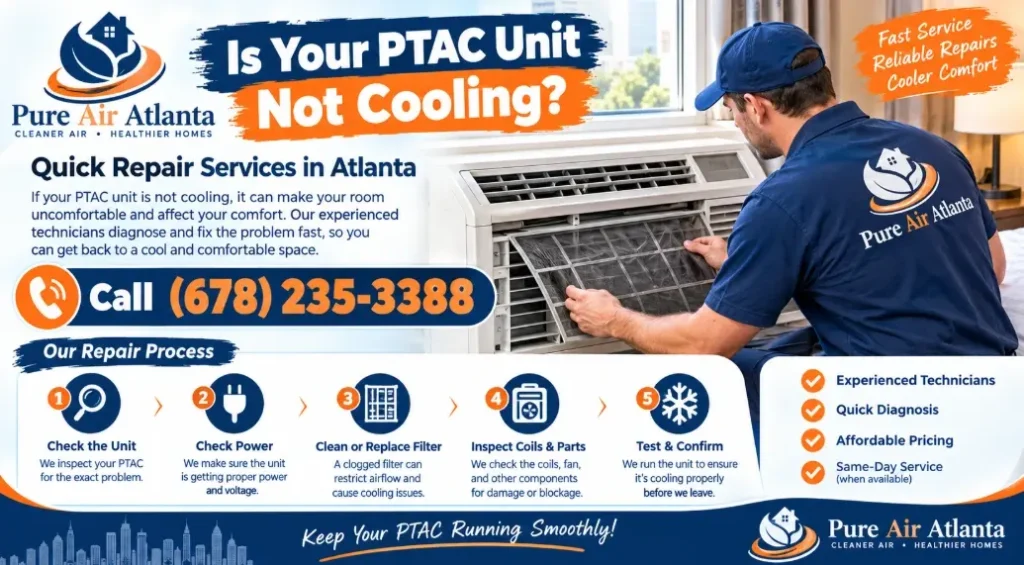
Most PTAC not cooling calls come from four simple causes: wrong thermostat mode, a clogged filter, a blocked indoor or outdoor airflow path, or dirty coils. Check those in that order and many rooms are back in service in minutes. If the unit still blows warm air, makes a loud compressor noise or ices up, stop and call a technician, because the next causes involve refrigerant and electrical parts. Our team handles PTAC unit repair in Atlanta for hotels, apartments and senior living.
A packaged terminal air conditioner (PTAC) is the through-the-wall unit you see under the window in hotel rooms and apartments. It cools and heats in one self-contained box, so when one fails the room is unusable. A PTAC not cooling is one of the most common complaints a property manager hears. Online guides are mostly written by equipment retailers and cover one model at a time. This guide is for the person who has to decide, room by room, what maintenance can fix and what needs a licensed technician in an Atlanta building.
Quick triage: what you see and what it usually means
| What you notice | Most likely cause | Who handles it |
|---|---|---|
| Fan runs, air is room temperature | Wrong mode or setpoint, clogged filter, dirty coils | Maintenance staff |
| Weak airflow from the front | Filter, blocked grille, dirty indoor coil | Maintenance staff |
| Cool at first, then warm | Frozen coil or short cycling from poor airflow | Staff first, then a technician |
| Water dripping inside | Clogged drain or condensate overflow, unit not level | Staff or technician |
| Loud hum, clicking or grinding at the compressor | Failing compressor, fan or capacitor | Technician |
| Runs but never cools, coil feels oily or iced | Low refrigerant or leak | Certified technician only |
| Dead display or no power | Breaker, plug, control board or thermostat | Technician |
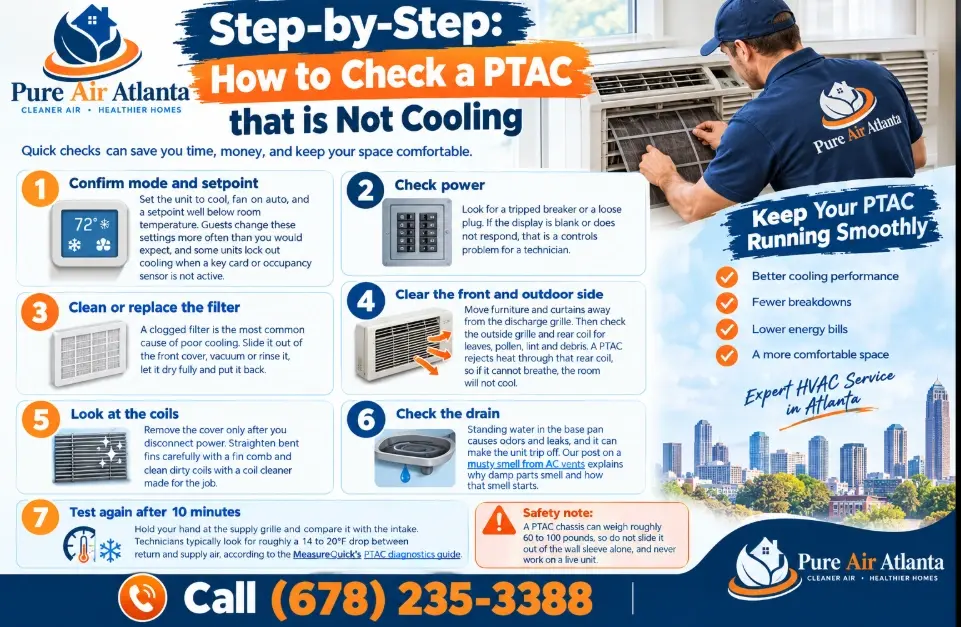
Step-by-step: how to check a PTAC that is not cooling
- Confirm mode and setpoint. Set the unit to cool, fan on auto, and a setpoint well below room temperature. Guests change these settings more often than you would expect, and some units lock out cooling when a key card or occupancy sensor is not active.
- Check power. Look for a tripped breaker or a loose plug. If the display is blank or does not respond, that is a controls problem for a technician.
- Clean or replace the filter. A clogged filter is the most common cause of poor cooling. Slide it out of the front cover, vacuum or rinse it, let it dry fully and put it back.
- Clear the front and the outdoor side. Move furniture and curtains away from the discharge grille. Then check the outside grille and rear coil for leaves, pollen, lint and debris. A PTAC rejects heat through that rear coil, so if it cannot breathe, the room will not cool.
- Look at the coils with the power off. Remove the cover only after you disconnect power. Straighten bent fins carefully with a fin comb and clean dirty coils with a coil cleaner made for the job.
- Check the drain. Standing water in the base pan causes odors and leaks, and it can make the unit trip off. Our post on a musty smell from AC vents explains why damp parts smell and how that smell starts.
- Test again after 10 minutes. Hold your hand at the supply grille and compare it with the intake. Technicians typically look for roughly a 14 to 20°F drop between return and supply air, according to MeasureQuick’s PTAC diagnostics guide. If you do not see a clear difference, move on to the section below.
Safety note: a PTAC chassis can weigh roughly 60 to 100 pounds, so do not slide it out of the wall sleeve alone, and never work on a live unit.
PTAC blowing warm air or not blowing cold air
If the fan runs but the air is warm, the compressor or refrigerant circuit is likely not doing its job. Common reasons are dirty coils that stop heat transfer, a failed compressor start component, a stuck reversing valve on heat pump models, or low refrigerant from a leak. A leak is not fixed by adding refrigerant. The leak has to be found and repaired. Federal law also prohibits intentionally venting refrigerant while servicing equipment, as the EPA explains on its Section 608 refrigerant management page, so recharging is a job for a qualified technician. See the cost and process side in our freon recharge in Atlanta service.
PTAC leaking water inside the room
Water that drips into the room usually means the drain path is blocked, the base pan is overflowing, or the unit is not pitched slightly toward the outside. Humid Atlanta summers make this common because a PTAC removes a lot of moisture from the air. Check the pan, clear the drain slots and confirm the unit is level. If water stains appear on the wall or the carpet stays wet, have it inspected before mold takes hold; see our guide to mold in air ducts in Atlanta for what moisture can lead to.
PTAC not heating in winter
Atlanta winters are short, but they arrive suddenly, and the first cold night is when rooms go without heat. A PTAC heats either with electric resistance strips or by running the heat pump in reverse. If there is no heat, check mode and setpoint, the filter and the airflow first. A failed heat strip, safety limit switch or reversing valve is a technician repair. Test a few rooms each fall before the first cold snap so problems show up before guests do.
Why PTACs struggle in Atlanta summers
A PTAC sits in an exterior wall, so it works against the hottest and most humid air on the property. Pollen, leaves and lint collect on the outdoor coil. Sun-facing rooms carry more heat load. Units that run nonstop through a long season wear out their fan motors, capacitors and compressors sooner. Buildings in places like Downtown Atlanta HVAC services territory and Midtown HVAC services territory often run hundreds of these units, which makes scheduled maintenance far cheaper than reacting to guest complaints.
When to call a technician for a PTAC not cooling
- A loud noise from the compressor while cooling.
- Ice on the coil after you have cleaned the filter and coils.
- Pressures or temperatures that point to low refrigerant or a leak.
- Repeated tripping of the breaker.
- A dead display, a failed fan motor or a suspected control board problem.
- The same room fails again within a short time after a “fix.”
For after-hours failures that cannot wait, see our emergency AC repair in Atlanta page, and for larger properties our commercial AC service in Atlanta overview.
Repair or replace: how to decide
- Age and history. A unit with repeated repairs in one season is telling you something.
- What failed. A cleaning, capacitor or fan motor is a normal repair. A failed compressor or a sealed-system leak often tips the decision toward replacement.
- How many rooms are affected. If many units of the same age fail, plan a phased replacement instead of paying for emergency calls.
- Sleeve and wall condition. Rust or damage at the sleeve can be fixed during a replacement.
If you plan a bigger change, some properties compare PTACs with ductless systems. Ask for a written estimate and check permit requirements with the City of Atlanta’s Office of Buildings and its online permitting pages before work starts.
A simple prevention routine
- Every month in cooling season: check or replace filters and look for water in the pan.
- Every season: clean the indoor and outdoor coils, check the sleeve seal and test cooling and heating in each room.
- Keep a log by room number so you can spot repeat failures and plan replacements.
- Standardize filters and parts so staff can swap them without waiting.
Need help setting up a schedule? Our HVAC cleaning in Atlanta service covers coil and component cleaning, and you can browse the Atlanta neighborhoods HVAC hub to see where we work.
Frequently asked questions
Why is my PTAC running but not cooling?
The most common reasons are a wrong mode or setpoint, a clogged filter, a blocked airflow path or dirty coils. If those are clear, low refrigerant, a failing compressor or a faulty capacitor is the next suspect, and that needs a technician.
Why is my PTAC blowing warm air?
Warm air from a running unit usually points to dirty coils, a compressor or capacitor problem, a reversing valve stuck in heat mode, or low refrigerant. Clean the filter and coils first, then call for service if it persists.
Why is my PTAC leaking water inside?
A blocked drain, an overflowing base pan or a unit that is not level are the usual causes. Humid weather makes it more noticeable. Clear the drain path and level the unit, and call a technician if it keeps leaking.
Can I add refrigerant to my PTAC myself?
No. Low refrigerant means a leak, which has to be found and repaired. Federal rules also restrict venting refrigerant during service, so recharging is a job for a qualified technician.
How often should PTAC filters be cleaned?
Many properties check them monthly during cooling season. Rooms with pets, smoking or heavy use may need it more often.
Do you repair PTAC units in Atlanta?
Yes. See our PTAC unit repair in Atlanta page, or call (678) 235-3388.
Rooms down? Get a PTAC technician on the schedule
Tell us how many units and what symptoms you see, and we will plan the fastest fix.
Call (678) 235-3388 Request serviceBottom line
When a PTAC is not cooling, check mode, power, the filter, the airflow on both sides and the coils before assuming a major failure. Leave refrigerant, compressors and controls to a technician. A short monthly routine prevents most no-cool complaints. For pricing questions see our HVAC pricing page or our frequently asked questions.
Sources
- MeasureQuick: PTAC Diagnostics
- HVAC.com: Amana PTAC troubleshooting
- U.S. EPA: Section 608 refrigerant management
- City of Atlanta: Office of Buildings and Online Permitting
General information, not a site-specific diagnosis. Always disconnect power before opening a unit and follow the manufacturer’s manual.
HVAC Service Area — ZIP Code Directory
92 ZIP codes served · Tap any ZIP to call +1 (678) 235-3388 · pureairatlanta.com