Walk In Cooler Temperature Georgia Requires: The 41°F Rule
The short answer for Georgia kitchens
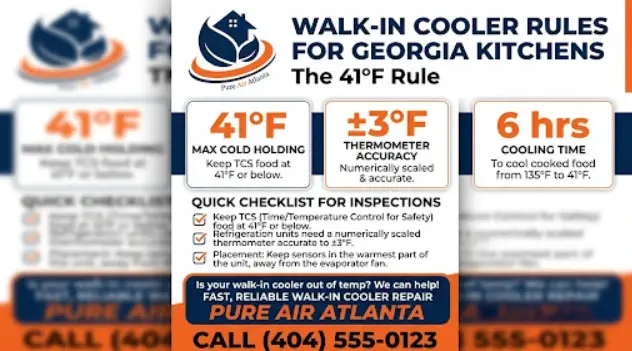
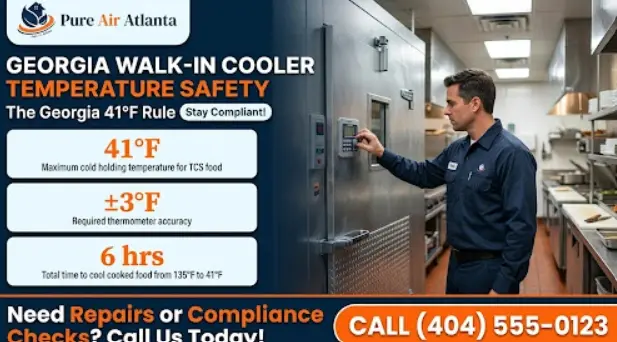
- Your walk-in must keep time/temperature control for safety (TCS) food at 41°F or below.
- Every refrigeration unit needs a numerically scaled thermometer accurate to ±3°F.
- The sensor belongs in the warmest part of the unit, not beside the evaporator fan.
- If product is above 41°F, fix the cause the same day. Walk-in cooler repair in Atlanta is one call away at (678) 235-3388.
Call (678) 235-3388Walk-In Cooler Repair
Walk in cooler temperature Georgia rules come from one place: the Georgia Department of Public Health (DPH) Food Service Rules, Chapter 511-6-1. DPH revised that chapter on February 12, 2025 to adopt the 2022 FDA Food Code, so the standard your inspector uses today is current and nationally aligned. What makes Georgia kitchens different is not the rule. It is the climate your cooler has to fight to meet it.
This guide explains the exact numbers, where the thermometer goes, what an inspector actually writes down, and what to do when your cooler fails a reading. It is written for Atlanta restaurant owners, caterers, church kitchens, school cafeterias and anyone holding a Georgia food service permit.
What Georgia Cold Holding 41 Degrees Actually Means
Georgia cold holding 41 degrees applies to food, not to the air setting on your controller. DPH’s food service design guidance for maintaining product temperature states that refrigerators must be capable of keeping TCS food at 41°F or below. TCS food is anything that supports fast bacterial growth: cut leafy greens, cooked rice and pasta, sliced melon, dairy, eggs, raw and cooked meat, poultry, fish and sauces.
| Requirement | What Georgia DPH says | What it means in your kitchen |
|---|---|---|
| Cold holding limit | Refrigerators must maintain TCS food at 41°F or below | Product probe readings, not just the wall display, must stay at or under 41°F |
| Thermometer type | Numerically scaled indicating thermometer, accurate to ±3°F | A dial or digital readout with real degree markings. A dial with only “cold” and “colder” fails |
| Thermometer placement | Measure air temperature in the warmest part of the unit | Usually near the door, away from the coil. Not in front of the cold air stream |
| Cooling cooked food | 135°F to 70°F within 2 hours, then to 41°F within 6 hours total | Use shallow pans and an ice bath. A loaded walk-in is not a blast chiller |
You can read the full rule text yourself on the Georgia Rules and Regulations page for Chapter 511-6-1, and DPH’s temperature guidance in its facilities maintain product temperature document. Bookmark both. When an inspector cites a violation, this is the language behind it.
Restaurant Refrigerator Thermometer Requirement Georgia Inspectors Check
The restaurant refrigerator thermometer requirement Georgia enforces has three parts, and kitchens fail on each one for different reasons.
1. It must be numerically scaled
The thermometer must show actual degrees. Cheap stick-on strips with color bands and unmarked dials do not satisfy the rule.
2. It must be accurate to within 3°F
A thermometer that reads 38°F while the box is really 44°F is worse than no thermometer, because it gives you false confidence. A simple, common check is to calibrate against an ice-water slurry, which should read 32°F. Replace any unit that drifts past the 3°F tolerance.
3. It must sit in the warmest part of the unit
DPH says the sensor should measure air temperature in the warmest part of the refrigerator. In a walk-in, that is typically the area near the door opening or the farthest corner from the evaporator. Hanging it directly under the evaporator fan shows you the coldest air in the room and hides a warm door zone where your dairy actually sits.
Pro tip: Keep a second, calibrated probe thermometer in a cup of water on the top shelf nearest the door. Water holds temperature like food does, so it tells you what your product is really doing, not just how cold the air feels.
Not sure your thermometer is accurate or in the right spot? Call (678) 235-3388
Cooler vs Freezer: Setpoints That Keep You Under the Limit
Georgia’s written limit for refrigerated TCS food is 41°F. The limit says nothing about how to set your controller, and that is where practical experience matters. Door openings, loading and defrost cycles all push product temperature above the air setpoint. Running with margin is the only reliable way to stay compliant.
| Unit | Legal / safety limit | Typical air setpoint we recommend | Why the margin matters |
|---|---|---|---|
| Walk-in cooler | TCS food at 41°F or below | 35°F to 38°F | Door traffic and warm deliveries can lift food 3°F to 5°F above the air reading |
| Walk-in freezer | Frozen food must stay frozen solid | 0°F or lower | Defrost cycles and propped doors cause surface thaw and ice build-up |
| Reach-in and prep tables | TCS food at 41°F or below | 34°F to 38°F | Lids open constantly during service |
Setpoints are our field recommendation, not a Georgia rule. The only number the state sets for cold holding is the 41°F food limit, so build your margin below it.
How a Georgia Health Inspection Cooler Check Really Works
A Georgia health inspection cooler check is quick and physical. In Fulton County, Environmental Health Services permits and inspects more than 6,000 food service establishments, and temperature maintenance of foods is one of the core items on the list, according to the Fulton County Board of Health restaurant inspection page. Expect the inspector to:
- Read the thermometer in each cooler and check that it is numerically scaled and in a sensible spot.
- Probe real product, especially cut produce, dairy, cooked leftovers and raw proteins.
- Ask for your cooling method for anything made the day before.
- Look at the unit itself: gaskets, door closure, ice on coils and frost on shelving.
What a failed cooler looks like in real life
The Atlanta Journal-Constitution reported on a Cherokee County tavern whose coolers were running too warm. One unit measured 49°F in the air. Food ranged from the high 50s to the high 60s, and pork reached 68°F in a reach-in, far past the 41°F limit. The inspector also noted that queso made the day before had not cooled to 41°F within six hours and had to be discarded. The restaurant scored 61/U, down from 74/C, and faced a re-inspection. You can read the full story, coolers set too high at Ball Ground tavern, on AJC.
The lesson is that one warm cooler rarely stands alone. Warm units lead to warm product, to discarded food, to a low score and to a posted report that customers can read. Georgia requires the most current inspection report to be displayed in public view, within 15 feet of the main entrance. You can also look up any establishment through the Georgia statewide inspection search.
Cooling Cooked Food in a Walk-In Without Failing
Many temperature violations come from the food, not the cooler. DPH requires TCS food prepared a day or more ahead to be cooled from 135°F to 70°F within the first two hours and to 41°F within six hours total. Pushing a hot stockpot into a full walk-in does the opposite of cooling it. It warms every other item on the shelf.
- Divide soups, sauces and rice into shallow pans, about 2 inches deep.
- Use an ice bath or ice wand before the product goes on the shelf.
- Leave air gaps around pans so cold air circulates.
- Log the time and temperature at the 2-hour and 6-hour marks.
Why Atlanta Kitchens Run Above 41°F
Metro Atlanta is hard on refrigeration. Summer ambient temperatures regularly reach the 90s, and the back of a kitchen can run well above that. Humid air is the other problem: every time a door opens, moisture enters the box and freezes onto coils, which reduces airflow and raises box temperature. The most common causes we see are:
- Dirty or blocked condenser coils. A coil packed with grease and lint cannot reject heat in a hot kitchen.
- Worn door gaskets. Warm, humid air leaks in and feeds ice build-up.
- Propped or slow-closing doors. Delivery days are the worst.
- Overloaded shelving. Boxes against the evaporator block airflow.
- Failing components. Evaporator fans, defrost controls and compressors lose capacity before they fail outright.
Humidity is a theme across Georgia HVAC and refrigeration, and it is why our guide on ERV vs HRV for humid climates in Atlanta matters for buildings with heavy ventilation too. Keeping a kitchen’s make-up air, hood and refrigeration in balance reduces the load on your cooler.
Fix a Failed Cooler Reading: Six Steps
If your thermometer or an inspector shows product above 41°F, work through this order. Do not wait for the next inspection.
- Protect the food first. Probe the product. Anything TCS that has been above 41°F longer than your food safety plan allows must be discarded. Move the rest to working refrigeration.
- Confirm the reading. Check the thermometer in ice water. A bad sensor can cause a false alarm, or hide a real problem.
- Remove the easy causes. Close and latch the door, clear shelves away from the evaporator, remove ice blocking the door seal and stop loading hot food.
- Check the coils and fans. Look for a frozen evaporator, a stopped fan or a clogged condenser. Do not chip ice off coils with tools, because refrigerant lines puncture easily.
- Call a refrigeration technician. If the box does not recover within an hour or two of steps 1 to 4, book walk-in cooler repair in Atlanta and ask for a written service report.
- Document everything. Keep the temperature log, the discard record and the service invoice. They show a re-inspection officer that you found the problem and fixed it.
Cooler still above 41°F? Do not wait for the inspector. Our technicians can diagnose it fast.
When It Is a Repair Problem, Not a Setting
You can adjust a setpoint. You cannot adjust your way out of a failing system. Call a technician if you notice any of these:
- The box temperature climbs every afternoon and recovers at night.
- The compressor runs constantly but the box never reaches setpoint.
- Ice builds up on the door frame, floor or coil again within days of clearing it.
- You hear short cycling, humming without starting, or a fan that has stopped.
Our technicians also handle the equipment around your kitchen. If your dining room is warm too, see our commercial AC service in Atlanta page, and learn what to check when a rooftop unit is struggling in our guide to a package unit not cooling in Atlanta. A hot, poorly maintained mechanical room pushes your refrigeration condenser harder, so regular AC maintenance service in Atlanta helps your cooler as well. For a full list of what we cover, browse all Pure Air Atlanta services.
Call (678) 235-3388Book Walk-In Cooler Repair
Power Outages and the Two-Hour Rule
Georgia’s food service rules treat an interruption of electrical service of two or more hours as an emergency that may create an imminent health hazard (Rule 511-6-1-.03(2)(p)). Unless you are operating under an approved emergency operation plan or direction from the health authority, operations must stop and the health authority must be notified. Keep doors closed, record the time power failed and call your county environmental health office if the outage is long. Winter storms and summer grid events both put Atlanta kitchens in this position.
Georgia Walk-In Cooler Daily Checklist
- Record the cooler and freezer reading at opening and closing, and once mid-shift.
- Probe-check one high-risk product near the door and note the result.
- Confirm the door closes and latches on its own.
- Look for ice on coils, door frames and floors.
- Check that shelves leave space around the evaporator.
- Calibrate thermometers monthly in ice water.
- Schedule professional service at least twice a year and before summer.
Need a pre-inspection cooler check? Schedule service before your next Georgia health inspection.
Walk-In Cooler Temperature Georgia FAQ
What temperature must a walk-in cooler be in Georgia?
TCS food must be held at 41°F or below. Most operators set the air temperature between 35°F and 38°F so product stays safely under the limit when doors open.
Does Georgia require a thermometer in every cooler?
Yes. Georgia DPH requires numerically scaled indicating thermometers accurate to ±3°F in refrigeration units, placed to measure air temperature in the warmest part of the unit.
What happens if my cooler is too warm during an inspection?
The inspector can record a temperature violation, require TCS food above 41°F to be discarded, lower your score and schedule a follow-up inspection.
Who inspects Atlanta restaurants?
County environmental health offices carry out the inspections. In Fulton County that is the Board of Health’s Environmental Health Services. Contact your own county office for details, since DeKalb, Gwinnett and other counties run their own programs.
How fast should I fix a warm walk-in cooler?
Same day. Protect the food, remove easy causes and call a refrigeration technician if the box does not recover quickly. Contact Pure Air Atlanta or call (678) 235-3388.
Keep Your Walk-In Cooler Inspection Ready
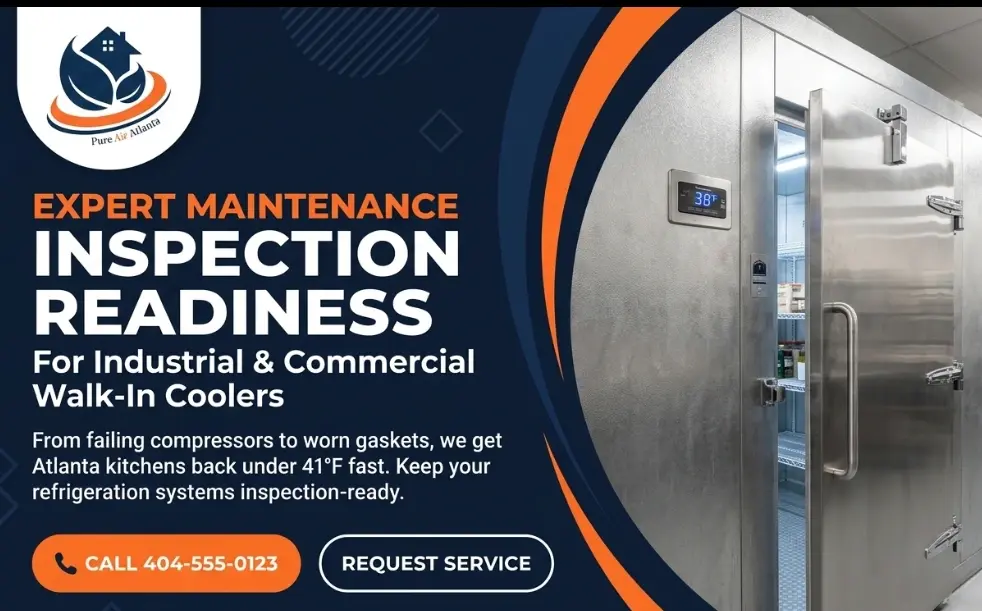
From failing compressors to worn gaskets, we get Atlanta kitchens back under 41°F fast. Ask about service in Midtown, Downtown, West Midtown and across Atlanta’s neighborhoods.
Call (678) 235-3388 Walk-In Cooler Repair Request Service See Pricing Tap to Call 678-235-3388Official Georgia and Atlanta Sources
- Georgia DPH Food Service program
- Georgia Rules and Regulations, Chapter 511-6-1 Food Service
- Georgia DPH: facilities maintain product temperature
- Fulton County Board of Health: restaurant inspection
- Georgia statewide food inspection search
Rules were reviewed in October 2026 and can change. Always confirm current requirements with your county environmental health office.
HVAC Service Area — ZIP Code Directory
92 ZIP codes served · Tap any ZIP to call +1 (678) 235-3388 · pureairatlanta.com