
Walk In Freezer Ice Buildup Atlanta: Why Our Humidity Makes It Worse
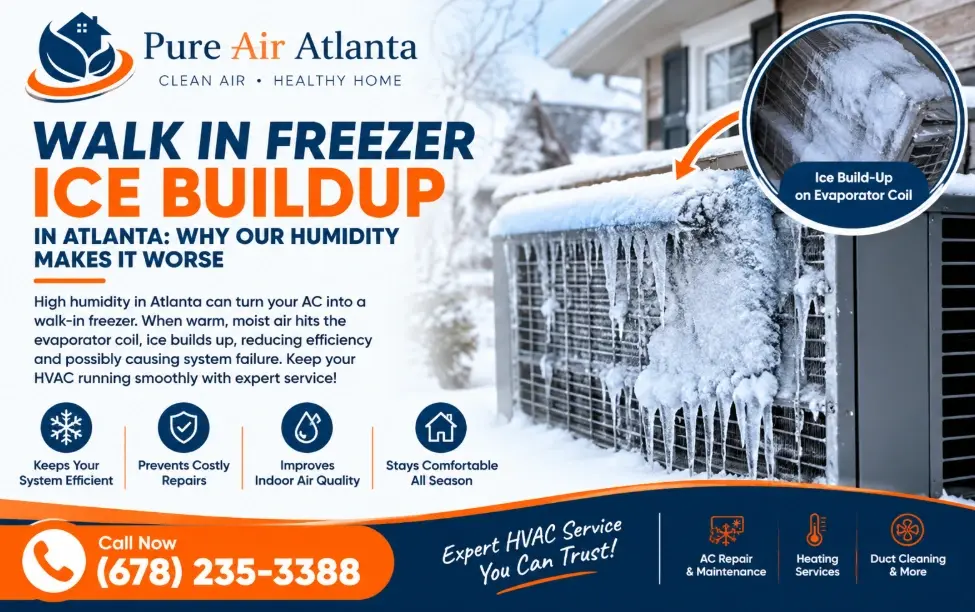
Walk in freezer ice buildup Atlanta kitchens face is one of the most common commercial refrigeration problems once summer arrives, and it is rarely a mystery once you know where to look. Ice is frozen moisture. If it is piling up on the evaporator coil, the door frame, the ceiling or the floor, more water is getting into the box than the defrost system can remove.
In Metro Atlanta, where summer air is heavy with moisture, that imbalance shows up faster than it does in drier parts of the country. A small gasket leak or a door left ajar during a delivery can turn into a frozen coil in a matter of days. This guide shows you how to read the ice, which parts usually fail, what is safe to check yourself and what Georgia food safety rules mean while you sort it out. If you would rather skip the detective work, our technicians handle walk-in cooler repair in Atlanta for freezers as well as coolers.
- Most ice comes from humid air getting in (an open or propped door, a worn gasket, a panel gap) or from a defrost system that stopped clearing frost.
- Where the ice forms tells you the cause: coil means defrost, door frame means gasket or door heater, floor means drain or threshold, ceiling seams mean air leaks.
- Door, gasket, airflow and drain checks are safe to do yourself. Anything electrical or involving refrigerant belongs to a certified technician.
- Never chip ice off the coil. The tubing punctures easily, and a refrigerant leak turns a cheap fix into an expensive one.
Freezer icing up right now? Talk to an Atlanta technician.
How Moisture Turns Into Ice Inside a Walk-In Freezer
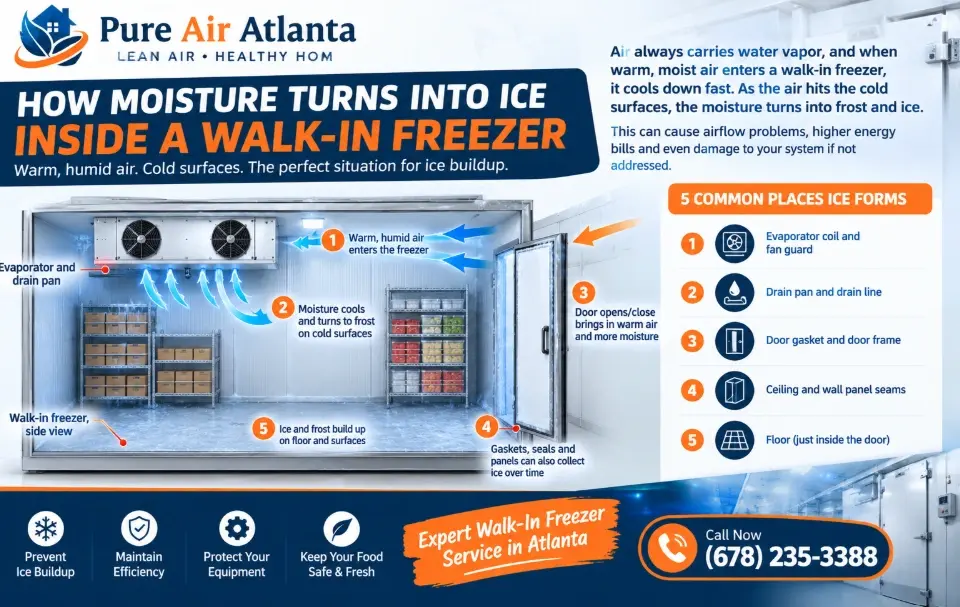
Air always carries water vapor, and warm air carries far more of it than the 0°F air inside a freezer. When humid air slips through a door, a worn gasket or a panel seam, it cools off quickly and drops its moisture. That moisture freezes on the first cold surface it meets, which is almost always the evaporator coil. A thin layer of frost on the coil is normal. The defrost cycle exists to melt it, and the meltwater is supposed to leave through a heated drain.
Walk in freezer ice buildup Atlanta operators see comes down to only three situations: too much moisture enters, the defrost system cannot clear what arrives, or the meltwater cannot leave and refreezes. Every cause in this article falls into one of those buckets, which makes diagnosis much simpler than it first looks.
The Atlanta factor is the first bucket. Summer afternoons in the metro area routinely bring dew points in the upper 60s and low 70s, and the National Weather Service in Peachtree City publishes monthly Atlanta climate summaries that show how long that warm season lasts. Every door opening during a lunch rush pulls that moisture-rich air into the box. A receiving or back door propped open during a delivery is worse, because the kitchen itself fills with humid air that the walk-in then has to fight all day.
- Evaporator coil and fan guard
- Drain pan and drain line
- Door gasket and door frame
- Ceiling and wall panel seams
- Floor just inside the door
Where the Ice Forms Tells You What Failed
Before you touch anything, look at the ice like a technician would. A walk-in freezer frozen evaporator, a frosted door frame and a sheet of ice on the floor each point to a different failure. The location narrows the cause quickly, and a few photos can save a service call a lot of diagnostic time. Use this table as a first pass.
| Where the ice is | Most likely cause | What to check | Who fixes it |
|---|---|---|---|
| Thick frost or a solid block on the evaporator coil | Defrost heater failure, bad timer or controller, failed termination sensor | Does the coil clear after a defrost cycle? Note the settings. | Technician |
| Frost only on the first rows of the coil, the rest dry | Low refrigerant or a restricted metering device | Photograph the pattern and note the box temperature. | Technician |
| Ice on the fan guard or blades, fans not turning | Failed fan motor, or fans locked by ice | Look and listen only. Never reach into the fan. | Technician |
| Frost or ice around the door edge and frame | Torn or frozen gasket, door not latching, failed door frame heater | Run the paper test on the gasket and watch the door close. | You, then technician |
| Ice sheet on the floor inside the door | Door left open, no strip curtain, threshold gap, drain overflow | Door habits during deliveries and prep rushes. | You |
| Ice in the drain pan or under the coil | Failed drain pan heater or drain line heater, clogged drain | Look for standing water that refreezes on the floor. | Technician |
| Frost on the ceiling and along panel seams | Warm air leaking through panel joints or damaged sealant | Note which seams frost first, especially on the warm side. | Technician |
| Door hard to open right after closing | Iced pressure relief port or failed vent heater | Do not force the door. Look for ice around the vent. | Technician |
Not sure what the ice pattern means? We will diagnose it.
Door Gaskets, Strip Curtains and Propped-Open Back Doors
The door is the biggest opening in the box, so it is where most humid air gets in and where a lot of walk in freezer ice buildup Atlanta kitchens see begins. Start with the gasket. A gasket that is torn, hardened, flattened or coated in ice cannot seal, even when the door looks closed. A frozen gasket is especially sneaky because it can hold the door shut while leaving a hairline gap that leaks all day.
Try the paper test. Close the door on a strip of paper at several points around the frame, low, middle and high on both sides. If the paper slides out with little resistance, the seal is weak at that spot. You can also check from inside with the lights off, but only if you have confirmed the interior safety release works and someone knows you are in there. When a gasket is cracked or has lost its shape, walk-in door gasket replacement is usually one of the quickest and most cost-effective repairs on the whole list, especially compared with running a coil that is constantly icing. Keep gaskets clean, and check hinges and the door closer too, because a sagging door will not compress even a new gasket evenly.
Two habits do more for ice prevention than almost any part:
- Use strip curtains or an air curtain. Any door that stays open for more than a few minutes during deliveries or prep benefits from a curtain that limits air exchange.
- Close the back door between trips. Prop a loading or kitchen back door open on a July afternoon and the whole kitchen fills with humid air. Stage deliveries, put product away in batches and shut the exterior door in between.
One more door item: freezers use a heated door frame to keep the perimeter from frosting. If the frame is frosting or sweating while the gasket seals well, the door heater may have failed, which is a job for a technician with a meter.
Defrost Heater Failure and a Frozen Evaporator in a Walk-In Freezer
A walk-in freezer frozen evaporator is usually a symptom, not the root problem. To understand why, it helps to know what the defrost system does. On a typical electric-defrost freezer, a timer or controller stops refrigeration at set intervals, heater elements on the coil warm up and melt the frost, a termination sensor ends the cycle once the coil is warm enough, and a short drip delay lets water drain before the fans restart. Some systems use hot gas instead of electric heaters, but the logic is the same. Many freezers run a few cycles a day, and the exact settings come from the manufacturer.
Defrost heater failure is the classic cause of a frozen coil. Heater elements burn out, wiring and relays fail, the termination sensor sticks, or the controller stops calling for defrost. Once the coil is buried in ice, airflow drops, the box warms, the compressor runs longer and even more frost forms. That feedback loop is why a freezer can go from fine to failing quickly.
Signs the defrost system has stopped doing its job:
- Frost that never fully clears after a cycle, or a coil that looks like a solid block
- Ice on the fan guard and a box temperature that drifts upward
- Water that does not drain, or ice that returns within a day or two of cleaning
- Uneven frost with a dry back section, which can point to low refrigerant instead
Be honest about what hand-melting accomplishes. Clearing the coil buys a few days of normal temperatures, but if the heater, sensor or timer is the problem, walk in freezer ice buildup returns almost immediately. A technician tests the heater elements, the termination sensor and the controller with a meter. If low charge or a leak is suspected, refrigerant work requires an EPA-certified technician, and our refrigerant leak repair and recharge service covers that side of the system.
Drains, Drain Heaters and Pressure Relief Ports
The overlooked ice makers are the small parts that keep water moving and pressure equal. Freezer drain lines are heated so meltwater does not freeze on its way out. When a drain line heater or drain pan heater fails, the line plugs with ice, water overflows the pan, runs onto the floor and refreezes into a slick sheet. Besides the slip hazard, that ice often builds back toward the coil.
The drain also needs a proper trap or air seal, installed the way the manufacturer specifies. A missing or incorrectly installed trap can pull warm, humid kitchen air up the drain line and into the box. A technician can check the drain assembly against the installation requirements for your model.
Then there is the pressure relief port. When a freezer door closes, the warm air that entered cools and contracts, creating a vacuum that makes the door hard to open. A heated vent port equalizes that pressure. If the port is iced over, the door sticks right after closing. Never force it. Pulling hard can damage the door, hinges or gasket, and the real fix is a clear, working vent heater.
Persistent moisture does not stay inside the freezer either. The same humid air that frosts a coil can feed mold elsewhere in a building, so if the kitchen feels clammy, it is worth reading about mold in HVAC systems and how moisture travels through a property.
Coil frozen or fans stopped? Do not wait for product loss.
Safe Step-by-Step Checks Before You Call
These checks for walk in freezer ice buildup are safe for kitchen staff and give a technician a head start. None of them requires opening an electrical panel or touching refrigerant lines.
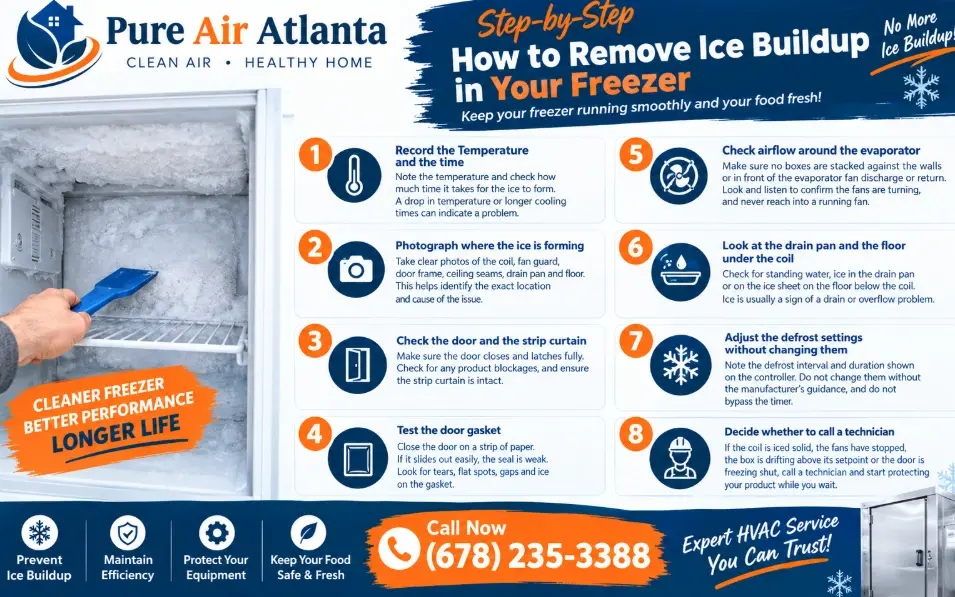
Record the temperature and the time
Read the box thermometer and write down the temperature and time. A temperature log protects you if product is affected and helps the technician see how long the problem has been developing.
Photograph where the ice is forming
Take photos of the coil, fan guard, door frame, ceiling seams, drain pan and floor. The location of the ice points to the failed part, and the photos save diagnostic time.
Check the door and the strip curtain
Make sure the door closes and latches fully, nothing props it open, no product blocks it, the hinges are not sagging and the strip curtain is intact.
Test the door gasket
Close the door on a strip of paper at several points around the frame. If the paper slides out easily, the seal is weak at that spot. Look for tears, flat spots, gaps and ice on the gasket.
Check airflow around the evaporator
Confirm that no boxes are stacked against the walls or in front of the evaporator fan discharge or return. Look and listen to confirm the fans are turning, and never reach into a running fan.
Look at the drain pan and the floor under the coil
Look for standing water, ice in the drain pan or an ice sheet on the floor below the coil. Ice here usually means a drain, drain heater or overflow problem.
Write down the defrost settings without changing them
Note the defrost interval and duration shown on the controller. Do not change them without the manufacturer’s guidance, and do not bypass the timer.
Decide whether to call a technician
If the coil is iced solid, the fans have stopped, the box is drifting above its setpoint or the door is freezing shut, call a technician and start protecting product while you wait.
What Not to Do With Ice in a Walk-In Freezer
- Do not chip or pry ice off the coil. Evaporator tubing is thin and a puncture releases refrigerant.
- Do not use a heat gun, torch or hair dryer. Heat can damage insulation and wiring and creates a fire and shock risk.
- Do not prop the door open to melt the ice. You flood the box with humid air and warm your product at the same time.
- Do not bypass or rewire the defrost timer. It hides the symptom and can damage the coil or compressor.
- Do not ignore floor ice. It is a slip hazard for staff carrying product, so keep walkways dry and clear.
Need the freezer fixed before your next inspection?
Protecting Product and Staying Inspection-Ready in Georgia
Walk in freezer ice buildup Atlanta restaurants face is also a food safety event. Georgia’s food service regulation is Chapter 511-6-1, and the Georgia Department of Public Health keeps the current rules, design manuals and permit forms on its Georgia DPH food service page. The rules were revised in February 2025 to adopt the 2022 FDA Food Code, and you can read the full text in the Georgia Food Service Rules and Regulations.
The department’s equipment guidance, Section D on facilities to maintain product temperature, is worth a read for any walk-in. It states that refrigerators must be capable of holding time and temperature control for safety (TCS) food at 41°F or below. It also requires numerically scaled indicating thermometers accurate to plus or minus 3°F, with the sensor placed in the warmest part of the unit, usually near the door. That is another reason door gaskets matter: the spot that warms first is also the spot an inspector will read.
In Atlanta, Fulton County Environmental Health Services inspects food service establishments, and the Fulton County restaurant inspection page explains that inspections cover sanitation practices and temperature maintenance of foods. During an icing event:
- Keep a written temperature log with times, starting before the technician arrives.
- Keep the door closed and move high-risk product to a working unit or insulated coolers if the box is drifting warm.
- Call for repair early instead of waiting for the box to fail completely.
- Let your person in charge decide discard questions using your written procedures and the state rules, and ask your inspector when you are unsure.
If a repair grows into replacing panels, adding equipment or changing electrical service, check with the City of Atlanta Office of Buildings about whether a permit applies to your project.
A Maintenance Schedule That Keeps Ice Away in Atlanta’s Humid Months
Most walk in freezer ice buildup Atlanta kitchens see is preventable with a small routine, and Atlanta’s long humid season is when it pays off most. The schedule below takes only a few minutes at each stage and focuses on the checks that matter most in a humid climate.
| How often | Who | What to do |
|---|---|---|
| Every shift | Kitchen staff | Confirm the door latches, nothing props it open, the strip curtain hangs clear and the thermometer reads normal. |
| Weekly | Kitchen manager | Wipe and inspect gaskets, look at the drain pan and floor, and keep product off walls and clear of the evaporator airflow. |
| Monthly | Kitchen manager | Review the temperature log, photograph the coil and compare frost patterns, and listen for fan noise changes. |
| Twice a year, and before summer | Technician | Test defrost heaters, termination sensor and controller, check drain and door heaters, inspect fan motors, clean coils, check refrigerant and seal panel joints. |
Location matters too. Restaurants and breweries in West Midtown, bars and kitchens in East Atlanta, and busy dining rooms in Midtown, Buckhead, Old Fourth Ward and Downtown Atlanta all open walk-in doors constantly during service. You can see the full list on our page for HVAC services by Atlanta neighborhood.
Do not forget the building around the freezer. An oversized or poorly set rooftop unit can leave a kitchen cool but clammy, and a humid kitchen gives the walk-in more moisture to fight. If that sounds familiar, our package unit and rooftop repair team can look at it, and our guide to ERV vs HRV in a humid climate explains how ventilation choices change indoor moisture. For routine upkeep across your whole property, see our AC maintenance service in Atlanta and commercial AC service pages.
Get a repair estimate for your walk-in freezer.
What Drives the Cost of Fixing a Freezer Icing Problem
We cannot responsibly quote a price without seeing the unit, because walk-ins vary widely by size, brand, parts availability and access. What we can tell you is how walk in freezer ice buildup Atlanta repairs usually rank from least to most expensive:
- Door habits and a new strip curtain
- Door gasket repair or replacement
- Sensors, timers and controllers
- Door, drain and defrost heaters
- Fan motors
- Refrigerant leak repair or coil replacement
- Panel repair or replacement
The expensive repairs are usually the ones you reach by waiting. A coil that runs iced for weeks drives up energy use and makes the compressor work harder, and spoiled inventory often costs more than the repair itself. Our pricing page explains how we approach estimates, and our frequently asked questions cover common service questions.
When to Call a Technician for Your Walk-In Freezer
Call as soon as you see any of the following signs of walk in freezer ice buildup Atlanta businesses should not ignore, because each one tells you the defrost system, the door seal or the drain has already lost the battle:
- The evaporator is iced solid or the fans have stopped turning
- The box temperature is drifting above its setpoint
- Ice returns within a day or two of clearing it
- The door freezes shut or is hard to open after closing
- Water is leaking or freezing on the floor
- You suspect a refrigerant leak or hear unusual compressor noise
Ice in your walk-in freezer? Get it diagnosed before it costs you product.
Our Atlanta technicians find the failed part, not just the frost. Read what other businesses say on our testimonials page or learn about Pure Air Atlanta.
Call (678) 235-3388 Walk-In Cooler and Freezer Repair
Prefer to write? Use our contact page. Pure Air Atlanta, Peachtree Street NE, Suite 100, Atlanta, GA 30309.
Walk In Freezer Ice Buildup Atlanta FAQs
Why does my walk-in freezer keep icing up after I defrost it by hand?
Hand defrosting only removes the symptom. If a worn door gasket, a propped door, a failed defrost heater or a frozen drain is still letting moisture build up, the ice returns within days. Find the source of the moisture or the failed defrost part, then the ice stays gone.
How often should a walk-in freezer defrost?
Many walk-in freezers are set for a few defrost cycles a day, but the right number depends on the model, the controller and how often the door opens. Follow the manufacturer’s settings. If the coil is icing between cycles, adding cycles only hides a door, gasket or heater problem, so have the cause diagnosed.
Can a bad door gasket cause ice on the evaporator coil?
Yes. A torn, flattened or frozen gasket lets humid air leak in all day. That moisture freezes on the coldest surface it reaches, which is usually the evaporator coil, and the defrost system eventually cannot keep up.
Is it safe to chip ice off the evaporator coil?
No. Evaporator tubing is thin and a screwdriver, knife or ice pick can puncture it and release refrigerant. Never use a heat gun or open flame either. Let a technician melt the ice with the system properly shut down and fix the cause.
What temperature should a walk-in freezer hold?
Walk-in freezers are commonly run at 0°F or colder, and frozen food is expected to stay frozen. Georgia’s food service rules set 41°F or below for refrigerated time and temperature control for safety (TCS) food, and require accurate thermometers on units. Follow your unit’s setpoint and your health inspector’s guidance.
How do I know if the defrost heater has failed?
Warning signs include frost that never fully clears after a defrost cycle, a coil buried in ice, ice on the fan guard, a box temperature that drifts upward, and ice that returns within a day or two of cleaning. A technician confirms it by testing the heater elements, the termination sensor and the timer or controller with a meter.
Does Atlanta humidity really change how often a freezer ices up?
It does. Summer air in Metro Atlanta holds a lot of moisture, so every door opening, gasket leak or propped back door pushes more water vapor into the box than it would in a dry climate. The defrost system has more to remove, so small faults show up sooner.
Do you repair walk-in freezers as well as walk-in coolers?
Yes. Our Atlanta technicians handle commercial refrigeration repair for both walk-in coolers and walk-in freezers, including defrost systems, door gaskets, heaters, fans and refrigerant issues.
Keep Reading
This guide is educational. Always follow the equipment manufacturer’s instructions, your health department’s requirements and lockout and safety procedures. Electrical and refrigerant work should be done by qualified, certified technicians.
HVAC Service Area — ZIP Code Directory
92 ZIP codes served · Tap any ZIP to call +1 (678) 235-3388 · pureairatlanta.com