
Package Unit Not Cooling Atlanta? Start With This Quick Answer
When a Package Unit Not Cooling Atlanta call comes in from an Atlanta home, restaurant or small office, the cause is rarely a mystery. In most cases it is one of three things: the unit has lost power, air cannot move through it, or the outdoor half cannot get rid of heat. The first two are often fixable in ten minutes. The third usually needs a technician.
Check the thermostat, the disconnect and breaker, the air filter, the vents and the condensate float switch first. Then look at the outdoor section for leaves, pollen, or a coil caked with dirt, and look for ice on the copper lines.
If all of that is clear and the unit still blows warm air, hums without starting, or trips the breaker, stop. Those point to a failed capacitor, contactor, fan motor, low refrigerant or a compressor problem, and they need a licensed tech. Our team handles package unit repair around the clock, 7 days a week.
Unit down and the building is heating up? Talk to a real technician now.
- What a package unit is and why it fails differently
- Safety rules before you touch anything
- 9 things to check before you call
- Symptom match table
- Warm air, no start, or tripped breaker
- What a technician checks
- DIY or call a pro?
- Why Atlanta is hard on package units
- Repair or replace
- Atlanta permits, codes and refrigerant rules
- Keeping the unit cooling all summer
- Atlanta buildings where package units are common
- FAQs
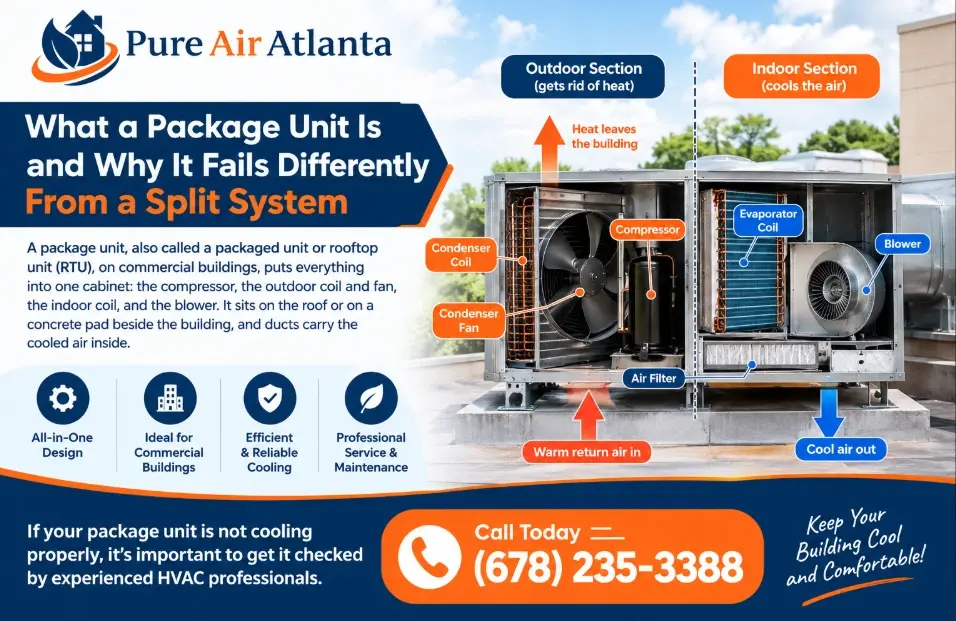
What a Package Unit Is and Why It Fails Differently From a Split System
A package unit, also called a packaged unit or rooftop unit (RTU) on commercial buildings, puts everything into one cabinet: the compressor, the outdoor coil and fan, the indoor coil, and the blower. It sits on the roof or on a concrete pad beside the building, and ducts carry the cooled air inside. A split system, by contrast, has an outdoor condenser plus an indoor air handler or furnace connected by refrigerant lines.
That single cabinet changes how problems show up. Water, leaves, roof heat and sun hit the whole machine at once. The filter and blower are also inside the same box as the hot compressor section, so a dirty filter or blocked coil affects more of the system than people expect. Packaged units come in three common types: gas and electric (electric cooling with gas heat), heat pump (electric cooling and heating), and dual fuel (a heat pump with gas backup).
Safety Rules Before You Touch Anything
- Power off first. Turn the thermostat to Off, then pull or flip the disconnect box mounted near the unit.
- Stay off the roof. For rooftop units, property managers should use a licensed HVAC company with roof access and fall protection, not a ladder and a flashlight.
- Do not add refrigerant. A cooling system does not use up refrigerant. Low charge means a leak. Federal rules under EPA Section 608 prohibit intentionally venting refrigerant during service, and handling it requires certification.
- Protect the people inside. If the building is heating up, move children, older adults and pets to a cooler room and keep water handy. During extreme heat the City of Atlanta has opened public relief spaces, as shown in its cooling center announcements, and the National Weather Service Atlanta forecast office posts heat alerts.
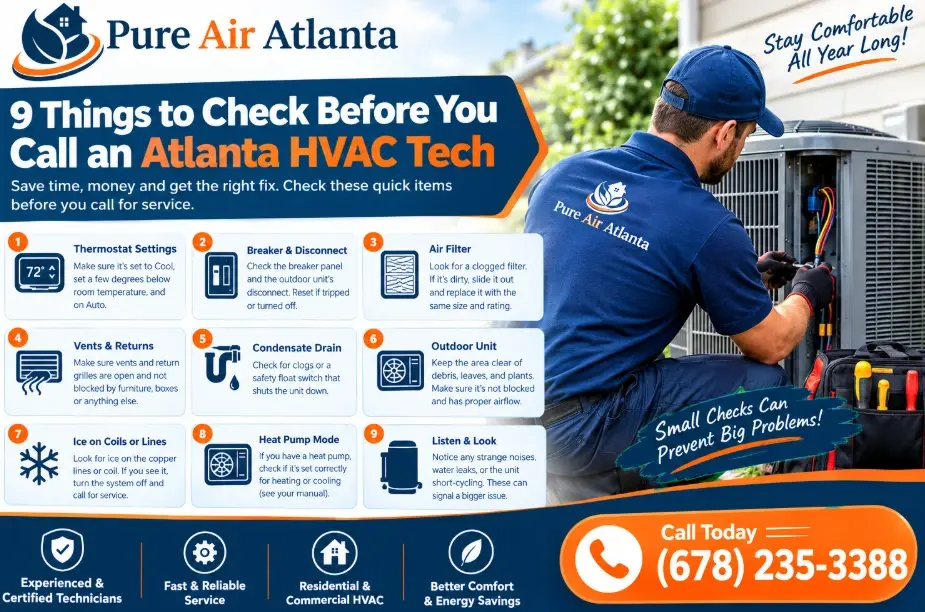
9 Things to Check Before You Call an Atlanta HVAC Tech
Work through these in order. Each one is quick, and each one rules out a common cause of a package unit not cooling. The tag beside each heading tells you whether it is a safe homeowner or property-manager check or a job for a licensed tech.
Thermostat settings DIY
Confirm the mode is set to Cool, the setpoint is several degrees below the room temperature, and the fan is on Auto. Replace dead batteries. On a smart or commercial programmable thermostat, look for a schedule, hold or “unoccupied” setting that is overriding you. If the screen is blank, you may have a power problem, which is the next check.
Disconnect box and breaker DIY
Look at the disconnect near the unit: the handle or pull-out block must be fully in. Then check the breaker panel. If the breaker has tripped, reset it once. If it trips again, leave it off, because something in the unit is drawing too much current. That is a technician job, and we cover it in the breaker section below.
Air filter DIY
A clogged filter starves the blower of air, the evaporator coil gets too cold, and the unit cools poorly or freezes. Slide the filter out and hold it to the light. If you cannot see through it, replace it with the same size and MERV rating. During Atlanta’s long cooling season, check filters monthly. A neglected filter also pushes dust into the coil and ducts, which is how many systems end up needing HVAC cleaning.
Vents, returns and doors DIY
Make sure supply vents are open and return grilles are not blocked by furniture, boxes or inventory. A closed door in a building with a single return can choke airflow to the whole unit. If some rooms are cool and others are not, the cause may be leaking or disconnected ductwork, which a technician can confirm and fix with duct sealing.
Condensate drain and float switch DIY look, pro fix
Cooling removes a lot of water from Atlanta’s humid air. If the condensate drain clogs, the pan fills and a safety float switch shuts the unit down on purpose. Look for water around the drain outlet or a wet ceiling below. Clearing the line is simple for a trained tech, and routine AC drain line cleaning prevents repeat shutdowns.
Airflow around the outdoor section DIY
The condenser coil and fan must be free to breathe. With the power off, clear leaves, plastic bags, weeds and stored items. On ground-mount units, keep shrubs back at least a couple of feet, or follow the clearance on the unit’s data plate. If the coil looks matted with pollen or cottonwood fluff, a gentle rinse with a garden hose from the inside out can help. Never use a pressure washer, which bends the fins. A heavily fouled coil is better handled with professional air conditioner coil cleaning.
Ice on the lines or coil DIY look, pro fix
Ice on the copper lines, or frost on the coil you can see through an access panel, means the coil has dropped below freezing. Turn the thermostat to Off and set the fan to On so air melts the ice, which can take hours. Ice is a symptom, not the problem. It usually comes from restricted airflow (checks 3 and 4), a failed blower motor, or low refrigerant. If it comes back after you replace the filter, call a tech.
Is it a package heat pump? Pro
Check the data plate. If your unit is a heat pump and it is blowing warm air while set to Cool, the reversing valve may be stuck or the thermostat may be configured for the wrong reversing-valve signal. Trade publications such as ACHR News use this exact scenario as a classic diagnostic puzzle, because the compressor and fans run normally while the unit heats instead of cools. It needs gauges and a meter, not a guess. If you are weighing heating options too, our guide on heat pumps versus furnaces in Atlanta explains the trade-offs.
Listen, look and smell, then note it down Observe
Before you call, write down what you notice. A humming sound with no fan movement, a clicking contactor, a burning smell, an oily residue near the lines, or a compressor that starts and quits all help the technician arrive with the right parts. Do not keep restarting a unit that hums or smells hot. Repeated attempts can burn out a compressor.
Checked all nine and the unit is still not cooling? Send us what you saw and we will tell you the likely fix.
Package Unit Symptom Match Table
Use this table to match what you are seeing to the most likely cause. It is a starting point, not a diagnosis, because different faults can look alike until a technician measures voltage, amperage and refrigerant pressures.
| What you see | Most likely cause | Try first | Who fixes it |
|---|---|---|---|
| Blank thermostat, nothing runs | Tripped breaker, open disconnect, dead batteries, blown low-voltage fuse | Batteries, disconnect, breaker (once) | DIY, then pro if it repeats |
| Fan blows but air is warm | Compressor not running, low refrigerant, dirty condenser coil, stuck reversing valve | Filter, outdoor airflow | Pro |
| Unit hums, fan will not start | Failed run or start capacitor, seized fan motor | Power off, call a tech | Pro |
| Breaker trips as soon as it starts | Shorted compressor, wiring fault, failed capacitor | Leave breaker off | Pro |
| Ice on lines or coil | Low airflow or low refrigerant | Filter, vents, thaw with fan on | DIY check, pro repair |
| Water near the unit or ceiling stain | Clogged condensate drain, tripped float switch | Look at drain outlet | Pro |
| Cools weakly, runs nonstop | Dirty coils, leaking ducts, undersized unit, low charge | Filter, coil, vents | DIY check, pro repair |
| Short cycles on and off | High-pressure or safety switch trip, bad thermostat, oversized unit | Thermostat location, outdoor airflow | Pro |
Package Unit Blowing Warm Air, Not Turning On, or Tripping the Breaker
These three complaints bring in most of our calls, so here is what each one usually means.
Package unit blowing warm air
If the blower is moving air but it is not cold, the cooling cycle has stopped even though the fan has not. The compressor may have shut down on a safety, the outdoor fan or capacitor may have failed, the refrigerant charge may be low, or on a heat pump the reversing valve may be in the wrong position. Commercial rooftop units can also have an economizer damper stuck open, pulling hot outdoor air into the building. Because three of those causes involve refrigerant or high-voltage parts, this is the point to call a technician. Clearing the filter and coil first is still smart, since a blocked coil makes the compressor overheat and shut itself off.
Package unit not turning on
No sound at all points to power or controls: a tripped breaker, an open disconnect, a failed transformer, a blown low-voltage fuse, a tripped float switch or a dead thermostat. A click with no fan or compressor suggests a worn contactor. A hum with no start suggests a failed capacitor or motor. The first three checks in this guide cover the free fixes. Past those, the parts involved carry stored electrical energy and need a trained tech.
Package unit tripping the breaker
A breaker protects the wiring from too much current. Common causes are a compressor drawing excess amps, a failing capacitor, a dirty condenser coil that raises system pressure, a damaged wire, or an aging breaker that no longer holds. Resetting it again and again is risky, because it can overheat wiring and damage the compressor. Reset once, and if it trips, leave it off and call us.
What a Technician Checks on a Package Unit
Here is what a professional visit should include, so you know what you are paying for and can compare quotes fairly. The “fix level” is a relative guide, not a price, because actual costs depend on the unit, access and parts.
| Check | What it tells the tech | Fix level |
|---|---|---|
| Voltage and amp draw at the disconnect and compressor | Whether power is arriving and whether the compressor is overloaded | Diagnostic |
| Run and start capacitors, contactor | Most common electrical failures. Our capacitor and fan service cost guide explains typical scope | Low to moderate |
| Outdoor fan motor and indoor blower motor | Airflow across both coils | Moderate |
| Refrigerant pressures, superheat and subcooling | Whether the charge is right or there is a leak or restriction. Leaks need repair before a freon recharge | Moderate to high |
| Temperature drop across the evaporator coil | Healthy systems typically drop air temperature roughly 15 to 20 degrees | Diagnostic |
| Condenser and evaporator coil condition | Dirt, damage or corrosion that blocks heat transfer | Low to moderate |
| Condensate drain, pan and float switch | Overflow and leak risk | Low |
| Reversing valve and control board (heat pumps) | Why a heat pump heats in cooling mode | Moderate to high |
| Economizer damper and controls (commercial RTUs) | Whether outdoor air is being let in when it should not be | Moderate |
| Compressor condition | The costliest repair. See our AC compressor repair page for what to expect | High |
DIY or Call a Pro?
| Task | Safe for you? | Why |
|---|---|---|
| Replace the air filter | Yes | No tools, no risk when the unit is off |
| Reset the thermostat, change batteries | Yes | Low voltage and easy to undo |
| Reset a breaker one time | Yes | If it trips again, stop |
| Clear debris and rinse the outside coil gently | Yes, power off | Avoid pressure washers and bent fins |
| Open panels, test capacitors or wiring | No | Stored electrical charge can injure or kill |
| Add refrigerant or find a leak | No | Requires EPA-certified handling and gauges |
| Work on a rooftop unit | No | Fall risk, plus all the electrical risks above |
| Clean the evaporator coil or blower | No | Requires panel removal and careful cleaning to avoid damage |
Why Atlanta Is Hard on Package Units
Long, humid summers
Units run for hours at a time, and every pound of moisture pulled from the air adds load. Clogged drains and dirty coils show up fast.
Pollen and debris
Spring pollen and fall leaves coat condenser coils and filters. A coated coil sheds heat poorly and runs hotter.
Roof heat
Rooftop cabinets bake in direct sun, so compressors and electrical parts work against hotter surrounding air.
Storm and power events
Surges and brownouts stress capacitors, contactors and control boards, which are among the first parts to fail.
Humidity matters beyond comfort. A unit that cools but leaves the air sticky may be short cycling or oversized, and persistent moisture can lead to musty smells and growth inside the system. If you notice that, read about mold in an HVAC system. Buildings that are tightly sealed may also benefit from dedicated ventilation, which we cover in ERV and HRV ventilation for humid Georgia homes.
Repair or Replace a Package Unit
A package unit costs more to replace than a single split component because the whole cabinet goes, plus possibly a curb adapter or crane on a roof. So the decision deserves a clear framework.
- Repair when the unit is under roughly 10 years old, the problem is a single part (capacitor, contactor, motor, drain), and the compressor and coils are sound.
- Consider replacement when the unit is past about 10 to 15 years, the compressor or a coil has failed, repairs keep recurring, or a repair would cost close to half the price of a new unit. These are rules of thumb, not guarantees.
- Check the refrigerant. Older units built for R-22 are expensive to recharge because that refrigerant has not been produced in the United States since 2020.
- Ask about the roof or pad. A replacement may involve a curb adapter, crane time and ductwork changes that affect the total price.
For context on repair spending, see our breakdown of AC repair costs in Atlanta and our pricing page. When you are ready to compare equipment, our AC replacement team can give you a written quote.
Atlanta Permits, Codes and Refrigerant Rules
Replacing equipment in the city of Atlanta is regulated, so it is worth knowing the basics before you sign a contract.
- Permits. The City of Atlanta Office of Buildings oversees construction activity and issues permits, as described on its Office of Buildings page. The City’s technical permit page lists a phone line for electrical, plumbing and HVAC permits at (404) 865-8550.
- Exempt work. The City’s Work Exempt from Permit document lists repair or replacement of existing air conditioner condensers on existing one- and two-family homes. A package unit is a complete system in one cabinet and commercial work follows different rules, so confirm with the City or your contractor before assuming a swap is exempt.
- Codes. The City’s construction codes page states that permit submissions beginning January 1, 2026 follow the 2024 International Mechanical Code with Georgia amendments.
- Refrigerant. EPA Section 608 rules govern how technicians handle and recover refrigerant.
Before any replacement, ask your contractor in writing who is pulling the permit. If you want a second opinion on scope, we are glad to walk you through it.
Keep Your Package Unit Cooling All Summer
Most breakdowns start as small, preventable issues. A simple routine goes a long way:
- Change or inspect the filter every month during the cooling season.
- Keep the outdoor section clear. Trim plants back, sweep roof debris and remove anything stacked against the cabinet.
- Schedule a tune-up before peak heat. A pro checks capacitors, contactors, refrigerant pressures, drain lines and coils. Our AC maintenance service covers those steps.
- Clean coils on schedule. A dirty coil forces the compressor to work harder, which is one of the fastest ways to shorten its life. See air conditioning cleaning for what we do.
- Do not ignore the ducts. Dirty or leaking ducts waste cooling and push dust through the system. Commercial buildings can add commercial duct cleaning to their plan, and homeowners can read how clean systems improve indoor air quality in Atlanta.
- Know your unit. Write down the brand, model, age and filter size and store them near the disconnect. It speeds up every service call.
Managing more than one building? Our commercial AC service page explains how we support multi-unit properties.
Atlanta Buildings Where Package Units Are Common
Package units tend to appear where space is tight or the building has no mechanical room: small offices, restaurants, retail strips, apartment buildings, and some homes and townhomes. We serve every in-town district, including Midtown, Downtown Atlanta, West Midtown, Buckhead, East Atlanta and Little Five Points. You can see all of them on our Atlanta neighborhoods page, or browse our wider service locations.
Dealing with a different type of equipment? Our guides on a PTAC not cooling and a mini split not cooling cover those systems step by step.
Package Unit Not Cooling: Frequently Asked Questions
Why is my package unit running but not cooling?
Usually airflow or heat rejection is the issue: a dirty filter, blocked return, iced coil, dirty or blocked outdoor coil, or a failed outdoor fan or capacitor. If those are clear, low refrigerant or a failing compressor is likely. Check the filter, thermostat and outdoor section first, then call a technician if the air is still warm.
Why is my package unit blowing warm air?
The blower is moving air, but the cooling cycle is not working. Causes include a tripped breaker on the compressor circuit, a failed capacitor or contactor, a safety lockout, low refrigerant, or on a heat pump a stuck reversing valve. On commercial rooftop units, an economizer damper stuck open can also let hot outdoor air in.
How do I reset a package unit?
Turn the thermostat to Off, switch off power at the disconnect, wait about five minutes, then restore power and set the thermostat back to Cool. Reset a tripped breaker only once. If it trips again, leave it off and call a technician rather than pressing internal reset buttons.
Why does my package unit keep tripping the breaker?
The unit is drawing more current than the circuit allows. Typical causes are a failing compressor, a bad capacitor, a dirty condenser coil that raises pressure, damaged wiring or a worn breaker. Repeated resets can overheat wiring and damage the compressor, so stop after one reset.
Can I clean the coil on my package unit myself?
You can gently rinse the outdoor coil with a garden hose when the power is off, working from the inside out and never using a pressure washer. The evaporator coil is inside the cabinet and should be cleaned by a professional. Do not do any of this on a rooftop unit without safe roof access.
Can I add refrigerant to my package unit myself?
No. A sealed system does not consume refrigerant, so low charge means there is a leak that must be found and repaired. Federal EPA Section 608 rules restrict who can handle refrigerant and prohibit intentionally venting it, so recharging is a job for a certified technician.
How long does a package unit last, and when should I replace it?
Many package units last roughly 10 to 15 years, though sun exposure and poor maintenance can shorten that. Replacement makes sense when a compressor or coil fails on an older unit, repairs keep coming back, or a repair would cost close to half the price of a new unit.
Do I need a permit in Atlanta to replace a package unit?
The City of Atlanta’s Work Exempt from Permit document lists repair or replacement of existing air conditioner condensers for existing one- and two-family homes. A package unit is a complete system in one cabinet, and commercial buildings follow different rules, so confirm with the Office of Buildings or your contractor. Ask your contractor in writing who is pulling the permit before work starts.
Get Your Package Unit Cooling Again
If you have worked through the nine checks and your package unit is still not cooling, you do not have to figure out the rest alone. Pure Air Atlanta is open 24 hours a day, 7 days a week, we are NADCA-certified, licensed and insured, and we serve Atlanta and the surrounding metro area. See our HVAC FAQ, learn about our company, or go straight to package unit repair in Atlanta to book.
Fast diagnosis and a clear explanation of what failed and why.
Sources and Further Reading
- City of Atlanta Department of City Planning, Office of Buildings
- City of Atlanta, Apply for a Technical Permit
- City of Atlanta Office of Buildings, Work Exempt from Permit
- City of Atlanta, Current Georgia Minimum Codes for Construction
- City of Atlanta news release on cooling centers
- National Weather Service, Atlanta/Peachtree City forecast office
- U.S. EPA, Section 608 Refrigerant Management
- ACHR News, Troubleshooting Challenge: A System That’s Blowing Warm Air in July
HVAC Service Area — ZIP Code Directory
92 ZIP codes served · Tap any ZIP to call +1 (678) 235-3388 · pureairatlanta.com