Mini Split Not Cooling? The Short Answer for Atlanta Homeowners
A mini split not cooling is one of the most common HVAC complaints in Atlanta once the humidity settles in. The unit hums, the fan blows, the display looks normal, and the room still feels like a sauna. The cause is usually one of eight things, and about half of them you can check safely yourself before anyone visits.
This guide walks through those eight causes in the order a technician would rule them out, explains what a professional actually tests, and flags the point where DIY stops being smart. It also covers the Atlanta-specific factors that make a ductless system fall behind here, from pollen-loaded filters to bonus rooms that were never sized for the heat they carry.
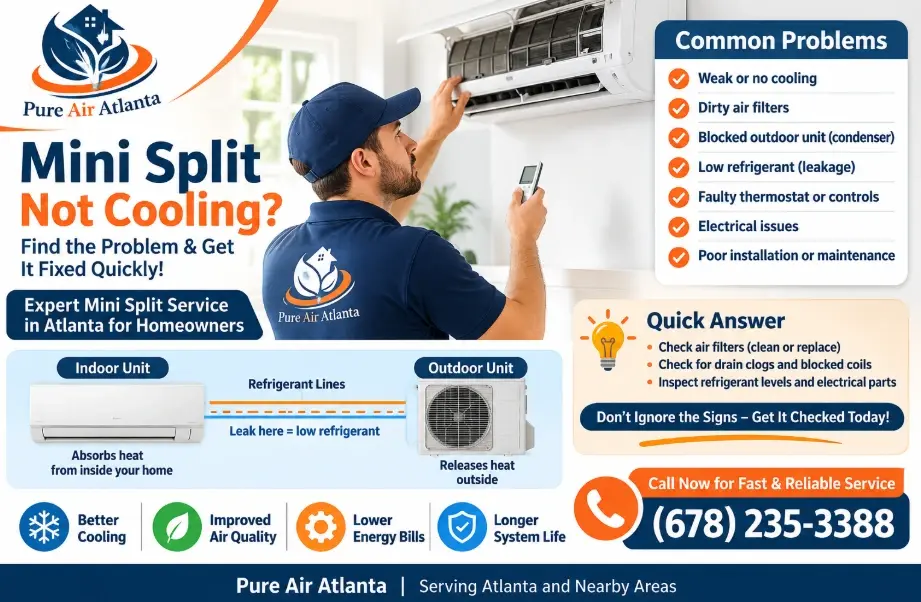
Quick answer
- Airflow problems (wrong mode, dirty filter, dirty coil, blocked outdoor unit) cause most weak cooling and are often safe to fix yourself.
- Water problems (clogged drain, iced-up coil) point to restricted airflow or a refrigerant issue behind it.
- Refrigerant and electrical faults always need an EPA-certified technician. If the unit blows warm air after the basics are clean, book ductless mini split repair.
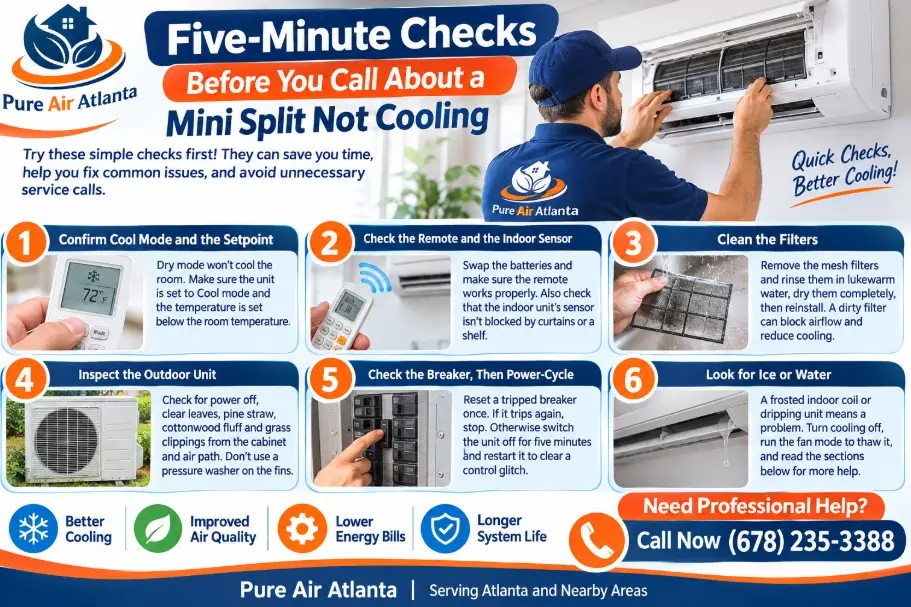
Five-Minute Checks Before You Call About a Mini Split Not Cooling Atlanta
Start here. These checks cost nothing, need no tools and rule out the simplest failures. Work through them in order and switch the unit off at the remote or breaker before touching any panel or filter.
- Confirm Cool mode and the setpoint. Dry mode removes moisture without really lowering temperature, and Fan mode only moves air. Choose Cool, set the target three to five degrees below the room, and leave the fan on Auto.
- Check the remote and the indoor sensor. Swap the batteries and make sure furniture, curtains or a shelf are not blocking the receiver window or the unit’s intake.
- Clean the filters. Pop out the mesh filters, rinse them in lukewarm water, dry them fully and reinstall them. A damp filter is as bad as a dirty one.
- Inspect the outdoor unit. With the power off, clear leaves, pine straw, cottonwood fluff and grass clippings from the cabinet and the air path. Do not use a pressure washer on the fins.
- Check the breaker, then power-cycle. Reset a tripped breaker once. If it trips again, stop. Otherwise switch the unit off for five minutes and restart it to clear a control glitch.
- Look for ice or water. A frosted indoor coil or a dripping unit changes the diagnosis completely. Turn cooling off, run Fan mode to thaw it and read the sections below.
Symptom Match: What Your Mini Split Is Telling You
Different symptoms point at different parts of the system. Use this table to narrow down the likely cause before you read the details.
| What you notice | Most likely cause | First move |
|---|---|---|
| Fan runs, air is room temperature | Wrong mode, dirty filter or coil, or low refrigerant | Check mode, then clean filters |
| Mini split blowing warm air, outdoor fan silent | Tripped breaker, failed capacitor or communication fault | Check breaker, then call a pro |
| Ice on the indoor coil or vents | Restricted airflow or low refrigerant | Turn off cooling, thaw with Fan mode |
| Water dripping from the indoor unit | Clogged condensate drain or heavy ice melt | Stop cooling, clear the drain path |
| Hissing, bubbling or oily residue at fittings | Refrigerant leak | Switch off and call a certified tech |
| Cools some hours, loses on hot afternoons | Undersized unit or dirty outdoor coil | Clean outdoor unit, then request a load check |
| Short cycling (on and off every few minutes) | Sensor fault, dirty coil or oversized unit | Clean filters, then book a diagnostic |
| Blinking lights or an error code | Sensor, board or communication fault | Note the code and check the manual |
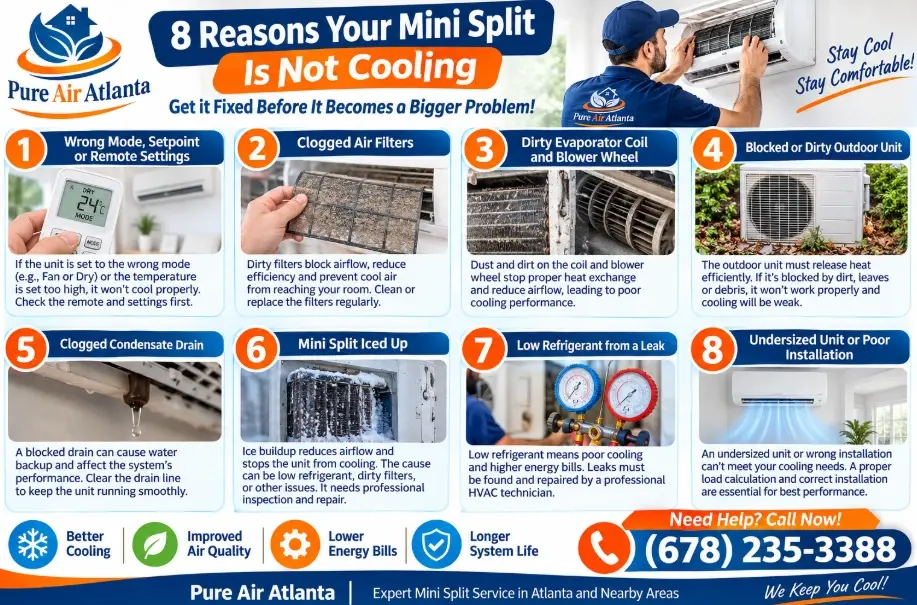
8 Reasons Your Mini Split Is Not Cooling
These are ranked roughly from easiest to hardest to fix. Each one shows whether it is a homeowner job or a technician job.
1. Wrong mode, setpoint or remote settings
DIYIt sounds too simple, but a surprising share of “broken” mini splits are sitting in Fan or Dry mode, or running an Eco or sleep timer that quietly raised the setpoint overnight. A remote that has slipped from Fahrenheit to Celsius can also leave you with a setpoint far from what you meant. Reset to Cool, pick a realistic target and give the room 20 to 30 minutes.
2. Clogged air filters
DIYThe mesh filters are the lungs of the indoor unit. When Atlanta’s spring pollen, pet hair and kitchen grease coat them, airflow drops and cooling drops with it. Starved airflow is also how a coil freezes. Clean them on a schedule and the single biggest cause of a mini split blowing warm air largely disappears. If pollen is a constant problem in your home, a whole-home approach such as air purification in Atlanta reduces what reaches the filters in the first place.
3. Dirty evaporator coil and blower wheel
ProFilters never catch everything. Fine dust and a thin film of biological growth build up on the indoor coil and the barrel-shaped blower wheel, which cuts heat transfer and airflow at the same time. You will notice weak airflow, a musty smell when the unit starts, or water spitting from the vents. Reaching these parts means taking the front housing apart, so this is where professional mini split cleaning pays off. If you also see dark growth or smell something persistently sour, read up on mold in an HVAC system before ignoring it.
4. Blocked or dirty outdoor unit
DIYThe outdoor unit has to push heat out of the house. Georgia yards hand it plenty to choke on: pine straw drifts, cottonwood fluff, mulch dust, grass clippings and overgrown shrubs. A unit squeezed into a tight side yard can also recirculate its own hot exhaust. Switch the power off, clear the debris, trim plants back, and rinse the fins gently with a garden hose. Keep the clearance your manual specifies, which is often a foot or two on the sides and more above. Bent fins and a seized fan blade are signs to stop and call.
5. Clogged condensate drain
DIYPro if it repeatsOn a humid Atlanta day, a mini split can pull a lot of water out of the air, and all of it has to leave through a small drain line. Algae and sludge narrow that line over a season. A float switch or full pan can then shut cooling down, or the water backs up and drips from the indoor unit. The same buildup that plugs central systems applies here, and our guide to AC drain line cleaning in Atlanta explains why it keeps returning. If water appears more than once, have the line flushed and the slope checked.
6. Mini split iced up
Thaw yourselfPro to diagnoseA mini split iced up in July looks alarming, but the explanation is simple. If air moves too slowly across the coil or the refrigerant pressure is too low, the coil drops below freezing and moisture turns to frost instead of draining. Turn cooling off, run Fan mode for a few hours until everything melts, clean the filters, and do not scrape the ice. If it freezes again, the root cause is probably refrigerant or a deeper airflow fault, and continued running can damage the compressor. That is a job for mini split repair in Atlanta rather than another reset.
7. Low refrigerant from a leak
Pro onlyMini splits do not burn through refrigerant like fuel. The system is sealed, so mini split low refrigerant always means a leak, commonly at a flare connection, a damaged line set or a pinhole in a coil. Symptoms include warm air, long run times, ice on the outdoor service valves, hissing or oily residue at fittings. Most modern units use R-410A or R-32. A technician locates the leak, repairs it, evacuates the system and weighs in the exact factory charge. Topping off without repair is a short-lived fix and, under federal rules, only certified technicians may handle the refrigerant. If a leak is confirmed, our refrigerant recharge service covers the recharge once the leak is sealed.
8. Undersized unit or a poor installation
Pro onlySome units were never able to cool the space. In Atlanta that often shows up in bonus rooms over garages, sunrooms, converted attics and open-plan additions where one head serves two rooms. Long line sets, uninsulated suction lines, a head mounted above a hot window or an outdoor unit in a heat trap all make the same problem worse. The fix starts with a Manual J load calculation, then either a larger head, an added zone or a proper relocation. When the equipment is simply too old or too small to rescue, compare options under AC replacement in Atlanta.
Why Atlanta’s Climate Makes Cooling Problems More Likely
A ductless system in a dry climate and the same system here live very different lives. Four local factors explain why so many Atlanta calls start with “it runs, but it will not cool.”
- Long, hot, humid summers. According to the National Weather Service, Atlanta averaged 80.7°F from June through August 2025, with an average daily high of 89.3°F and a peak of 100°F on July 29. See the NWS Atlanta summer 2025 climate summary. That is a lot of run time, and every hour adds condensate and coil wear.
- Heavy pollen. Spring pollen packs filters and coats coils, so a unit that was fine in March can be starved for air by June.
- Tree-heavy yards. Pine straw, leaves and cottonwood find the outdoor unit quickly, and many intown lots leave little space around it.
- Additions that outgrew the equipment. Homeowners often add a mini split to a room the original system could not reach, then finish the space with big windows or a vaulted ceiling that the unit was never sized for.
Humidity also changes how cooling feels. A unit that is slightly short on capacity may hit the temperature number while leaving the air sticky. If moisture is a recurring complaint across your whole house rather than one room, our comparison of ERV and HRV ventilation for humid Georgia homes explains how fresh-air systems affect indoor humidity.
What a Technician Checks When a Mini Split Is Not Cooling
A proper diagnostic is a sequence, not a guess. Here is what a trained technician works through on a service call for a mini split that will not cool, and why each step matters.
| Check | What it reveals |
|---|---|
| Settings, error codes and sensor readings | Whether the board has already logged a fault or a sensor is reading the wrong temperature. |
| Airflow at the indoor unit | Filter, coil and blower wheel condition, plus how much air actually moves. |
| Temperature split between return and supply air | A healthy system typically shows a drop of roughly 15 to 20°F. Humid conditions and brand specs shift the exact number, so techs compare against the manufacturer’s range. |
| Outdoor fan and compressor operation | Whether the outdoor unit starts, runs and sheds heat. |
| Capacitor and electrical connections | Weak capacitors and loose terminals stop the compressor or fan from starting. |
| Indoor and outdoor communication | Damaged signal wiring, including rodent damage, can lock out the compressor. |
| Refrigerant charge and leak search | Pressures and temperatures show whether the charge is low and where it escapes. |
| Condensate drain and pan | Blockages, float switch behavior and drain slope. |
| Line set, installation and unit sizing | Insulation, line length, head placement and whether capacity matches the room. |
If you want to know what a visit and repair typically cost before you book, our pricing page and the guide to AC repair costs in Atlanta set out how diagnostic fees and parts are handled.
Mini Split Not Cooling: DIY or Call a Pro?
| Problem | Who handles it | Why |
|---|---|---|
| Mode, setpoint, remote batteries | You | No tools or risk. |
| Washing filters | You | Manufacturers expect owners to do this regularly. |
| Clearing debris around the outdoor unit | You (power off first) | Simple, but keep hands away from fins and fans. |
| Thawing an iced coil | You, then a pro if it returns | Thawing is easy; finding why it froze is not. |
| Deep coil and blower cleaning | Pro | Requires partial disassembly and water control. |
| Refrigerant leaks and recharging | Pro only | EPA Section 608 rules and precise charging. |
| Capacitors, boards, wiring, compressors | Pro only | High-voltage components and diagnostic tools. |
| Sizing and relocation | Pro only | Needs load calculation and line-set work. |
Heat safety comes first. If your cooling fails during an extreme heat day and you have young children, older adults or anyone with a medical condition at home, do not wait. Request emergency AC repair in Atlanta. The City of Atlanta has also opened public cooling centers during heat waves, for example the July 2025 center announced in this City of Atlanta cooling center notice. Check the city’s current announcements for hours and locations.
Repair or Replace a Mini Split That Will Not Cool?
Most causes above are inexpensive to fix, so repair is usually the right first move. Replacement starts to make sense when several of these are true:
- The compressor has failed, or the coil is leaking repeatedly in different spots.
- The unit is well past a typical service life and parts are becoming hard to source.
- The system was undersized from day one and cannot be fixed by cleaning.
- Repair quotes keep climbing while efficiency keeps dropping.
Because many mini splits are also heat pumps, the same unit heats in winter. Our guide on heat pumps versus furnaces in Atlanta explains how that dual role affects the repair-or-replace decision. A technician can walk you through both numbers rather than push you toward the bigger invoice.
Atlanta Permits, Codes and Refrigerant Rules to Know
What the City and federal rules say
- Permits: The City of Atlanta’s Office of Buildings issues building permits and inspects work. Permit submissions from January 1, 2026 use the 2024 International Mechanical Code with Georgia Amendments.
- Work that is exempt: The City’s Work Exempt from a Permit list includes repair or replacement of existing air conditioner condensers at existing single-family, two-family or duplex homes. The work must still meet minimum code requirements, and larger scopes such as a new installation may need a permit.
- State codes: The City lists the current Georgia minimum codes for construction, including the mechanical and energy codes that apply to HVAC work.
- Refrigerant: The EPA’s Section 608 refrigerant rules prohibit venting refrigerants during service, which is why leaks and recharging belong to certified technicians.
Rules change and condos or rental properties may add their own approvals. Confirm the scope of your project with the Office of Buildings at 404-330-6150 before work begins.
Keep Your Mini Split Cooling All Summer
A little routine beats an emergency call on the hottest weekend. Here is a schedule that fits Atlanta conditions.
- Every two to four weeks in spring and summer: rinse the filters and glance at the outdoor unit for debris.
- Each spring, before the first heat wave: trim plants back, rinse the outdoor fins gently, and test every zone in Cool mode.
- Once a year: book professional coil, blower and drain care, or a full AC maintenance service visit that includes the electrical checks you cannot do yourself.
- Before storm season: consider surge protection for the outdoor unit and its disconnect, because lightning-related surges damage boards and compressors.
- Whenever you smell something musty: do not wait. Schedule professional mini split cleaning before growth spreads.
If you also run a central system, the same attention applies to it. A quick look at air conditioning cleaning in Atlanta shows what a thorough cleaning covers, and our PTAC not cooling troubleshooting guide covers the equivalent problems for through-wall units.
Mini Split Problems by Atlanta Neighborhood
Ductless systems show up in very different buildings around the city, and the failure patterns shift with them. Older intown homes in places like Inman Park, Virginia-Highland, Grant Park, Candler Park, Little Five Points, East Atlanta and Old Fourth Ward often use mini splits for additions and rooms without ducts, which makes sizing and line-set routing the usual suspects. Lofts and condos in Midtown, Downtown Atlanta and West Midtown tend to hit drain and airflow problems in tight spaces. Larger homes in Buckhead and Morningside-Lenox Park can have several zones, so one weak head is easy to miss until a heat wave exposes it.
Not sure which area you are in? Browse all Atlanta neighborhoods we serve, read what neighbors say on our testimonials page, or learn more about Pure Air Atlanta and meet our technicians.
Mini Split Cooling Problems: Frequently Asked Questions
Why is my mini split running but blowing warm air?
The most common reasons are the wrong mode (Fan or Dry instead of Cool), a clogged filter, a dirty indoor coil, a blocked outdoor unit, or low refrigerant from a leak. Check the mode, setpoint and filter first. If the air is still warm after the filter is clean and the outdoor fan is spinning, a technician needs to test refrigerant charge and the outdoor components.
Why is my mini split iced up in summer?
Ice forms when the indoor coil gets too cold to shed moisture as water. The usual causes are restricted airflow from a dirty filter or coil, a blocked drain, or low refrigerant. Turn the cooling off, run Fan mode until the ice melts, clean the filters, and do not chip the ice. If it freezes again, stop using it and book a diagnostic.
How often should I clean mini split filters in Atlanta?
During spring pollen and the peak cooling months, check them every two to four weeks and rinse them when they look dusty. The rest of the year, once every month or two is usually enough. Always let a washed filter dry completely before putting it back, and follow your manual for the exact interval.
Can I add refrigerant to my mini split myself?
No. A mini split is a sealed system, so low refrigerant means there is a leak that has to be found and repaired first. Federal rules under EPA Section 608 also restrict who may handle refrigerant, and venting it is prohibited. Topping off without fixing the leak only delays the same failure.
Does replacing or repairing a mini split need a permit in Atlanta?
It depends on the scope. The City of Atlanta's Work Exempt from a Permit list includes repair or replacement of an existing air conditioner condenser at an existing single-family, two-family or duplex home, and the work must still meet minimum code. New installations and larger changes can need a permit, so confirm with the Office of Buildings at 404-330-6150 before starting.
Is my mini split too small for the room?
Signs include a unit that runs nonstop on hot afternoons, a room that never reaches the setpoint while the coil and outdoor unit are clean, and a single head serving two connected spaces. Bonus rooms, sunrooms and converted attics are common culprits. A Manual J load calculation confirms whether the capacity matches the space.
Is it normal for a mini split to struggle on extreme heat days?
A properly sized, clean unit should keep up on a normal Atlanta summer day. Atlanta reached 100°F on July 29, 2025, according to the National Weather Service, and a marginally undersized system can fall behind on days like that. If yours only struggles at the peak of a heat wave, sizing or airflow is the first thing to check.
Still Dealing With a Mini Split Not Cooling?
If the filters are clean, the outdoor unit is clear and the room still will not cool, stop running it and let a technician find the cause. We diagnose first, explain what we find in plain language and quote before any repair.
Book mini split repair Contact Pure Air AtlantaQuestions first? Visit our HVAC FAQ or browse more guides on the Pure Air Atlanta blog.
- National Weather Service Atlanta: Summer 2025 climate summary
- City of Atlanta Office of Buildings
- City of Atlanta: Work Exempt from a Permit
- City of Atlanta: Current Georgia minimum codes for construction
- City of Atlanta: Cooling center announcement, July 2025
- U.S. EPA: Section 608 refrigerant management
HVAC Service Area — ZIP Code Directory
92 ZIP codes served · Tap any ZIP to call +1 (678) 235-3388 · pureairatlanta.com