PTAC maintenance checklist Atlanta properties: the one-page version
A good PTAC maintenance checklist is what separates a quiet summer from a week of guest-room complaints. PTAC units sit in the room, run for hours, and breathe in whatever the room produces: lint, hair, pollen and moisture. This guide gives hotel and apartment teams a practical routine by frequency and by Atlanta season, written so housekeeping, maintenance staff and your HVAC contractor each know their part.
If a unit is already failing, go to our PTAC not cooling troubleshooting guide first. This page is about keeping the rest of your units out of that guide.
The short version
- Every turnover: 60-second visual check by housekeeping.
- Monthly: filter check, clean or replace.
- Quarterly: coil face, drain and wall seal check.
- Before summer and before winter: full cooling and heating test.
- Yearly: coil and drain cleaning plus technician inspection.
- Need help running it? See our AC maintenance service or PTAC unit repair in Atlanta.
PTAC maintenance checklist by frequency
The intervals below are our suggested routine for busy guest rooms. Lightly used rooms can stretch them, and the Department of Energy gives no fixed filter interval, so adjust to what you see when you open the unit.
| When | Who | Tasks |
|---|---|---|
| Every turnover | Housekeeping | Unit powers on, cover and grille intact, no water at the base, no odor, air moving, thermostat reset to default. Flag anything off with a work order. |
| Monthly | Maintenance | Pull the filter. Clean or replace if it looks loaded. Wipe the intake grille. |
| Quarterly | Maintenance | Vacuum the coil face, check the condensate drain and base pan, inspect the wall seal and outside grille, run cool and heat modes briefly. |
| Pre-summer and pre-winter | Contractor | Full cooling or heating test, electrical connection check, refrigerant concerns, heat strip or heat pump function. |
| Annually | Contractor | Evaporator and condenser coil cleaning, fin straightening, drain channel clearing, fan and motor check, written condition report. |
The Department of Energy’s home cooling guide backs the basics: routinely replace or clean air filters, check the evaporator coil every year and clean it as necessary, straighten bent coil fins with a fin comb, and pass a stiff wire through drain channels to prevent clogs. It also advises hiring a certified professional when a unit needs more than basic maintenance.
Pre-summer PTAC checklist for Atlanta
Run this in March or April, before the first hot week. Cooling season is when guest-room HVAC complaints spike, and Atlanta humidity makes drain and coil problems show up fast.
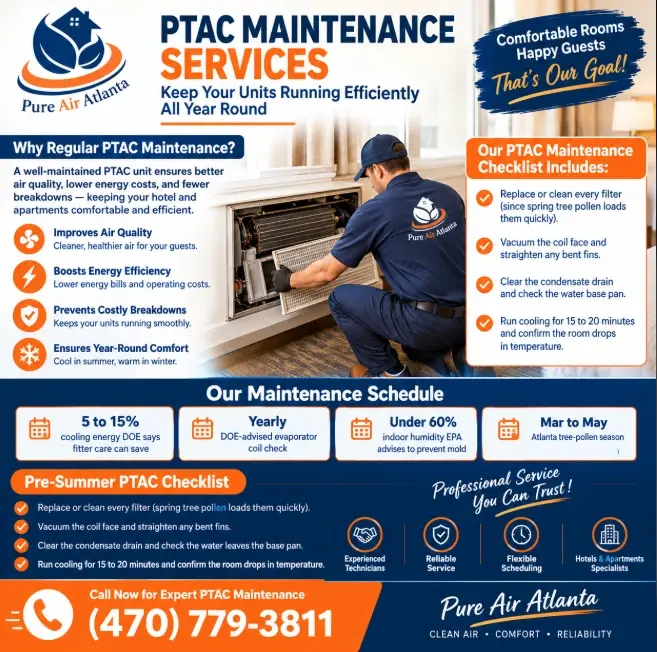
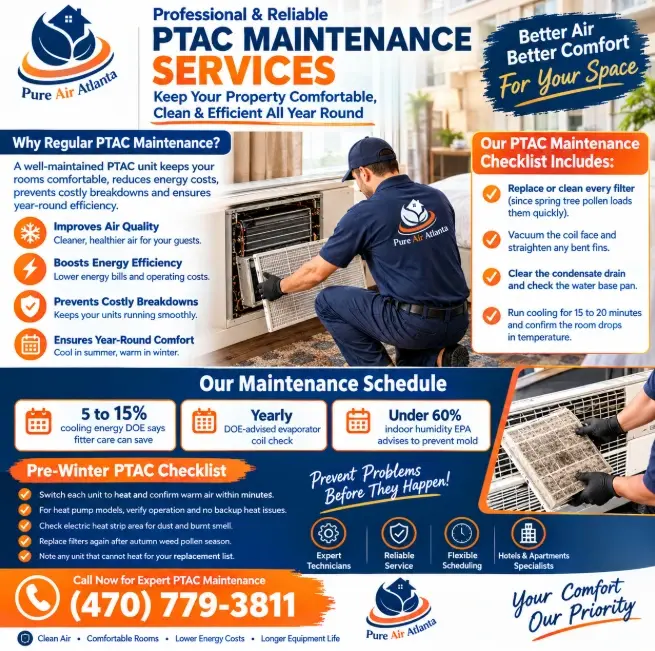
- Replace or clean every filter, since spring tree pollen loads them quickly.
- Vacuum the coil face and straighten any bent fins.
- Clear the condensate drain and check that water leaves the base pan.
- Run cooling for 15 to 20 minutes and confirm the room drops in temperature.
- Check the wall seal and outside grille for gaps, debris or insect nests.
- Listen for rattling, grinding or clicking, and check that the cover is secure.
- Log any unit that repeatedly ices up, leaks or loses cooling for a technician.
A unit that ices up or blows warm air after a clean filter and coil may be low on refrigerant. Do not keep topping it off; read about freon recharge and let a technician find the leak.
Pre-winter PTAC checklist
Do this in October or November, before the first cold snap. Many properties only discover a dead heating mode when a guest complains on a cold night.
- Switch every unit to heat and confirm warm air within a few minutes.
- For heat pump models, confirm the unit changes over correctly and does not run on backup heat all the time.
- Check the electric heat strip area for dust and burnt smell.
- Seal gaps around the sleeve so cold air does not leak in.
- Replace filters again after autumn weed pollen season.
- Note any unit that cannot heat for your replacement list.
Winter has the lowest pollen counts in Atlanta, which makes it a good time for deeper cleaning in vacant rooms and for planning replacements. Our guide to the cost of replacing PTAC units and when to do it lays out the repair-or-replace math if a unit has reached that point.
Hotel PTAC cleaning schedule: who does what
A workable hotel PTAC cleaning schedule gives every task an owner. Housekeeping already enters every room, so give them the fastest checks. Maintenance staff handle anything that needs a tool. Your contractor handles anything that touches refrigerant, wiring or the sealed system.
The 60-second turnover check for housekeeping
- Press power and confirm the fan starts.
- Look for water on the floor or a stained wall below the unit.
- Smell for musty or burnt odor.
- Check that the cover and grille are on and not cracked.
- Reset the thermostat to your default setting.
- Report a problem the same day, not at the next complaint.
Apartment communities can use the same flow at move-out. For larger portfolios, our commercial AC service team can set a recurring visit schedule by building.
PTAC coil cleaning: what staff can do and when to call a pro
PTAC coil cleaning is the single most useful annual task, because a blocked coil forces the compressor to work harder and lets the room warm up. Staff can handle basic surface cleaning safely if they follow these steps:
- Turn off the unit and disconnect power at the breaker or plug.
- Remove the front cover and filter.
- Vacuum the coil face with a soft brush attachment, moving along the fins.
- Straighten any bent fins gently with a fin comb.
- Clear the drain channel and make sure water can leave the base pan.
- Refit the filter and cover, restore power and run the unit.
Do not use a pressure washer, and keep water away from controls and wiring. If the coil stays blocked, the fins are damaged, or the unit has ice or refrigerant issues, stop and call a technician. Our pages on air conditioner coil cleaning, air conditioning cleaning and AC drain line cleaning explain what a professional cleaning covers and what drain work involves, including drain line cleaning cost.
One compliance note: anyone who services equipment that could release refrigerant must be certified, per the EPA’s Section 608 certification requirements.
Guest room HVAC complaints: what each one points to
Treat every complaint as data. The right-hand column tells staff which checklist item to check first; our PTAC not cooling troubleshooting guide covers deeper diagnosis.
| Guest complaint | Check first | If it continues |
|---|---|---|
| Room will not cool | Thermostat mode, filter, coil face | Technician visit; possible refrigerant or compressor issue |
| Musty smell | Filter, drain pan, standing water | See musty smell from AC vents and mold in air ducts |
| Water on the floor | Drain channel, base pan, sleeve seal | Drain line service; check wall for damage |
| Loud or rattling unit | Cover, fasteners, fan debris | Fan motor or mount inspection |
| Cold air in heating mode | Mode setting, filter, heat function test | Heat strip or heat pump repair |
| Draft around the wall | Sleeve gasket and exterior seal | Reseal or replace the sleeve |
| Unit will not turn on | Breaker, plug, control panel | Electrical or control board diagnosis |
For same-day failures, our emergency AC repair line is available around the clock, and our AC repair page covers other cooling problems in the building.
Atlanta humidity and pollen: why local seasons change your schedule
Atlanta’s pollen calendar is a useful maintenance calendar. According to IQAir’s Atlanta pollen overview, tree pollen peaks from March to May, grass pollen from June to August, and weed pollen (mainly ragweed) from September to November, with the lowest counts in winter. Filters load faster in those windows, so check them more often than your monthly baseline.
Humidity matters just as much. The EPA’s mold guidance says moisture control is the key to mold prevention, that HVAC drain pans should stay clean, flowing and unobstructed, and that indoor relative humidity should stay below 60 percent (ideally 30 to 50 percent); see the EPA mold course chapter on HVAC and moisture. A PTAC with a slow drain in an Atlanta August is exactly where that guidance gets tested.
For apartments and condos with tightly sealed units, ventilation also affects moisture. Our article on ERV vs HRV in humid Atlanta explains the options, and our ERV installation page covers installation.
Keep a PTAC maintenance log that shows repeat problems
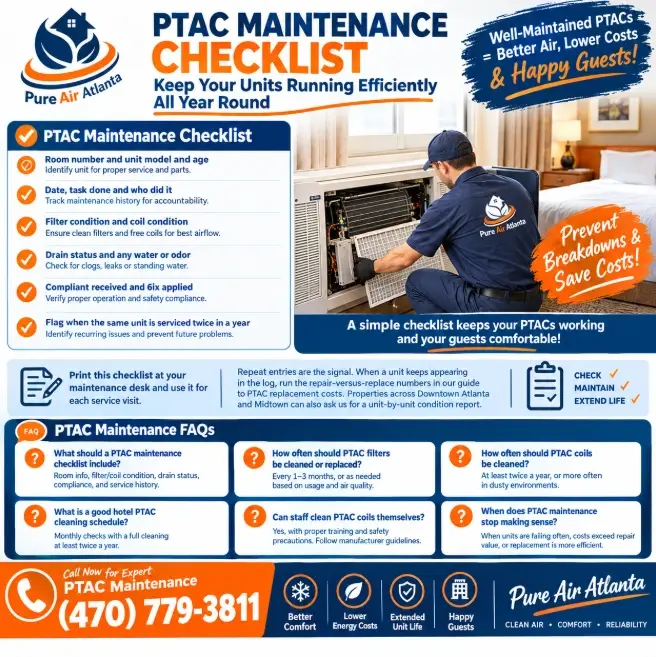
A checklist only works if results are recorded. Whether you use a spreadsheet, a work-order system or paper, capture the same fields for every unit:
- Room number and unit model and age
- Date, task done and who did it
- Filter condition and coil condition
- Drain status and any water or odor
- Complaint received and fix applied
- Flag when the same unit is serviced twice in a year
Print this page and keep the checklists at your maintenance desk.
Repeat entries are the signal. When a unit keeps appearing in the log, run the repair-versus-replace numbers in our guide to PTAC replacement costs. Properties across Downtown Atlanta and Midtown can also ask us for a unit-by-unit condition report.
Basic upkeep and repairs rarely raise permit questions. The City of Atlanta’s Work Exempt from Permit list says no permit or fee is required for repair work under a $10,000 total valuation, provided the work is otherwise lawful and meets code. If a job grows into sleeve, wall or electrical work, check the City of Atlanta technical permit page for the Office of Buildings contact before starting.
PTAC maintenance checklist FAQs
What should a PTAC maintenance checklist include?
At minimum: a quick check at every room turnover, a monthly filter clean or replacement, a quarterly look at the coil face, drain and wall seal, a seasonal test of cooling and heating before summer and winter, and an annual coil and drain cleaning with a technician inspection. Keep a written log so repeat problems are visible.
How often should PTAC filters be cleaned or replaced?
The U.S. Department of Energy says to routinely replace or clean air filters and notes this can cut cooling energy use by 5 to 15 percent, but it gives no fixed interval. For guest rooms we suggest checking filters monthly and cleaning or replacing any that look loaded, and checking more often during Atlanta's spring tree-pollen season.
How often should PTAC coils be cleaned?
The Department of Energy advises checking an air conditioner's evaporator coil every year and cleaning it as necessary. For PTACs in busy rooms, a quarterly vacuum of the coil face and an annual deeper cleaning by a technician is a practical routine.
What is a good hotel PTAC cleaning schedule?
Split it by who can do each task. Housekeeping does a one-minute visual check at every turnover, maintenance staff handle monthly filters and quarterly coil-face and drain checks, and a contractor handles the seasonal tests and the annual deep clean and inspection.
Can staff clean PTAC coils themselves?
Basic surface work is reasonable for trained maintenance staff with the power off: vacuuming the coil face and straightening bent fins with a fin comb. Anything involving refrigerant, electrical components or a coil that stays blocked after cleaning should go to a technician. Refrigerant work requires EPA Section 608 certification.
When does PTAC maintenance stop making sense?
When repair quotes keep climbing against the price of a new unit, or the same unit keeps failing after proper maintenance. One common rule of thumb is to consider replacement when a repair reaches about 40 percent of the installed cost of a new unit.
Put your PTAC maintenance checklist on a schedule
Tell us how many rooms you manage and when your busy season hits. We will build a visit plan around turnover, summer and winter so units stay running. Our line is open 24 hours, 7 days a week.
Call (678) 235-3388Request a visit planSee our HVAC services, check pricing, or read the FAQ.
Sources
- Home Cooling 101, U.S. Department of Energy: Home Cooling guide (filters, coils, drains).
- Mold Course Chapter 9, U.S. EPA: mold and moisture control in HVAC systems.
- Section 608 Technician Certification Requirements, U.S. EPA.
- Work Exempt from Permit, City of Atlanta Office of Buildings.
- Apply for a Technical Permit, City of Atlanta online permitting.
- IQAir Atlanta pollen, Atlanta pollen seasons.
HVAC Service Area — ZIP Code Directory
92 ZIP codes served · Tap any ZIP to call +1 (678) 235-3388 · pureairatlanta.com