
AC Low on Freon Signs Atlanta: The Short Answer for Homeowners
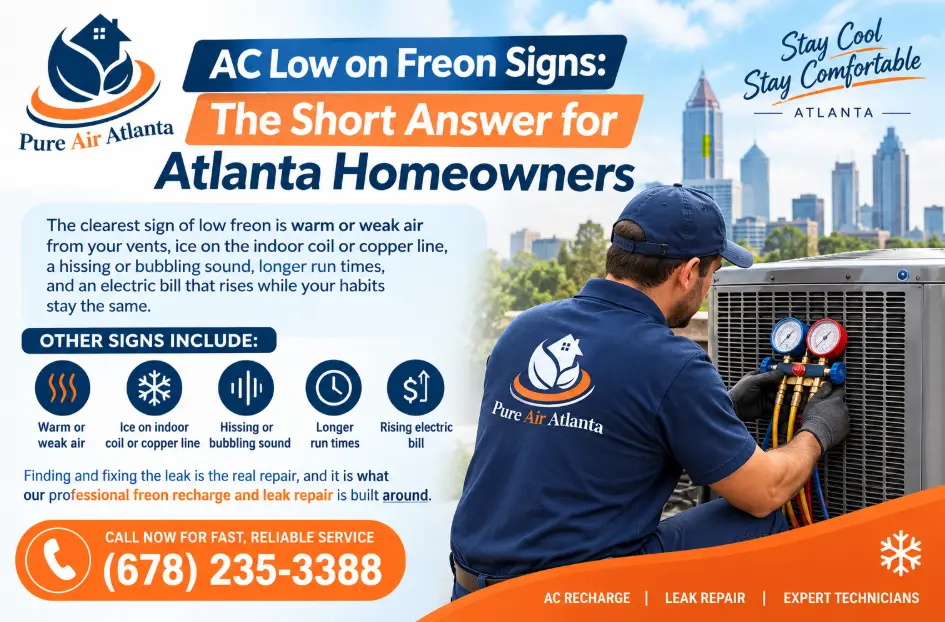
The clearest AC low on freon signs Atlanta homeowners should watch for are warm or weak air from the vents, ice on the indoor coil or copper line, a hissing or bubbling sound, longer run times and an electric bill that rises while your habits stay the same.
Here is the part most guides skip: an air conditioner does not use up refrigerant. If the charge is low, there is a leak (or the system was undercharged at installation), and adding freon alone only buys time. Finding and fixing the leak is the real repair, and it is what our professional freon recharge and leak repair is built around.
“Freon” is an old brand name that most people still use for refrigerant, so you will see both words on this page. Whichever you call it, the stakes are the same in Metro Atlanta: our cooling season is long and humid, and an AC that is quietly losing refrigerant tends to fail on the hottest weekend of the year. Catching it early keeps a small leak repair from turning into a coil or compressor replacement.
Below you will find nine warning signs, a five-minute check that separates low refrigerant from other airflow problems, the most common reasons systems leak, and what a licensed technician actually does to fix it. If your system is already blowing warm air, call (678) 235-3388 and we will send a technician.
9 Warning Signs Your AC Is Low on Freon
One sign alone doesn’t prove a refrigerant problem, but two or three together usually point there. Here is what to look and listen for.
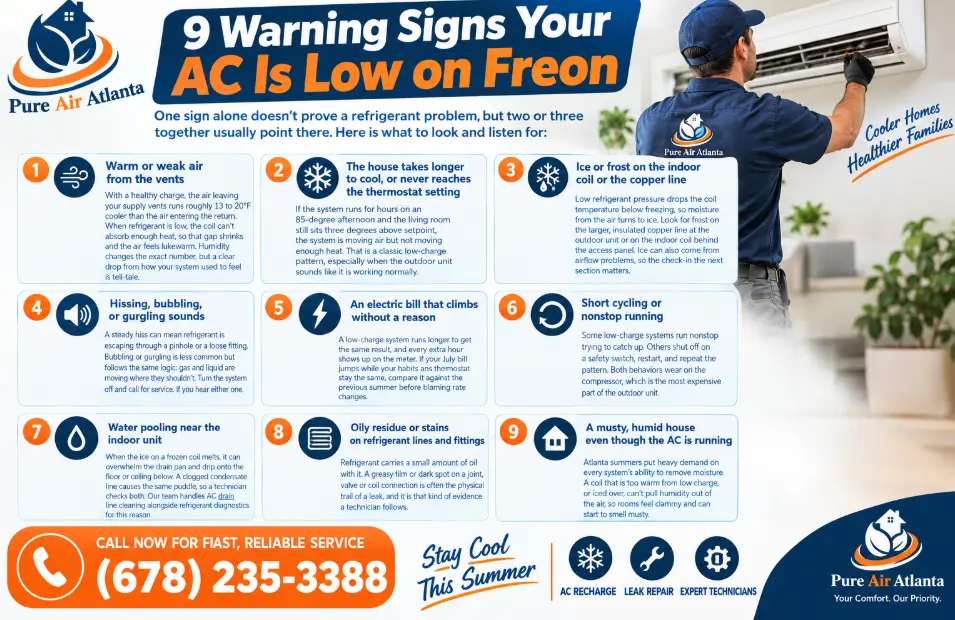
Warm or weak air from the vents
With a healthy charge, the air leaving your supply vents runs roughly 15 to 20°F cooler than the air entering the return. When refrigerant is low, the coil can’t absorb enough heat, so that gap shrinks and the air feels lukewarm. Humidity changes the exact number, but a clear drop from how your system used to feel is the tell.
The house takes longer to cool, or never reaches the thermostat setting
If the system runs for hours on an 88-degree afternoon and the living room still sits three degrees above setpoint, the system is moving air but not moving enough heat. That is a classic low-charge pattern, especially when the outdoor unit sounds like it is working normally.
Ice or frost on the indoor coil or the copper line
Low refrigerant pressure drops the coil temperature below freezing, so moisture from the air turns to ice. Look for frost on the larger, insulated copper line at the outdoor unit or on the indoor coil behind the access panel. Ice can also come from airflow problems, so the check in the next section matters.
Hissing, bubbling or gurgling sounds
A steady hiss can mean refrigerant is escaping through a pinhole or a loose fitting. Bubbling or gurgling is less common but follows the same logic: gas and liquid are moving where they shouldn’t. Turn the system off and call for service if you hear either one.
An electric bill that climbs without a reason
A low-charge system runs longer to get the same result, and every extra hour shows up on the meter. If your July bill jumps while your habits and thermostat stay the same, compare it against the previous summer before blaming rate changes.
Short cycling or nonstop running
Some low-charge systems run nonstop trying to catch up. Others shut off on a safety switch, restart, and repeat the pattern. Both behaviors wear on the compressor, which is the most expensive part of the outdoor unit.
Water pooling near the indoor unit
When the ice on a frozen coil melts, it can overwhelm the drain pan and drip onto the floor or ceiling below. A clogged condensate line causes the same puddle, so a technician checks both. Our team handles AC drain line cleaning alongside refrigerant diagnostics for this reason.
Oily residue or stains on refrigerant lines and fittings
Refrigerant carries a small amount of oil with it. A greasy film or dark spot on a joint, valve or coil connection is often the physical trail of a leak, and it is the kind of evidence a technician follows.
A sticky, humid house even though the AC is running
Atlanta summers put heavy demand on every system’s ability to remove moisture. A coil that is too warm from low charge, or iced over, can’t pull humidity out of the air, so rooms feel clammy and can start to smell musty.
Turn it off if you see ice. An iced coil keeps freezing while the compressor runs. Switch the thermostat to off, leave the fan on, and let the ice melt before you restart or call for air conditioning repair.
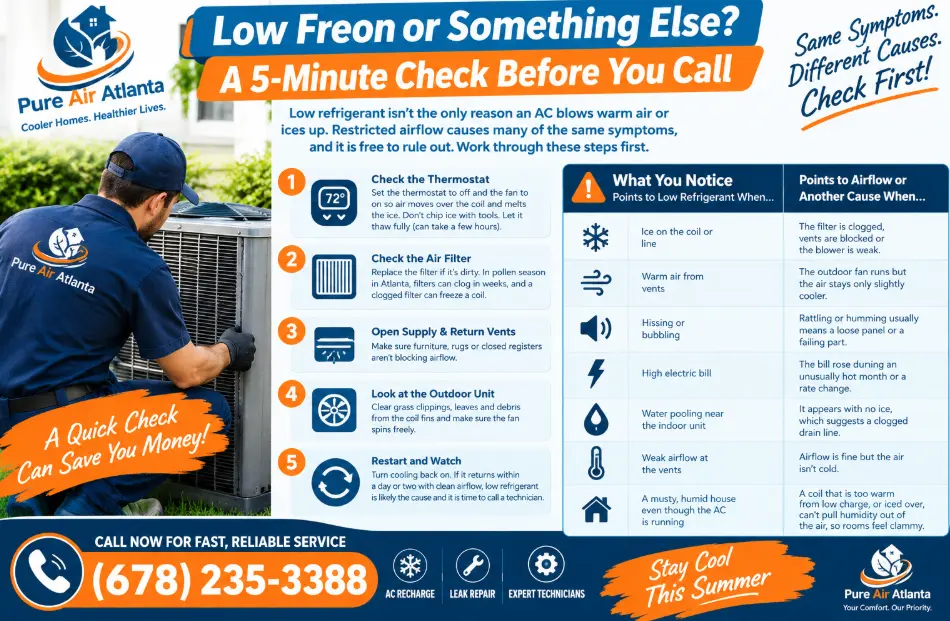
Low Freon or Something Else? A 5-Minute Check Before You Call
Low refrigerant isn’t the only reason an AC blows warm air or ices up. Restricted airflow causes many of the same symptoms, and it is free to rule out. Work through these steps first.
- Thaw the system. Set the thermostat to off and the fan to on so air moves over the coil and melts the ice. Do not chip ice with tools. Let it thaw fully, which can take a few hours.
- Check the air filter. Replace the filter if it is dirty. In pollen season an Atlanta filter can clog in weeks, and a clogged filter alone can freeze a coil.
- Open every supply and return vent. Make sure furniture, rugs or closed registers aren’t choking airflow.
- Look at the outdoor unit. Clear grass clippings, leaves and debris from the coil fins and confirm the fan spins freely.
- Restart and watch. Turn cooling back on. If ice returns within a day or two with clean airflow, low refrigerant is the likely cause and it is time to call a technician.
This table shows how the two most common causes compare.
| What you notice | Points to low refrigerant when… | Points to airflow or another cause when… |
|---|---|---|
| Ice on the coil or line | It returns after a thaw with a clean filter and open vents | The filter is clogged, vents are blocked or the blower is weak |
| Warm air from vents | The outdoor fan runs but the air stays only slightly cooler | The outdoor unit isn’t running or the breaker has tripped |
| Hissing or bubbling | The sound comes from the indoor coil or the outdoor line connections | Rattling or humming usually means a loose panel or a failing part |
| High electric bill | Run times are longer with no change in settings or weather | The bill rose during an unusually hot month or a rate change |
| Water near the indoor unit | It appears after ice melts | It appears with no ice, which suggests a clogged drain line |
| Weak airflow at the vents | Airflow is fine but the air isn’t cold | Airflow itself is weak, which can mean dirty ducts or a failing blower, so consider air duct cleaning |
Why an AC Gets Low on Freon: Where Leaks Start
Refrigerant moves through a sealed loop of copper tubing, two coils and a compressor. Nothing in that loop consumes it, so a low charge always comes from one of a few places.
- Evaporator coil corrosion. Tiny pinholes, often called formicary corrosion, can form in the copper coil inside the air handler. They are hard to see and are a common reason older systems lose charge slowly.
- Loose or worn fittings. Years of vibration can loosen flare connections and the small service valves, which then weep refrigerant.
- Damaged line sets. The copper lines running between indoor and outdoor units can be nicked by a trimmer, rubbed through where they pass framing, or kinked during a renovation.
- Failed solder joints. A poor joint from installation can hold for years and then let go.
- Installation undercharge. A system that was never charged to the manufacturer’s specification runs low from day one, even without a leak.
Atlanta adds its own pressure. A system that runs hard for months, sits in a hot attic, or has a coil coated in pollen and dust works with less margin, so small defects show up sooner. Keeping the coil clean through air conditioning coil cleaning reduces that strain.
Why “just adding freon” isn’t a real fix
A top-off treats the symptom. If refrigerant escaped once, it will escape again, usually from the same spot, and each repeat visit costs more than a proper repair would have. An honest recharge appointment includes a leak search first. If you are weighing the money, read what a freon recharge costs in Atlanta, then compare it with the cost of repeating the top-off every summer.
Why not a DIY recharge kit? Technicians who service air conditioners must be certified, and venting refrigerant is prohibited under EPA’s rule against venting refrigerants. You can learn who must hold a certification at EPA Section 608 technician certification. Beyond the legal side, guessing at a charge without gauges and the manufacturer’s data risks overcharging, which strains the compressor just as undercharging does.
What Happens If You Keep Running an AC That Is Low on Freon
The damage builds in stages. First the coil ices and cooling collapses. Then the compressor runs hotter than it should, because returning refrigerant is part of how it stays cool. Repeated freeze-ups, nonstop run times and short cycling shorten its life, and a failed compressor is often the repair that tips an older system toward AC replacement. If you are already seeing symptoms, a visit for AC compressor repair evaluation may be needed after the leak is fixed.
The comfort cost matters too. Georgia heat is not just an inconvenience, and the Georgia Department of Public Health’s heat safety guidance stresses staying in a cooled space, especially for older adults and young children. If your AC fails during a heat wave and you can’t get service the same day, City of Atlanta’s cooling center information lists where residents can cool off. We also offer emergency AC repair in Atlanta and 24-hour AC repair for these situations.
AC blowing warm air right now?
Talk to a technician now or book a leak and charge diagnosis.
Call (678) 235-3388 Book Freon RechargeWhat a Licensed Technician Does to Fix a Low-Refrigerant AC
A proper repair follows a sequence. Skipping steps is how a “recharge” ends up lasting three weeks.
- Rule out airflow problems. Filter, blower, coil and ducts are checked first so the diagnosis isn’t built on a false symptom.
- Measure the charge. Gauges and temperature readings show pressures, superheat and subcooling compared with the manufacturer’s chart for that exact system.
- Find the leak. Electronic detectors, fluorescent dye, soapy-water bubble checks or a nitrogen pressure test narrow the location.
- Repair or replace the failed part. A fitting, valve or joint can be repaired. A corroded evaporator coil usually has to be replaced.
- Evacuate and charge by weight. After the repair the system is pulled into a vacuum and refilled to the specified amount.
- Verify performance. Temperature split, pressures and run behavior are confirmed before the technician leaves.
That is the work behind our Atlanta freon recharge service. Before you hire anyone, you can verify a contractor’s state license through the Georgia Secretary of State’s Board of Conditioned Air, which describes licensing requirements and links to a license lookup.
Repair, recharge or replace?
The right answer depends on three things: where the leak is, how old the system is, and which refrigerant it uses. A simple fitting leak on a newer system is almost always worth repairing. A leaking coil on a system that is old and already needs other work is a closer call. Refrigerant type matters because it affects availability and cost over the life of the system, and a technician can read it from the nameplate. For a price benchmark, see AC repair costs in Atlanta, and for the bigger decision, our team can walk you through AC replacement options without pressure.
Low Refrigerant in Heat Pumps, Package Units and Mini Splits
The same principle holds across equipment types. Heat pumps lose charge the same way split systems do. If your package unit isn’t cooling, start with the airflow check above and then call for a gauge test. Ductless owners should read why a mini split isn’t cooling, because ice on the indoor head or a hissing line points to the same refrigerant question with a different set of parts.
How to Prevent Low Refrigerant Problems in Atlanta
- Schedule yearly AC maintenance service. A spring tune-up catches weeping fittings, dirty coils and weak airflow before the heat arrives.
- Change filters on time. Check monthly during pollen season. Clogged filters cause freeze-ups that look like refrigerant problems.
- Keep the outdoor unit clear. Leave about two feet around it and mow or trim away from the line set.
- Don’t ignore small changes. A slow drift in cooling, a new sound or an odd bill is the early warning. The sooner a leak is found, the less refrigerant is lost.
- Clean the coils. Dirt acts as insulation and raises operating pressure. See our coil cleaning costs guide for what to expect.
Think your AC is low on freon?
Our technicians find the leak, fix it and charge the system to spec, so you aren’t paying for the same top-off twice.
Call (678) 235-3388 Request Service OnlineAC Low on Freon Signs Atlanta: Where We Help Across the Metro
We service homes across the metro area, including the Atlanta neighborhoods and surrounding suburbs. Browse all of our service areas, or go straight to your city.
Want to know who will be at your door first? Meet our technicians, read our customer reviews, or check the pricing page before you book. Questions we hear often are also on our FAQ page.
Frequently Asked Questions About AC Low on Freon Signs Atlanta
How do I know if my AC is low on freon?
Can an air conditioner run out of freon without a leak?
Is it safe to keep running my AC if it is low on freon?
Can I add freon to my AC myself?
How much does it cost to fix an AC that is low on freon?
Does low freon damage the compressor?
Next Step: Get a Real Diagnosis, Not a Guess
If two or more of the signs above match your system, stop running it and book a leak-and-charge diagnosis. It is faster and cheaper to repair a small leak than to rebuild a system that ran iced over all summer. Call (678) 235-3388, use the contact page, or review all HVAC services to see everything we can help with.
References: EPA’s rule against venting refrigerants; EPA Section 608 technician certification; Georgia Secretary of State’s Board of Conditioned Air; Georgia Department of Public Health’s heat safety guidance; City of Atlanta’s cooling center information.
HVAC Service Area — ZIP Code Directory
92 ZIP codes served · Tap any ZIP to call +1 (678) 235-3388 · pureairatlanta.com