
Georgia Boiler Inspection Requirements at a Glance
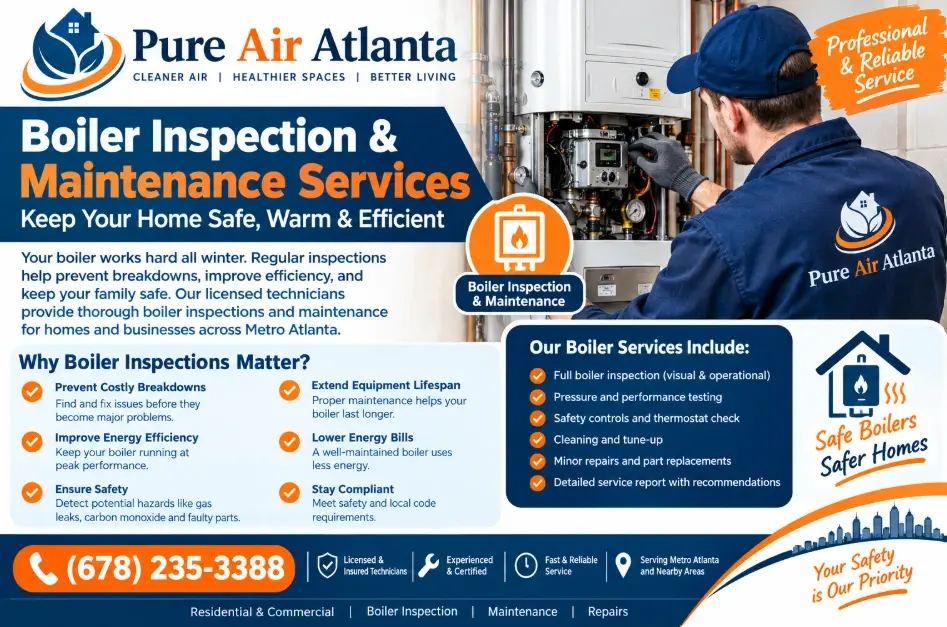
If you own or manage a building in Metro Atlanta, the Georgia boiler inspection requirements decide whether your boiler can legally run. Under Georgia’s Boiler and Pressure Vessel Safety Act, every boiler and pressure vessel used in the state must be inspected, unless it falls under a listed exemption. The state issues a certificate (also called an operating permit) after each inspection, and how often you need one depends on the type of boiler.
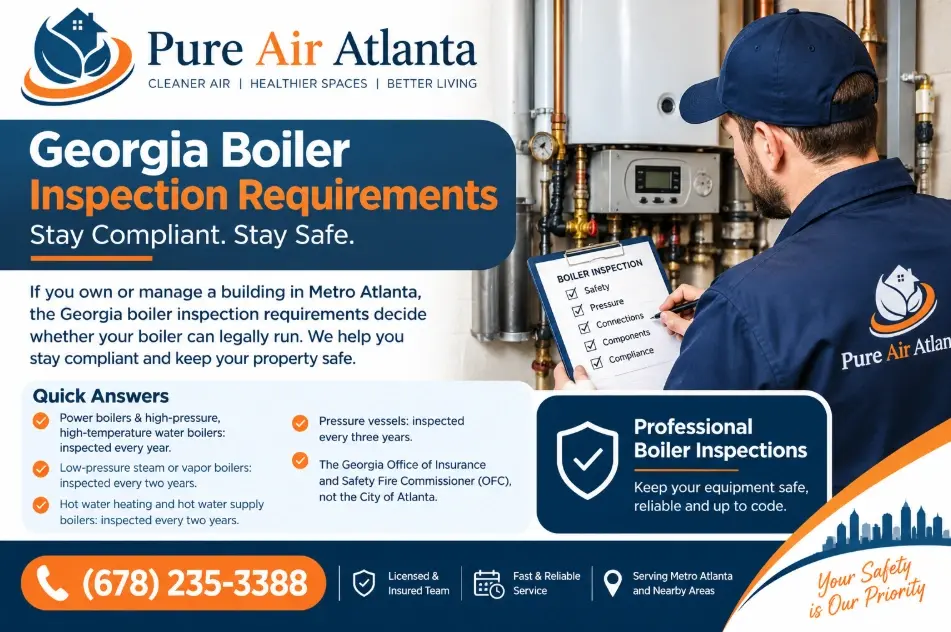
Quick answer
- Power boilers and high-pressure, high-temperature water boilers: inspected every year.
- Low-pressure steam or vapor boilers: inspected every two years.
- Hot water heating and hot water supply boilers: inspected every two years.
- Pressure vessels: inspected every three years.
- Who inspects: the Georgia Office of Insurance and Safety Fire Commissioner (OCI), not the City of Atlanta.
In this guide
Who Needs a Boiler Certificate in Georgia?
Georgia’s rule on boiler and pressure vessel inspection (Rule 120-3-26-.08) applies to each boiler and pressure vessel used, or proposed to be used, in the state, except those exempted under O.C.G.A. § 25-15-16. In practice, the people responsible are the owner or user of the equipment. That usually means:
- Commercial property owners and facility managers with steam or hot water heating boilers.
- Hotels, apartment communities, schools, churches and medical offices with central boiler plants.
- Restaurants, laundries and manufacturers that run process or hot water supply boilers.
- Owners of pressure vessels connected to those systems.
Exemptions to check before you assume you are covered
Not every boiler falls under the Safety Act. Besides the exceptions in O.C.G.A. § 25-15-16, Rule 120-3-26-.22 exempts items such as qualifying espresso machine boilers, boilers with an outlet open to the atmosphere that cannot exceed 0 psig or 212°F, and small open-system spa or pool water heaters (six gallons or less and 400,000 BTU/hr or less). Those small heaters must still meet the adopted construction and installation standards.
How Often Does Georgia Require Boiler Inspections?
The schedule is set by equipment type. This table summarizes Rule 120-3-26-.08:
| Equipment | Inspection type | Frequency |
|---|---|---|
| Power boilers and high-pressure, high-temperature water boilers | Internal where construction permits, plus external under pressure if possible | Annually |
| Low-pressure steam or vapor boilers | Permit (certificate) inspection | Every 2 years |
| Hot water heating and hot water supply boilers | Permit (certificate) inspection | Every 2 years |
| Pressure vessels | Permit inspection; internal at the inspector’s discretion | Every 3 years |
Industrial plants may apply to the OCI for longer internal inspection intervals on certain power boilers (up to 24 months), but only with approved operator training, maintenance records, water chemistry data and an inspection agency’s approval letter. For a typical commercial building, plan on the standard schedule above.
What Happens During a Georgia Boiler Certificate Inspection?
Certificate inspections follow the National Board Inspection Code (NBIC), Parts 1 and 2. The inspector looks at the boiler’s construction, installation and condition. For safety, the inspector also witnesses or reviews testing of the controls and safety devices, such as low-water cutoffs, pressure and temperature limits, relief valves and flame safeguards, against the manufacturer’s requirements. The ASME CSD-1 checklist is the common reference for what gets tested.
The owner or user is responsible for making sure installation, maintenance, operation and control testing follow manufacturer requirements. State inspectors also have the right to access premises during reasonable hours, and denying them access is a violation of the Act.
Who Is Allowed to Service Your Boiler Before Inspection?
This is the point many Atlanta property managers miss. Under Georgia’s rule, maintenance and testing of boiler controls and safety devices must be done by a contractor holding a valid Certificate of Authority with the appropriate classification. Before you hire anyone for pre-inspection work, ask to see that certificate and the classification it covers.
Keep records of every service visit. If you are also planning boiler work, our team can walk you through scope and scheduling on our boiler repair in Atlanta service page.
Georgia Boiler Inspection Checklist: How to Prepare
Passing a certificate inspection is mostly about preparation. Use this checklist in the weeks before your due date:
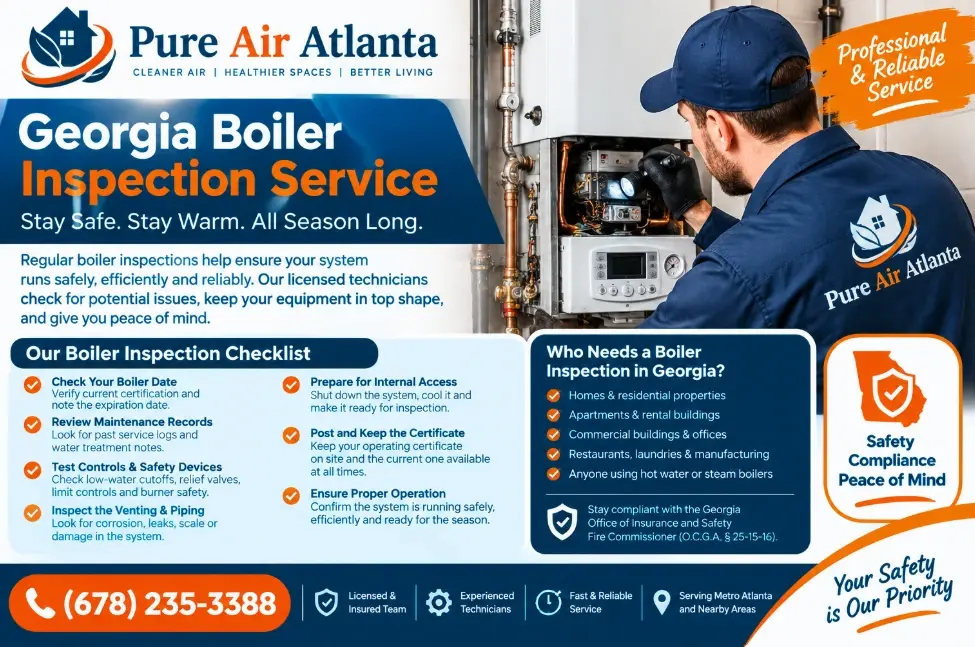
- Find your due date. Check your current certificate and note the expiration. Georgia’s schedule runs from it.
- Review maintenance records. Have service logs, water treatment notes and control test results in one folder.
- Test controls and safety devices. Low-water cutoffs, relief valves, limit controls and burner safeties should be tested to the manufacturer’s requirements by a properly certified contractor.
- Clear the boiler room. Keep access open, remove stored materials and make sure combustion air openings are unblocked.
- Inspect the venting and piping. Look for corrosion, leaks, scale or damaged insulation and fix them before the inspector arrives.
- Prepare for internal access. Where the inspection is internal, the boiler needs to be shut down, cooled and made ready as the inspector requires.
- Post and keep the certificate. Keep the current operating certificate available at the site.
Because boilers share a mechanical room with other equipment, this is also a good time to service related systems. Our furnace maintenance and tune-up guide shows what a seasonal check should include, and our HVAC cleaning in Atlanta service keeps the rest of the heating and cooling system running cleanly.
What Happens If a Boiler Is Overdue or Fails Inspection?
The state treats overdue and unsafe boilers seriously:
- Cessation orders. If a boiler or pressure vessel is found hazardous or unsafe, the Commissioner or an authorized representative can issue a written order to stop operating it. It cannot resume until the problems are corrected to their satisfaction.
- Penalties. Operating after a cessation order, or before required inspections, can lead to penalties under the state rules.
- Special inspections and extra fees. If a boiler is more than six months overdue, a state deputy inspector inspects it and the owner may be invoiced for a special inspection on top of standard fees.
- Appeals. Anyone aggrieved by an order can appeal under O.C.G.A. § 25-15-28.
If a boiler accident occurs, report it immediately to the OCI at (404) 473-1301, followed by the written report the office requires.
For a downed boiler in a commercial building, an overdue inspection is only half the problem. If you also need heat restored fast, see our emergency furnace repair in Atlanta page for same-day heating help, and our Atlanta winter weather heating guide for what to prepare before cold snaps.
New Boiler Installations and Replacements in Atlanta
New and secondhand boilers add a second layer of rules. The company or person doing the installation must obtain an installation permit from the state before any work begins, and installations must meet ASME, NBIC and CSD-1 requirements. Boilers at or above 12,500,000 BTU/hr must also meet NFPA 85. The installer is responsible for notifying the state’s Safety Engineering Section when the boiler is ready for inspection.
Inside the city, mechanical work such as heating equipment and vent changes can also require a City of Atlanta permit. The City of Atlanta technical permit page explains online permitting and lists the contact line for HVAC permits, and the Office of Buildings overview explains when permits are required for mechanical changes. The city permit is separate from the state boiler certificate, so plan for both.
Replacing a rooftop or package system instead of a boiler? Compare options on our package unit repair page, or see how hotel and apartment owners handle through-wall systems in our PTAC replacement cost guide.
Boiler Inspection vs. Boiler Maintenance: Not the Same Thing
A state certificate inspection confirms your boiler met safety requirements on the day it was inspected. It does not replace routine maintenance. Efficiency, water quality, burner tuning and early repairs all happen between inspections. Many commercial owners in Atlanta also pair boiler care with other building systems, such as commercial air duct cleaning in Atlanta and commercial AC service, so one vendor relationship covers heating, cooling and air quality.
If your building mixes boilers with other heating types, our heat pump vs. furnace comparison can help you decide what to replace first, and our PTAC maintenance checklist covers the in-room units many hotels run alongside a central plant.
Need boiler help before your inspection date?
Tell us what you are running and when your certificate expires. We will help you plan repairs and service so you are not scrambling at the deadline.
Boiler Repair Atlanta Contact Pure Air AtlantaGeorgia Boiler Inspection Requirements: FAQs
How often does Georgia require a boiler inspection?
Power boilers and high-pressure, high-temperature water boilers need an annual inspection. Low-pressure steam or vapor boilers and hot water heating or supply boilers need one every two years, and pressure vessels every three years.
Who performs boiler inspections in Georgia?
The Georgia Office of Insurance and Safety Fire Commissioner is responsible for boiler and pressure vessel inspections and for issuing Certificates of Authority to companies that install, maintain or service boilers.
Can any HVAC company service my boiler?
No. Maintenance and testing of controls and safety devices must be done by a contractor with a valid Certificate of Authority in the appropriate classification. Ask to see it before work starts.
What if my boiler inspection is overdue?
An overdue boiler can face penalties, and if it is more than six months overdue, a state deputy inspector may inspect it and the owner can be invoiced for a special inspection in addition to standard fees.
Are all boilers covered by the inspection rule?
No. Some boilers and pressure vessels are exempt under O.C.G.A. § 25-15-16 and Rule 120-3-26-.22. Confirm your equipment with the Office of Insurance and Safety Fire Commissioner before assuming an exemption applies.
Do I also need a City of Atlanta permit?
Possibly. State boiler certification and City of Atlanta mechanical permits are separate. Installations and certain mechanical changes can require a city permit, so check with the Office of Buildings.
Official Sources and Local Service Areas
This guide summarizes publicly available rules and is not legal advice. Always confirm current requirements with the state before acting.
- Ga. Comp. R. & Regs. 120-3-26-.08: Boiler and Pressure Vessel Inspection Requirements
- Ga. Comp. R. & Regs. 120-3-26-.07: New and secondhand boiler installations
- Georgia Office of Insurance and Safety Fire Commissioner: Boilers and Pressure Vessels
- City of Atlanta: Apply for a Technical Permit
Pure Air Atlanta serves commercial and residential customers across Metro Atlanta locations, including the Atlanta neighborhoods we serve. Browse our full HVAC services, or check pricing and frequently asked questions before you call.
HVAC Service Area — ZIP Code Directory
92 ZIP codes served · Tap any ZIP to call +1 (678) 235-3388 · pureairatlanta.com