
Heat Pump vs Furnace Atlanta: The Short Answer
The heat pump vs furnace Atlanta question comes up every fall, and the honest answer is that both can work well here. Atlanta winters are mild enough that a modern heat pump can heat most homes efficiently, while a gas furnace still has the edge on the coldest nights and delivers the warmer, stronger airflow many people prefer. Which one is better for you depends on your gas service, your ductwork, your energy prices and how you like your home to feel.
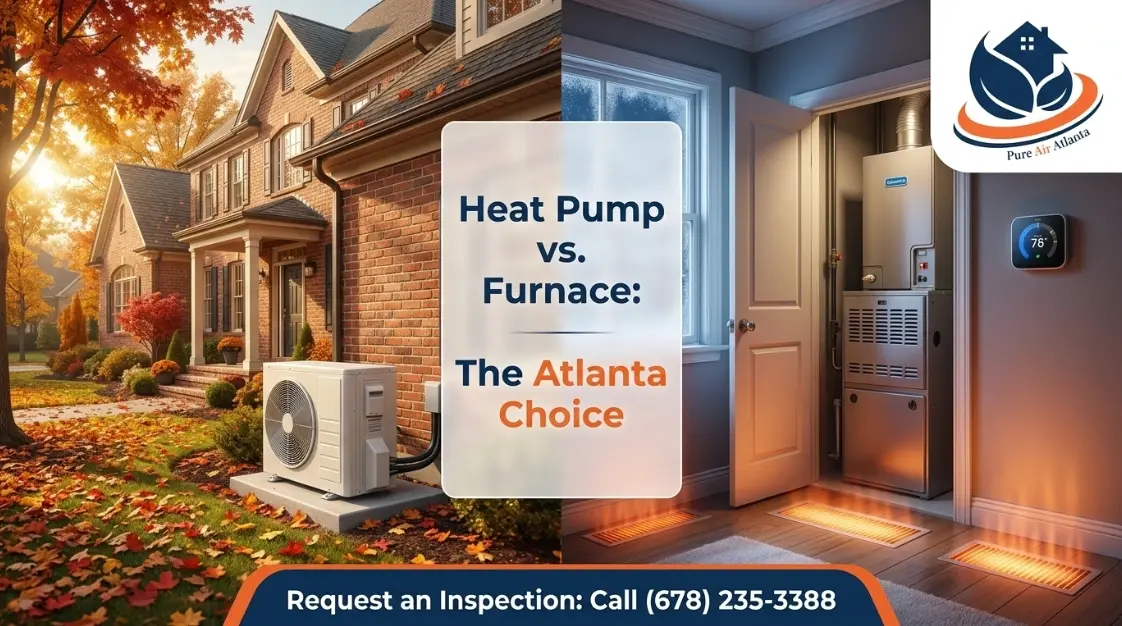
If your furnace is aging and you are weighing furnace replacement in Atlanta against a new heat pump, this guide gives you the real trade-offs, without sales pressure, so you can make the call before the cold arrives.
Choose a heat pump if you want one efficient system for heating and cooling and your winters rarely get severe. Choose a gas furnace if you value strong, hot airflow and already have natural gas. Consider dual fuel if you want efficiency on mild days with gas backup when it gets cold.
How Each System Heats Your Home
Gas furnace
A gas furnace burns natural gas, passes the heat to your air through a heat exchanger and pushes it through the ducts. Efficiency is measured as AFUE, the share of the fuel’s heat that becomes heat in your home. Standard models sit around 80%, and condensing models reach roughly 90% to 99%. It still needs electricity to run the igniter and blower.
Heat pump
A heat pump moves heat instead of making it. In winter it pulls heat from outdoor air into the house, and in summer it reverses and works like an air conditioner. ENERGY STAR notes that heat pumps can deliver up to three times more heat energy than the electrical energy they use. When it gets very cold, electric backup heat strips help out.
Heat Pump vs Furnace in Atlanta Winters
Temperature is the heart of the heat pump vs furnace Atlanta debate. ENERGY STAR certified air-source heat pumps are tested to perform at temperatures as low as 5°F, and most Atlanta winter nights are well above that. Still, a heat pump loses output and efficiency as the air gets colder, and it leans on backup heat during hard freezes. A gas furnace keeps its output no matter how cold it is outside. Here is how the two compare day to day.
| Factor | Gas furnace | Heat pump |
|---|---|---|
| Heat source | Burns natural gas | Moves heat from outdoor air using electricity |
| Cooling | None, needs a separate air conditioner | Heats and cools with one outdoor unit |
| Cold nights | Steady output at any temperature | Output drops as it gets colder and backup heat may start |
| How the air feels | Hot, strong airflow | Warm but milder, with longer run times |
| Running cost | Depends on natural gas prices | Depends on electricity prices and backup heat use |
| Typical lifespan | Around 15 to 20 years | Around 10 to 15 years |
| Safety | Combustion, so it needs venting, yearly service and carbon monoxide alarms | No combustion gases from heating |
| Power outage | Will not run without electricity | Will not run without electricity |
You can read the official explanations on the Department of Energy’s heat pump systems page and ENERGY STAR’s air-source heat pump guide.
What It Costs: Furnace vs Heat Pump
When comparing heat pump vs furnace Atlanta costs, we will not throw out a single number, because installed prices vary with the size of your home, your ducts, the equipment tier and what already exists. Instead, focus on the factors that drive the total:
- Replacing both systems: a heat pump replaces your air conditioner and furnace with one outdoor unit, while a furnace usually pairs with a separate air conditioner.
- Energy prices: heat pump bills follow electricity rates, and furnace bills follow natural gas rates, so the cheaper option can change from year to year.
- Ductwork: leaky or undersized ducts hurt either system, so repairs may be part of the project.
- Gas availability: a furnace needs a gas line, and a heat pump may need electrical upgrades.
- Incentives: the IRS lists the federal Energy Efficient Home Improvement Credit for property placed in service before December 31, 2025, so do not assume it covers a 2026 installation. Ask about current utility, manufacturer and local offers.
For local pricing context, see what furnace installation costs in Atlanta and our heat pump repair and installation costs in Smyrna. If you also need a new air conditioner, compare AC replacement costs in Smyrna and in Alpharetta, or review AC replacement in Atlanta for the cooling side. You can also browse our service pricing page.
Dual Fuel: A Heat Pump Plus a Gas Furnace
You do not always have to pick one. A dual fuel system, sometimes called a hybrid, pairs a heat pump with a gas furnace. The Department of Energy describes the idea simply: the heat pump handles heating in mild weather, and the furnace takes over during colder temperatures. In the heat pump vs furnace Atlanta decision, where most winter days are mild but a few nights bite, that mix can keep bills in check while guaranteeing strong heat on the worst nights.
Dual fuel often makes sense when your existing furnace is still in good shape and your air conditioner is near the end of its life, because swapping the air conditioner for a heat pump adds efficient winter heating without throwing out a working furnace. It also suits homeowners who want gas backup for peace of mind during ice storms and cold snaps.
Which System Fits Your Atlanta Home?
There is no universal winner in the heat pump vs furnace Atlanta choice, but these profiles show where each option tends to fit best.
A heat pump fits if…
You want one system for year-round comfort, your home has no gas service, your ducts are in decent shape, and you are comfortable with gentler warm air and occasional backup heat.
A gas furnace fits if…
You already have natural gas, you like hot, strong airflow, you want steady output on the coldest nights, and your current furnace needs replacing but your cooling system is fine.
Dual fuel fits if…
You want lower running costs on mild days with gas backup for hard freezes, and your furnace and ducts are in good enough condition to keep working alongside a heat pump.
Repair may be smarter if…
The system is under about 10 years old and needs one part. Our furnace repair in Atlanta team can tell you honestly whether replacing makes sense.
Before You Decide: Get the Home Evaluated
Whichever way you lean on heat pump vs furnace Atlanta, the best equipment performs badly if it is sized or installed poorly. The Department of Energy says plainly that an efficient furnace will not save energy or money if it is not properly installed, and the same applies to heat pumps. Ask for these steps before you sign anything:
- A proper load calculation. Ask the contractor to size the system with a Manual J load calculation, not a rule of thumb. Oversized equipment short cycles and wears out sooner.
- A duct inspection. Leaky ducts waste heat in the attic or crawlspace. Duct sealing in Atlanta and air duct cleaning often belong in the same project.
- A look at your current furnace. A furnace maintenance and tune-up visit shows whether the existing unit still has years left, which matters a lot for the dual fuel option.
- Written options with clear numbers. Get the heat pump, furnace and dual fuel options side by side, with equipment, installation and any duct work itemized.
Not sure which system fits your home?
Our technicians will inspect your current system and walk you through heat pump, furnace and dual fuel options with clear numbers.
Call (678) 235-3388 Request an InspectionSafety and Maintenance for Either System
A gas furnace burns fuel, so it should be professionally inspected every year, and your home should have carbon monoxide alarms on every level and outside sleeping areas, as the Consumer Product Safety Commission recommends. A heat pump does not burn fuel to heat, but it still needs clean filters, clear outdoor coils and a yearly checkup. If a furnace stops heating, our guides to a furnace not heating in Atlanta homes and gas furnace repair explain what to do. For safe heating practices during cold weather, see the Ready.gov winter preparedness guidance.
Official Energy and Safety Resources
These government sources back up the facts in this guide and are worth bookmarking before you shop.
- DOE heat pump systems: how heat pumps work
- DOE furnace purchasing guide: AFUE and installation quality
- ENERGY STAR air-source heat pumps: efficiency and cold performance
- ENERGY STAR furnace criteria: what AFUE means
- IRS home improvement credit: federal credit dates and rules
- CPSC carbon monoxide center: alarms and symptoms
- NWS Atlanta and Peachtree City: live local forecasts
- Georgia GEMA winter safety: state preparedness tips
Heating Help Across Metro Atlanta
Pure Air Atlanta serves homeowners across the metro area. Pick your city for local furnace information, or visit our service areas page for the full list.
- Furnace replacement in Smyrna and Smyrna replacement costs
- Furnace replacement in Marietta and Marietta replacement costs
- Furnace replacement in Alpharetta and Alpharetta replacement costs
- Furnace replacement in Roswell
- Furnace replacement in Lawrenceville
- Furnace replacement in Douglasville
- Furnace repair in Kennesaw
- Furnace repair in Sandy Springs
- Furnace installation in Decatur
- Furnace repair costs in Cumming
Want to know who will be in your home? Read about Pure Air Atlanta, meet our technicians, or see our customer testimonials. Our frequently asked questions cover scheduling and service basics, and the Pure Air Atlanta blog has more heating guides.
Heat Pump vs Furnace Atlanta FAQs
Are heat pumps good for Atlanta winters?
Yes, for most homes. Atlanta winters are mild compared with northern states, and modern heat pumps are tested to heat down to about 5 degrees Fahrenheit, well below the temperatures Atlanta sees on most winter nights. On the coldest nights a heat pump leans on backup heat, which is why some homeowners prefer a gas furnace or a dual fuel system.
Is a heat pump cheaper to run than a gas furnace?
It depends on local electricity and natural gas prices, your home’s insulation and ductwork, and how cold the winter is. A heat pump moves heat instead of burning fuel, so it can deliver several times more heat than the electricity it uses on mild days. Ask for a written estimate that compares both systems for your actual home.
Does a heat pump work when it is freezing outside?
Yes. A heat pump keeps heating below freezing, but its efficiency and output drop as the temperature falls. Below a certain point it relies on electric backup heat, which costs more to run. Cold-climate and ENERGY STAR certified models are built to hold up better at low temperatures.
Can I keep my gas furnace and add a heat pump?
Often yes. A dual fuel system pairs a heat pump with a gas furnace. The heat pump handles mild weather efficiently, and the furnace takes over when it gets colder. Your existing ducts, furnace age and condition, and thermostat compatibility decide whether the upgrade makes sense.
How long do heat pumps and furnaces last?
Gas furnaces commonly last around 15 to 20 years with regular maintenance. Heat pumps often last somewhat less, around 10 to 15 years, because they run for cooling in summer as well as heating in winter. Yearly service and clean filters help either system reach the long end of that range.
Which is safer, a heat pump or a gas furnace?
Both are safe when installed and maintained properly. A gas furnace burns fuel, so it needs yearly inspection, proper venting and working carbon monoxide alarms. A heat pump does not burn fuel to make heat, so it produces no combustion gases, but it still needs regular service like any HVAC system.
Get an honest recommendation for your home
Call (678) 235-3388 or send a message, and we will compare repair, furnace, heat pump and dual fuel options for you.
Call (678) 235-3388 Contact Pure Air Atlanta
HVAC Service Area — ZIP Code Directory
92 ZIP codes served · Tap any ZIP to call +1 (678) 235-3388 · pureairatlanta.com