If you’re smelling an intense hot odor, hearing a loud crackling or roaring sound, or seeing dense smoke or flames from your chimney right now — leave the house and call 911 immediately. The rest of this guide covers prevention, not what to do during an active fire.
How Often Should You Clean Your Chimney Douglasville? A Fire Safety Guide
The most common question we get when it comes to how often clean chimney Douglasville homeowners should be scheduling is simple on the surface — but the real answer depends on how you use your fireplace, not the calendar. The National Fire Protection Association (NFPA) sets the floor: every chimney, fireplace, and vent should be inspected at least once a year, regardless of how much it’s used. From there, actual cleaning frequency depends on usage, wood quality, and what your inspection finds.
This guide is less about pricing and more about chimney fire safety — why chimney fires start, the warning signs, and how often you actually need a professional out to your Douglasville home to stay ahead of them.
Why Chimney Fires Happen: The Creosote Danger
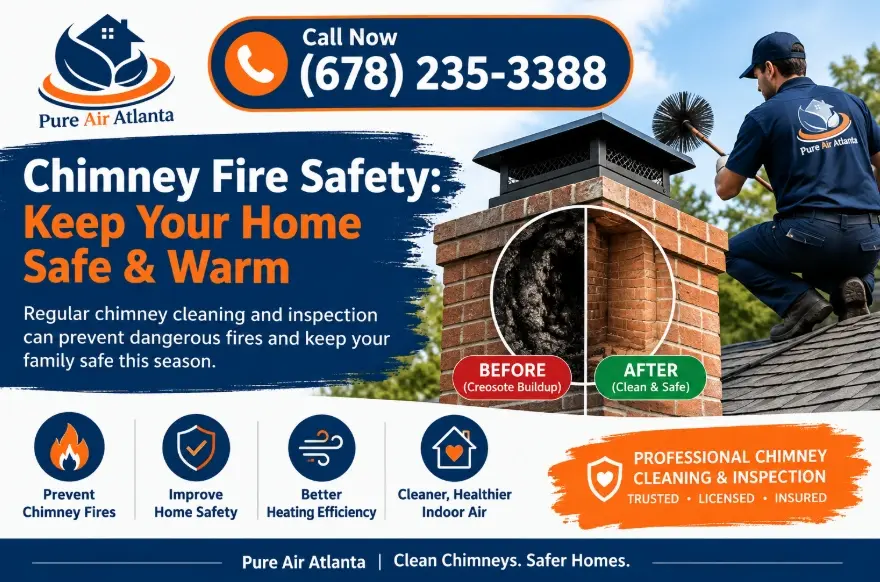
Every time you burn wood, the smoke, gases, and unburned particles that rise up your flue cool against the chimney walls and condense into creosote — a black or brown residue that’s highly combustible in every form it takes. Creosote builds in three recognized stages, and each one is harder to remove and more dangerous than the last:
- Stage 1 — Flaky soot: Light, dusty, and easy to brush away during a routine cleaning. Lowest fire risk, and the easiest stage to catch.
- Stage 2 — Crunchy, shiny crust: Baked on by repeated heat cycles, often described as “honeycombed.” Requires specialized tools to remove and carries meaningfully higher fire risk.
- Stage 3 — Glazed, tar-like coating: The most dangerous stage — a thick, glass-like coating that can ignite at flue temperatures and burn at over 2,000°F. Often requires chemical treatment plus mechanical brushing, or in severe cases, liner replacement.
Burning unseasoned or “green” wood accelerates every stage, since wetter wood produces more smoke and slower, cooler combustion — exactly the conditions creosote needs to build up fast.
Warning Signs of an Active Chimney Fire
Chimney fires aren’t always the dramatic, roof-shooting-flames scene people picture — the CSIA notes that a majority of them go undetected while they’re happening. Know these signs and treat any of them as an emergency:
- An intense, hot smell coming from the fireplace or flue
- Dense smoke filling the room or visible outside
- A low rumbling sound, or loud cracking and popping noises
- Flames or dense smoke shooting from the top of the chimney
If You Notice Any of These Signs
- Get everyone out of the house immediately — don’t stop to gather belongings.
- Call 911 from outside the home, not from inside.
- Do not throw water on the fire — it can crack a hot flue liner and create a steam hazard.
- Do not use the fireplace again until a certified chimney sweep has inspected it for damage.
Signs You’ve Already Had a Chimney Fire (and Didn’t Know)
Because so many chimney fires go unnoticed in the moment, a professional inspection is often the only way you’ll find out one happened. Signs a sweep looks for include cracked or discolored flue tiles, a warped or discolored chimney cap, creosote flakes or ash on the roof, and heat damage to anything mounted on the chimney. This is exactly why the annual inspection matters even if nothing seems wrong.
Chimney Fire Safety Statistics Every Douglasville Homeowner Should Know
Winter in Douglas County means exactly the conditions that drive that last statistic — heavier fireplace use through December and January. The Douglas County Fire/EMS Department responds to preventable chimney fires every heating season, and an annual sweep before your first fire of the year is the single biggest lever you have to stay off that list.
How Often to Clean Based on How You Use Your Fireplace
| Usage Pattern | Recommended Frequency | Why |
|---|---|---|
| Primary heat source (daily use, all winter) | 2–3x per season | Fastest creosote buildup, highest fire risk |
| Regular use (weekly, cold months) | Annually, mid-season check | Moderate buildup, still needs a mid-season look |
| Occasional use (holidays, special occasions) | Annually | NFPA minimum still applies regardless of usage |
| Rarely or never used | Annually | Animal nests, debris, and moisture damage an unused flue too |
| Burned any unseasoned/wet wood | Inspect sooner | Green wood accelerates creosote glaze significantly |
Chimney Fire Safety Checklist
- Schedule a professional inspection at least once a year, before your first fire of the season
- Only burn well-seasoned hardwood, dried 6–12 months, never cardboard or trash
- Keep a glass or metal screen in front of the fireplace to catch sparks
- Keep anything combustible at least three feet from the fireplace or chimney
- Install a chimney cap to keep out animals, debris, and stray embers
- Never leave a fire burning unattended or while you sleep
Frequently Asked Questions
How often should you clean your chimney if you use it daily?
Homes that rely on a fireplace or wood stove as a primary heat source through the winter typically need 2 to 3 cleanings per season, since creosote builds up much faster with daily use.
Do I need a chimney inspection if I never use my fireplace?
Yes. The NFPA recommends an annual inspection regardless of usage — unused chimneys still collect animal nests, leaves, and moisture damage that can block airflow or damage the liner.
What’s the difference between an inspection and a cleaning?
An inspection checks the flue, liner, damper, and crown for damage or buildup. A cleaning physically removes creosote and debris. Most annual visits include both, and cleaning frequency depends on what the inspection finds.
Can I tell if I have dangerous creosote buildup myself?
Not reliably. Stage 2 and Stage 3 creosote can look deceptively minor from a flashlight check at the firebox. A certified sweep uses tools to check thickness and condition along the full flue length.
What should I do if I think I’ve already had a chimney fire?
Stop using the fireplace and schedule a professional inspection before your next fire — a chimney fire can damage the liner in ways that aren’t visible without a proper inspection, even if the fire seemed to go out on its own.
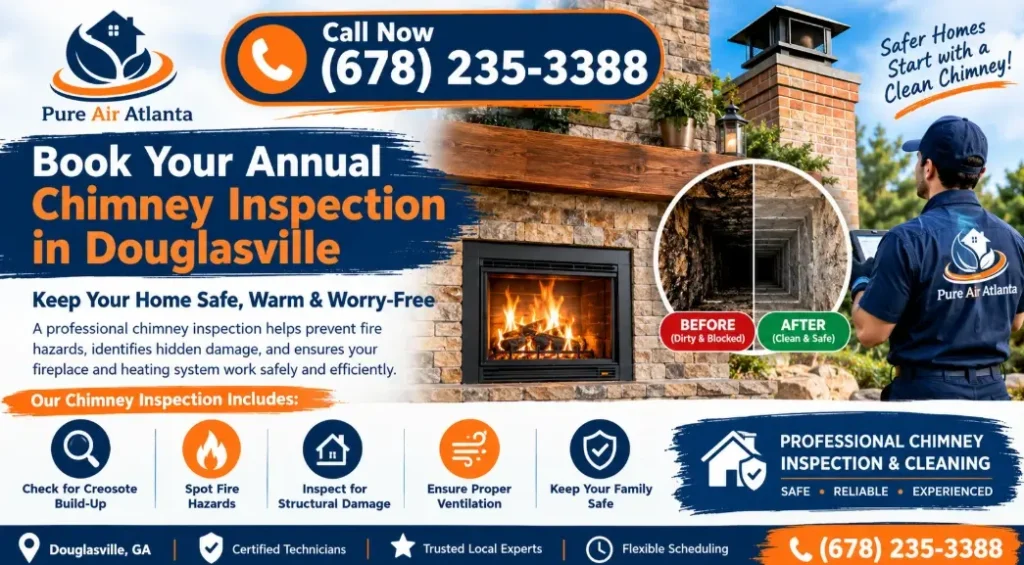
Book Your Annual Chimney Inspection in Douglasville
Staying ahead of chimney fire safety starts with one appointment a year. See our Douglasville chimney cleaning cost guide for itemized pricing, or head straight to our Douglasville chimney cleaning page to book. While you’re thinking about winter safety, our dryer vent fire risk guide and guide to choosing a reliable Douglasville heating and air company cover the rest of your home’s fire-prevention checklist this season.
Book your annual chimney inspection before your next fire — certified, itemized, no surprises.
Call (678) 235-3388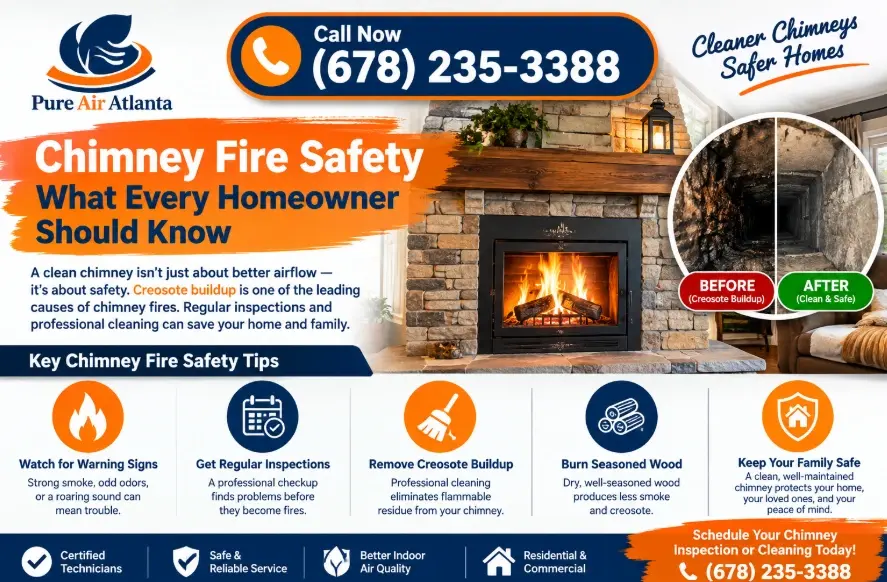
Douglasville, GA Service Area — ZIP Code Directory
2 ZIP codes served · Tap any ZIP to call +1 (678) 235-3388 · pureairatlanta.com