

Steam vs Hot Water Boiler Atlanta: The Short Answer
If you own or manage an older building in Atlanta, the first thing any boiler technician will ask is whether you have a steam vs hot water boiler Atlanta. The two systems look alike from the street, and they often share the same cast-iron radiators, but they work differently, break differently and are repaired differently. Knowing which one you have saves you from paying for the wrong part, the wrong vent or the wrong service call.
Fastest way to tell
- Look for a vertical glass tube on the boiler. A sight glass (gauge glass) showing a water level means steam.
- Look for a circulator pump near the boiler. A pump on the piping points to hot water, since steam is not pumped.
- Read the gauge. A pressure and temperature gauge reading well above zero when cold points to hot water. A steam boiler runs at very low pressure.
- Check a radiator. A small bleeder valve usually means hot water, and an air vent on a one-pipe radiator usually means steam.
In this guide
How Steam and Hot Water Heating Work
Both systems start with a boiler heating water. The difference is what travels to the radiators.
Steam heating
The boiler turns water into low-pressure steam. The steam rises through the pipes into the radiators, gives up its heat, condenses back into water and returns to the boiler. Because steam moves on its own, there is usually no pump.
Hot water heating
The boiler heats water without boiling it, and a circulator pump moves that hot water through a closed loop of pipes and radiators. The water cools as it heats each room and returns to the boiler to be reheated.
Clues in the Boiler Room: Sight Glass, Gauges, Pumps and Controls
The boiler itself usually answers the question in under a minute. Look for these signs. Do not open, drain or adjust anything while you check.
1. The sight glass
Steam boilers carry a vertical gauge glass that shows the water level inside the boiler. If you see one, you almost certainly have steam. Hot water boilers are sealed and full of water, so they do not have a level glass.
2. The pressure and temperature gauge
A hot water boiler normally has a gauge that shows both pressure and temperature, and the pressure reads above zero even when the system is cold. A steam boiler operates at very low pressure, so its gauge sits near zero most of the time and only rises a little while the boiler is firing.
3. The pump
One or more circulator pumps mounted on or near the boiler point to a hot water system. No pump on the piping points to steam.
4. The controls and relief valve tag
Steam is controlled by pressure, using a pressure control such as a Pressuretrol or Vaporstat. Hot water is controlled by temperature. The safety relief valve is also tagged for its rating, and technicians commonly see 15 psi on steam boilers and 30 psi on hot water boilers. If you are unsure what a tag means, photograph it and send it to your technician instead of guessing.
Clues at the Radiators and Piping
Steam radiators
- Often connect with a single pipe that carries steam in and condensate out.
- Have an air vent on the side of the radiator, away from the top, that lets air escape so steam can fill the unit.
- On two-pipe steam systems, look for steam traps on the return side near the floor.
- Run hot at the top only when steam is present, and can knock or hiss as they heat.
Hot water radiators
- Have a small bleeder valve, usually near the top, often opened with a key, to release trapped air.
- Usually connect to a supply and a return pipe, with a pump somewhere in the system.
- Heat evenly and quietly when the air is purged.
Some buildings were converted from steam to hot water years ago and still have old traps or radiators that look like steam equipment. If the clues disagree, trust the boiler room evidence (sight glass, pump, gauge) and ask a technician to confirm.
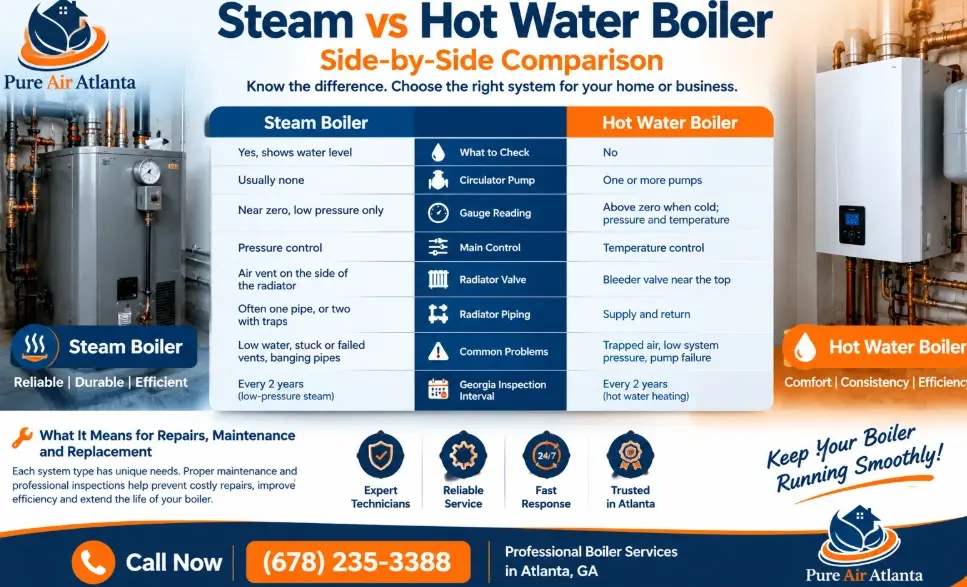
Steam vs Hot Water Boiler: Side-by-Side Comparison
| What to check | Steam boiler | Hot water boiler |
|---|---|---|
| Sight glass | Yes, shows water level | No |
| Circulator pump | Usually none | One or more pumps |
| Gauge reading | Near zero, low pressure only | Above zero when cold; pressure and temperature |
| Main control | Pressure control | Temperature control |
| Radiator valve | Air vent on the side of the radiator | Bleeder valve near the top |
| Radiator piping | Often one pipe, or two with traps | Supply and return |
| Common problems | Low water, stuck or failed vents, banging pipes | Trapped air, low system pressure, pump failure |
| Georgia inspection interval | Every 2 years (low-pressure steam) | Every 2 years (hot water heating) |
What It Means for Repairs, Maintenance and Replacement
Once you know the system type, the next steps change.
- Repairs. Steam problems often involve water level, vents, traps and pressure controls. Hot water problems often involve air in the loop, system pressure, the expansion tank and the circulator. Fitting a steam vent on a hot water radiator, or the other way around, can cause leaks and poor heat.
- Maintenance. Steam systems depend on correct water level and clean water in the boiler. Hot water systems depend on correct fill pressure and bleeding trapped air. Ask your technician for a seasonal checklist matched to your type.
- Replacement. A replacement boiler must be sized and piped for the right system. Changing from steam to hot water is a bigger project than swapping equipment, because the piping and radiators have to suit the new system. Get a written scope before you commit.
- Costs and planning. Boiler age, fuel, radiator condition and building type all affect cost, so request an on-site assessment instead of relying on a phone quote.
If your boiler is not heating or you are not sure what you have, our boiler repair in Atlanta team can identify the system and explain the options. For gas-fired heating that is not a boiler, see our gas furnace repair in Atlanta page, and for a no-heat call, our emergency furnace repair in Atlanta page.
Older Atlanta buildings
Boiler heat is more common in older, larger or multi-unit buildings than in newer homes. If your property is in a historic district such as Midtown, Old Fourth Ward, Inman Park or Downtown Atlanta, check the boiler room before you assume what is behind the radiators. You can find all of our Atlanta neighborhood service areas in one place.
Many older buildings also run a mix of equipment. Hotels and apartment communities often have a central boiler alongside in-room units, so see our PTAC unit repair and PTAC maintenance checklist pages. If you are weighing a different heating approach, our heat pump vs. furnace comparison explains the tradeoffs for Atlanta’s climate.
Inspection and Safety Rules in Georgia
Under Georgia’s boiler rules, low-pressure steam or vapor boilers and hot water heating and supply boilers each receive a certificate inspection every two years, unless an exemption applies. Georgia’s Office of Insurance and Safety Fire Commissioner oversees boiler and pressure vessel inspections and issues Certificates of Authority to companies that install, maintain or service boilers, so ask any contractor to show theirs. Our full guide to Georgia boiler inspection requirements covers exemptions, penalties and a preparation checklist.
For installations or mechanical changes inside the city, you may also need a City of Atlanta permit. The City of Atlanta technical permit page lists the HVAC permit contact, and the Georgia Office of Insurance and Safety Fire Commissioner boiler page explains the state side.
Not sure whether you have steam or hot water?
Send us a photo of your boiler and a radiator valve, or book a visit. We will identify the system and tell you what it needs.
Boiler Repair Atlanta Contact Pure Air AtlantaSteam vs Hot Water Boiler: FAQs
How can I tell if my boiler is steam or hot water?
Check the boiler first. A vertical sight glass showing water level means steam. A circulator pump on the piping and a gauge reading above zero when cold point to hot water. Radiator valves are a second clue: air vents suggest steam, bleeder valves suggest hot water.
Do steam and hot water systems use the same radiators?
Cast-iron radiators can look very similar, and some are used with either system, but the valves and piping connections differ. Confirm your system type before replacing a radiator or valve.
Is it normal for a steam radiator to bang or hiss?
Some hissing as air leaves the vent is normal. Loud banging can point to trapped water in the pipes or a pitch problem, and steam or water spitting from a vent needs a technician.
Do steam and hot water boilers both need inspections in Georgia?
Yes, unless exempt. Under Georgia’s rule, low-pressure steam boilers and hot water heating boilers each receive a certificate inspection every two years. Confirm exemptions with the Office of Insurance and Safety Fire Commissioner.
Can I convert a steam system to hot water?
It can be done, but it is a larger project than a boiler swap because the piping, radiator connections and controls must suit the new system. Ask for an on-site assessment and a written scope.
Sources and Related Services
This guide is general information, not a substitute for an on-site evaluation. Always have a qualified technician confirm your system type before making changes.
- Ga. Comp. R. & Regs. 120-3-26-.08: Boiler and Pressure Vessel Inspection Requirements
- Georgia Office of Insurance and Safety Fire Commissioner: Boilers and Pressure Vessels
- City of Atlanta: Apply for a Technical Permit
Explore all of our HVAC services, see pricing, or read our FAQ page.

HVAC Service Area — ZIP Code Directory
92 ZIP codes served · Tap any ZIP to call +1 (678) 235-3388 · pureairatlanta.com