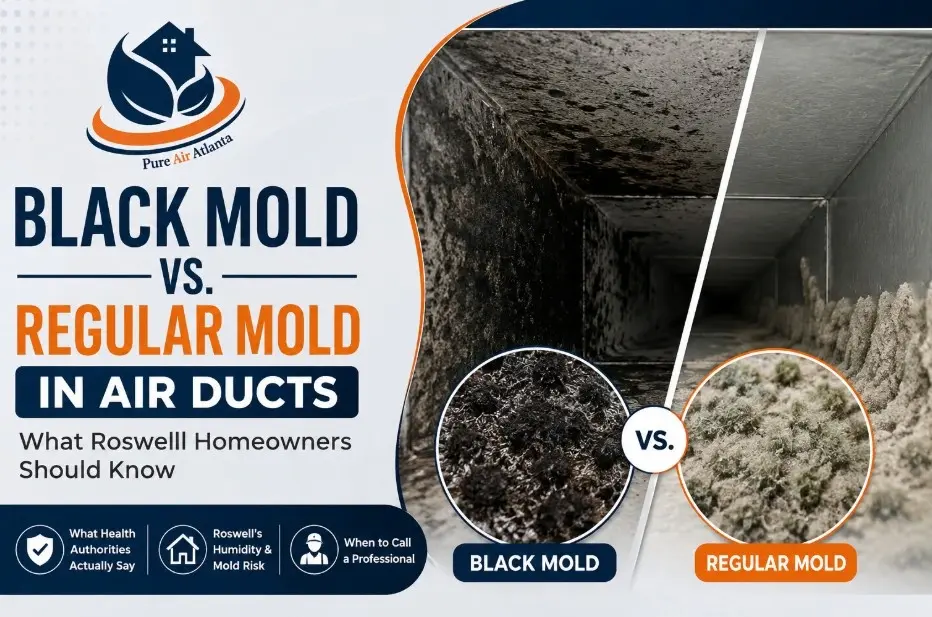
Black Mold vs. Regular Mold in Air Ducts: What Roswell Homeowners Should Know
Updated for 2026 | Pure Air Atlanta
“Black mold” gets a lot of attention online, often more than other mold types found in homes. Here’s what’s actually accurate about the distinction and what matters more for Roswell homeowners dealing with mold in their ductwork.
On This Page
What “Black Mold” Actually Refers To
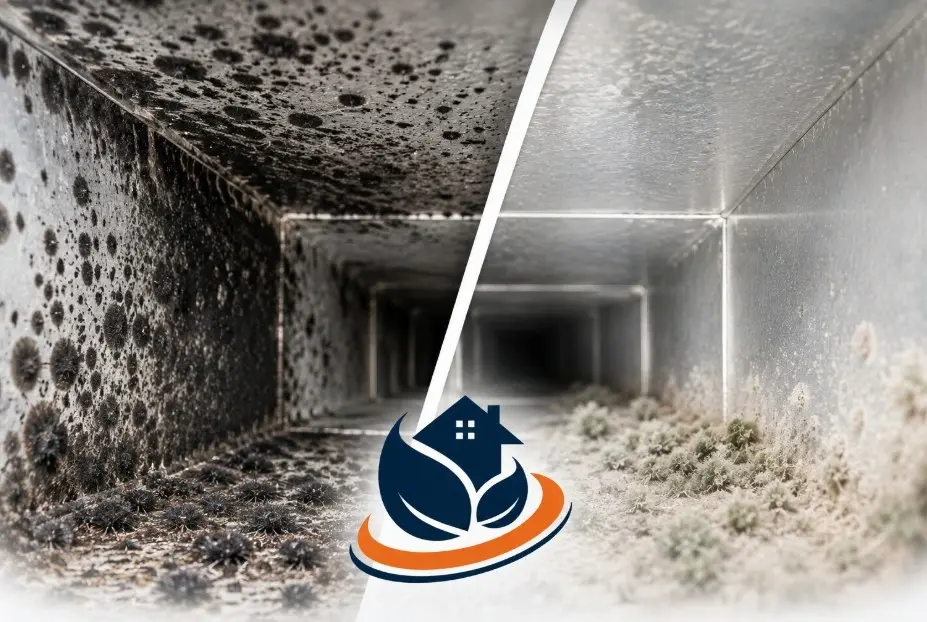
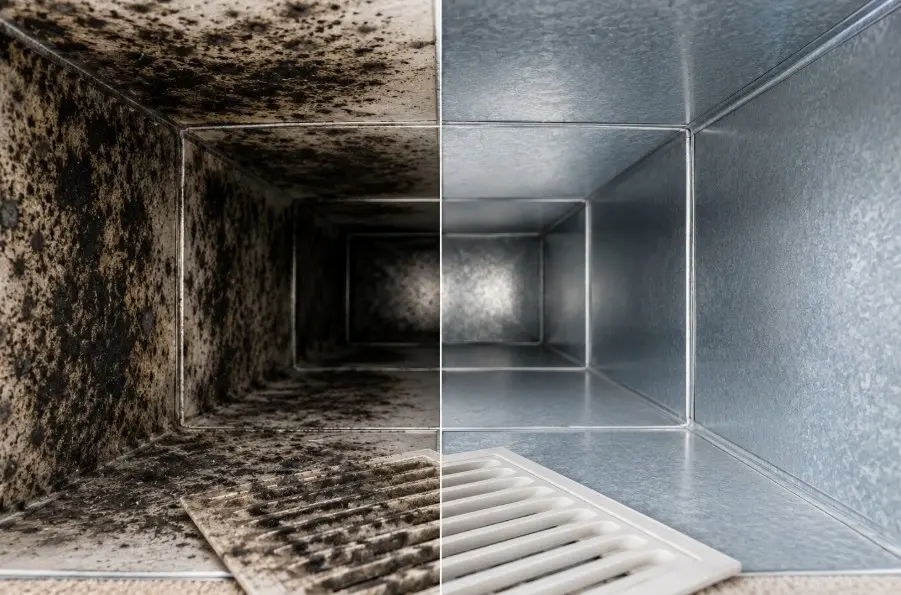
“Black mold” is commonly used to describe Stachybotrys chartarum, a specific mold species that’s dark in color and often associated with water-damaged materials. But color alone isn’t a reliable way to identify mold species. Many common household molds also appear dark or black, and Stachybotrys itself can sometimes appear more olive or dark green depending on conditions.
This matters because a lot of the anxiety homeowners feel about duct mold comes from assuming a dark color automatically means the more feared species. In practice, technicians can’t reliably tell you the species just by looking at a duct register, and neither can most homeowners. Our HVAC cleaning service in Roswell treats any visible growth the same way: as a problem that needs to be removed and traced back to its moisture source.
What Health Authorities Actually Say
The CDC notes that no home should have mold growth, regardless of the type, and that testing to identify the specific species is generally not necessary for most situations. The practical guidance is the same across mold types: identify and fix the moisture source, then remove the mold.
This lines up with what regional regulators say too. EPA Region 4, the federal office covering Georgia and headquartered right here in Atlanta, publishes indoor air quality resources that focus on moisture control rather than species identification. The Georgia Department of Public Health goes a step further and states plainly that mold inspections and remediation have no enforceable state or federal standards, which is part of why it’s worth working with a company that follows recognized industry protocols rather than one that leans on scare tactics about “toxic black mold.”
Not Sure What’s Growing in Your Ducts?
Skip the guesswork. A certified inspection tells you exactly what you’re dealing with.
Call (678) 235-3388Mold Colors Found in Ductwork: A Quick Comparison
To make the “does color matter” question more concrete, here’s how different colors typically show up and what actually drives the response in each case.
| Color Often Reported | Common Association | Recommended Response |
|---|---|---|
| Black / dark green | Often assumed to be Stachybotrys, but not confirmed without lab testing | Remove growth, fix moisture source |
| White / gray | Frequently found on fiberglass duct liner and drywall | Remove growth, fix moisture source |
| Green / olive | Can appear on both organic debris and building materials | Remove growth, fix moisture source |
| Orange / pink | Often bacteria or mildew rather than mold, but treated the same way | Remove growth, fix moisture source |
Note: color-based identification here is for general reference. Only a laboratory can confirm mold species.
Why the Color Doesn’t Change the Response
Whether mold in your ductwork is black, green, white, or another color, the underlying cause is almost always the same: moisture that hasn’t been addressed. The response is also the same, remove the growth and fix the source, rather than treating one color as urgent and another as harmless.
Roswell’s Humidity and Duct Mold Risk
Metro Atlanta’s humid subtropical climate is a major factor behind duct mold, and Roswell homes are no exception. Long, humid summers combined with air conditioning systems that cycle on and off create condensation inside ductwork, especially where insulation has thinned or seams have separated. Homes near the Chattahoochee River corridor and older Roswell neighborhoods with mature tree cover tend to run higher indoor humidity, which is exactly the environment mold needs to establish itself.
If your home is showing musty odors when the AC kicks on, that’s often the first sign before visible growth appears. We cover this in more detail in our guide to musty smells from AC vents, and our Roswell air duct cleaning service is built around catching this early, before it spreads through the whole system.
We also serve nearby communities:
Musty Smell When the AC Turns On?
That’s often the earliest warning sign. Get it checked before it spreads.
Call (678) 235-3388What Matters More Than Identifying the Type
- Finding and fixing the moisture source driving the growth
- Removing the mold thoroughly, not just the visible surface
- Addressing any household members with existing respiratory sensitivities, who may want to consult a doctor regardless of mold type
- Preventing recurrence through better humidity control or duct sealing
- Verifying the work with a post-service inspection rather than taking a technician’s word for it
If moisture control is the real issue, it’s also worth having your system evaluated as a whole rather than treating the ducts in isolation. Our mold in HVAC system service looks at the full path air travels through your home, from the coil to the vents, so the source doesn’t get missed.
When to Call a Professional
If mold covers a large area, is inside ductwork you can’t easily reach, or keeps returning after cleaning, it’s time for a professional assessment. Our mold in HVAC system service identifies the moisture source alongside remediation, so the problem doesn’t just come back. It pairs well with a full HVAC cleaning if it’s been a while since your last service.
Concerned About Mold in Your Ductwork?
Professional inspection and source-focused remediation.
Call (678) 235-3388Related Reading
Quick Questions
Do I need to test which mold species I have?
Generally no. Health authorities like the CDC note that testing usually isn’t necessary since the recommended response is the same regardless of type.
Should I be more worried if the mold looks black?
Color alone doesn’t reliably identify species or risk level. Any mold growth should be addressed the same way, by fixing the moisture source and removing it.
Should I see a doctor about mold exposure?
If anyone in the home has ongoing respiratory symptoms or existing sensitivities, it’s reasonable to consult a doctor regardless of the mold type present.
Why does Roswell seem to have more duct mold than drier climates?
Metro Atlanta’s humid subtropical climate, including Roswell, creates the moisture-rich conditions mold needs, especially inside ductwork where condensation can build up unnoticed.
Are there official regulations for mold remediation in Georgia?
No. The Georgia Department of Public Health confirms there are no enforceable state or federal standards for mold inspection or remediation, which makes choosing an experienced, protocol-driven company important.
Ready to Get Your Ducts Checked?
Serving Roswell and Metro Atlanta with NADCA-aligned inspection and cleaning.
Call (678) 235-3388Roswell, GA Service Area — ZIP Code Directory
3 ZIP codes served · Tap any ZIP to call +1 (678) 235-3388 · pureairatlanta.com